
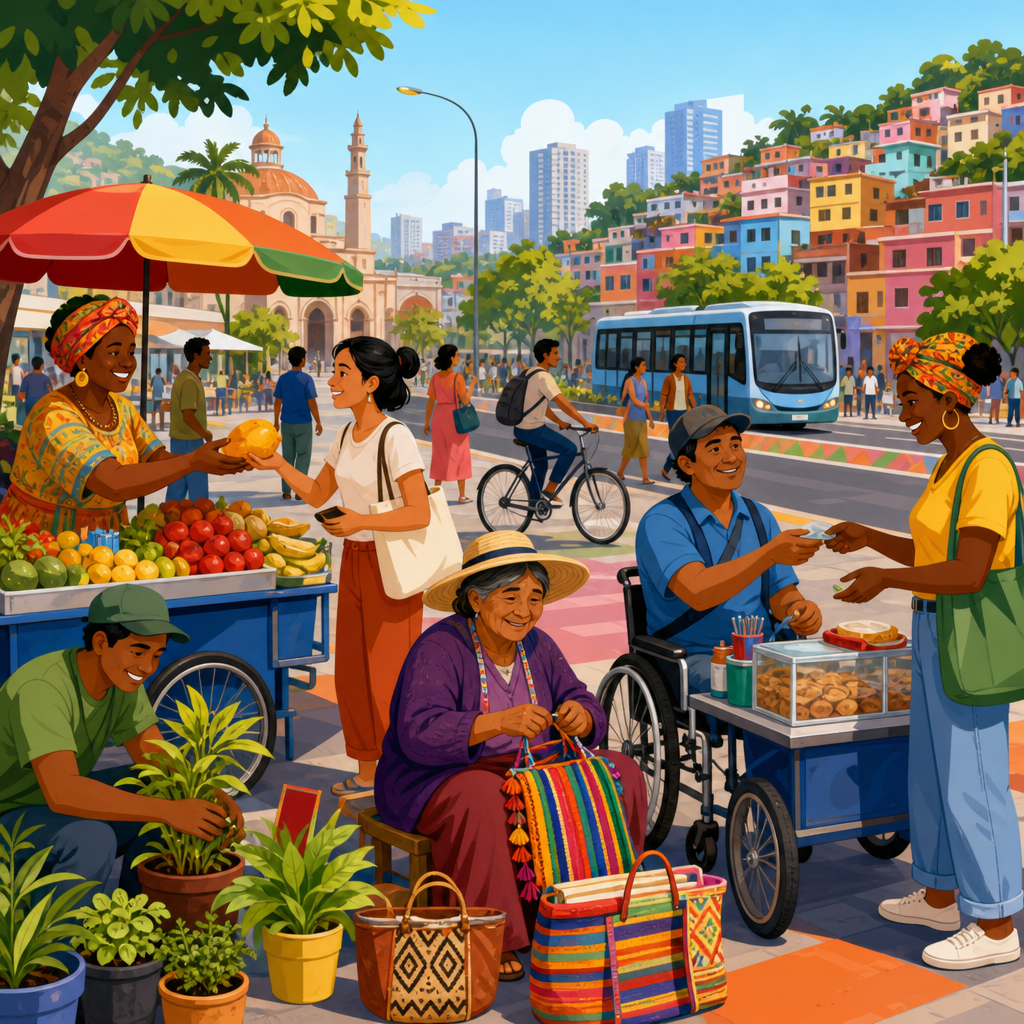
Inclusive street vending policies from cities in the Global South are reshaping how urban planning treats work, mobility, public space, and economic survival. Street vending refers to the sale of goods or services in public spaces, usually by self-employed workers operating from carts, stalls, mats, bicycles, or temporary stands. Inclusive policy means rules that recognize vendors as legitimate economic actors, protect their livelihoods, manage public space fairly, and improve health, safety, and accessibility without relying on blanket evictions. This matters because street vending is one of the largest sources of non-wage urban employment across Africa, Asia, and Latin America, especially for women, migrants, and low-income households. In many cities where I have studied market regulation and public-space management, the core planning mistake has been treating vendors as a nuisance to be removed instead of an essential part of the urban economy. When policy starts from recognition rather than criminalization, cities gain better order, stronger local commerce, more eyes on the street, and a more realistic approach to informality.
The Global South offers some of the most instructive examples because its cities face rapid urbanization, limited formal retail space, strained transport systems, and large informal labor markets at the same time. A useful policy framework begins with several basic questions. Who gets access to trading space? How are permits issued? Are vendor organizations represented in decision-making? What design standards govern stalls, waste, sanitation, and pedestrian movement? How are conflicts handled between vendors, shopkeepers, traffic engineers, and police? Effective answers usually combine legal recognition, spatial planning, service provision, and accountable enforcement. Poor answers rely on raids, confiscations, and relocation to remote sites that customers never visit. This hub article maps the major policy themes, practical tools, and city lessons that define inclusive street vending policy today, so planners, researchers, and local officials can understand what works, what fails, and where the strongest ideas are emerging.
Why street vending belongs in urban policy
Street vending belongs in urban policy because it solves real market failures. Formal retail rents are often unaffordable, licensing systems for microbusinesses can be slow or exclusionary, and low-income residents need convenient access to small-quantity goods near transport nodes, schools, clinics, and workplaces. Vendors fill these gaps with flexible distribution systems that formal planning rarely replicates at the same cost. The International Labour Organization has long documented the scale of informal employment in developing economies, and street trade is a visible expression of that labor reality. In practice, vending supports household cash flow, local food access, and neighborhood safety through constant activity in public space. Where officials deny this role, enforcement costs rise while livelihoods collapse. Where officials accept it, planning can shift from impossible elimination to practical management.
There is also a social equity case. Women are heavily represented in food vending and petty trade, often because these occupations allow income generation alongside caregiving. Migrants and displaced people often enter vending because it requires low capital and offers immediate earnings. Young workers use it as a bridge into entrepreneurship. An inclusive policy therefore addresses more than commerce. It touches gender equity, social protection, food systems, and the right to the city. The best cities recognize this multidimensional role and coordinate planning departments with public health agencies, transport authorities, sanitation services, and market administrations rather than leaving vendors to the police alone.
Core features of inclusive street vending policies
Inclusive street vending policies usually share five features. First, they provide legal recognition through ordinances, permits, or protected trading categories. Second, they designate space through vending zones, market streets, time-sharing arrangements, or transport-adjacent layouts. Third, they create fair administrative systems with transparent criteria, affordable fees, and appeal processes. Fourth, they provide basic services such as lighting, toilets, water, drainage, waste collection, storage, and fire safety. Fifth, they institutionalize representation by including vendor associations in rule-setting and conflict resolution. If one of these pieces is missing, the system weakens quickly. Legal recognition without space produces paper rights with nowhere to trade. Space without services creates unsafe congestion. Enforcement without representation produces abuse and bribery.
I have seen the strongest results when cities treat vending policy as a design and governance challenge rather than a disciplinary problem. That means measuring footfall, pedestrian clear zones, peak-hour activity, loading patterns, and waste streams before writing rules. It also means distinguishing among vendor types. A fruit seller near a bus terminal, a night food stall on a commercial street, and a mobile household-goods hawker do not create the same spatial impacts, so they should not be regulated identically. Good policy defines categories, locations, hours, and infrastructure needs with precision. It also links permits to actual public-space capacity instead of political favoritism.
| Policy tool | What it does | Inclusive practice | Common failure |
|---|---|---|---|
| Licensing | Creates legal status for vendors | Low-cost permits, clear criteria, renewals, appeals | Caps used to exclude poorer applicants |
| Zoning | Allocates trading space | Near customer demand and transit access | Relocation to isolated sites |
| Street design | Protects circulation and safety | Marked pitches, pedestrian clearways, storage | Uniform bans on busy corridors |
| Vendor representation | Improves legitimacy and compliance | Committees with elected vendor leaders | Token consultation after decisions are made |
| Enforcement | Handles violations and conflicts | Graduated penalties and receipt-based confiscation rules | Raids, extortion, and arbitrary seizure |
Lessons from India, South Africa, and Latin America
India offers one of the clearest legal reference points through the Street Vendors (Protection of Livelihood and Regulation of Street Vending) Act, 2014. The law established a national framework that requires surveys of vendors, limits evictions without due process, and creates Town Vending Committees with vendor representation. Its central idea is straightforward: vending should be regulated, not erased. Implementation has been uneven across states and municipalities, but the framework matters because it moved the debate from illegality to rights-based management. In cities where surveys were completed and certificates issued, vendors gained stronger protection against sudden displacement. In cities where committees remained weak or delayed, old patterns of confiscation continued. The lesson is that national recognition helps, but local administrative capacity determines whether rights become real.
South Africa presents another important case. Durban’s Warwick Junction has been widely studied as an example of integrating informal trade into a major transport interchange. Instead of trying to purge traders from a high-demand location, municipal actors worked over time to organize market areas, improve sanitation, support trader committees, and adapt infrastructure to actual economic activity. Warwick Junction is not a perfect story, and political pressure has repeatedly threatened trader space, but it demonstrates a crucial principle: the busiest urban nodes are often the right places for vending if they are managed well. Excluding traders from such nodes usually pushes them into cat-and-mouse enforcement or into worse sites that destroy earnings.
Across Latin America, cities have alternated between accommodation and crackdown. Bogotá, Lima, and Mexico City have all struggled with the politics of central sidewalks, historic districts, and transit corridors. The most durable improvements have come from negotiated management rather than mass removal. In several cities, attempts to relocate vendors to formal markets failed because planners overestimated the power of built infrastructure and underestimated the importance of visibility, foot traffic, and habitual customer routes. A stall in a new market building is not equivalent to a stall outside a station entrance. That simple spatial truth explains why so many relocation schemes underperform.
Designing space, mobility, and services around vendors
Space is the heart of inclusive street vending policy. If a city cannot specify where vending can happen, under what conditions, and with what services, every other policy promise becomes unstable. The most practical approach starts with mapping demand. Planners should identify high-footfall corridors, transport interchanges, school edges, hospital surroundings, market spillovers, and evening food streets. They should then measure minimum pedestrian clear widths, emergency access routes, loading needs, and conflict points with crossings or bus operations. This is standard urban design work, but too often it is skipped in favor of simple prohibition signs. Once mapped, cities can establish fixed pitches, rotational use, night markets, seasonal vending areas, or time-of-day sharing arrangements that reflect real patterns of urban life.
Services matter as much as space. Food vendors need water, drainage, waste removal, and hygienic surfaces. All vendors benefit from lighting, secure storage, weather protection, and nearby toilets. These are not luxuries. They are basic operating conditions that reduce public-health risks and improve compliance. I have repeatedly found that authorities blame vendors for mess created by absent municipal services. If waste collection comes once daily to a street with hundreds of food transactions per hour, overflowing bins are a management failure, not proof that vending is inherently disorderly. Service standards should therefore be written into policy, budgeted, and monitored like any other public-space function.
Governance, enforcement, and vendor organizations
Governance determines whether inclusive policy survives political change. Vendor organizations are indispensable because they provide communication channels, negotiate rules, help resolve disputes, and make enforcement more predictable. In successful systems, associations help verify trader identities, allocate pitches transparently, and relay complaints about corruption or unsafe conditions. This does not mean every association is democratic or free from internal politics. Some are gatekeepers. That is why cities need clear rules for representation, regular elections where possible, public meeting records, and multiple avenues for participation including women’s groups, migrant traders, and mobile vendors who are often underrepresented.
Enforcement should be rule-bound, proportionate, and documented. Confiscation, if permitted at all, must follow written procedures, receipts, storage rules, and rapid appeal timelines. Fines should be affordable and graduated, not set at levels that wipe out weekly income. Police should not be the primary interface with vendors except in serious safety situations. Trained municipal market officers, mediation teams, and local committees usually produce better outcomes. Digital permitting systems can reduce discretion, but only if they are accessible to workers with limited internet access or literacy. Analog support remains essential. The real test of fairness is simple: can a vendor understand the rules, afford compliance, challenge a decision, and return to work without paying a bribe?
Measuring success and setting a future agenda
Inclusive street vending policies should be evaluated with real indicators, not with before-and-after photographs of cleared sidewalks. Useful measures include vendor income stability, permit coverage, pedestrian travel times, waste volumes collected, sanitation compliance, harassment complaints, gender participation, and occupancy rates in designated spaces. Cities should also track whether relocation sites retain customer flows after six and twelve months. If sales collapse, the policy failed even if the pavement looks neater in official reports. Good monitoring combines counts, surveys, and direct observation at different times of day. It should also compare conditions during normal operations, festivals, rain seasons, and transport disruptions, because vending systems are highly sensitive to temporal change.
As a hub within urban planning and policy, this topic points to a broader lesson: inclusive cities manage informality through recognition, design, and accountable governance. The strongest policies from the Global South do not romanticize street vending, and they do not criminalize it. They accept that public space has multiple users and that economic inclusion must be planned as carefully as traffic flow. For planners, the next step is practical. Review local bylaws, map existing trade, meet vendor organizations, and test management pilots in high-demand corridors before launching sweeping enforcement. Cities that do this well create cleaner, safer, and more economically resilient streets while protecting the workers who keep them alive every day.
Frequently Asked Questions
What do inclusive street vending policies actually mean in cities in the Global South?
Inclusive street vending policies are rules, planning approaches, and administrative practices that treat street vendors as legitimate workers and small-scale entrepreneurs rather than as a nuisance to be removed. In many cities in the Global South, vending is a major source of employment, food access, and low-cost retail, especially for women, migrants, and households with limited access to formal jobs. An inclusive approach starts from that reality. Instead of relying only on evictions, confiscations, or punitive licensing systems, city governments create frameworks that allow vendors to operate legally and safely while also managing traffic flow, sanitation, and shared public space.
In practice, that can include affordable permits, transparent registration systems, designated vending zones developed with vendor input, access to water and waste collection, storage facilities, safer stall design, and dispute-resolution mechanisms that reduce harassment and bribery. It also often means recognizing different types of vending, such as stationary stalls, mobile carts, night markets, seasonal trade, and food vending, because each has different space and infrastructure needs. The most effective policies are not one-size-fits-all. They are flexible enough to reflect local economies, neighborhood rhythms, and the fact that public space serves many users at once.
Most importantly, inclusive policy is about governance as much as regulation. Cities that make progress usually involve vendor organizations in planning, rule-setting, and enforcement. That participation helps authorities understand where vending supports mobility and local commerce and where adjustments are needed to reduce congestion or safety risks. The result is a more balanced model of urban management: one that protects livelihoods, improves order, and recognizes that survival work is an essential part of the city, not an exception to it.
Why are these policies so important for urban planning, public space, and economic survival?
These policies matter because street vending sits at the intersection of employment, transport, land use, food systems, and social equity. In many cities across Africa, Asia, and Latin America, a large share of the workforce operates informally, and vending is often one of the most accessible ways to earn income with limited capital. When urban planning ignores that reality, the result is usually conflict: vendors are pushed out of high-demand areas, customers lose convenient access to affordable goods, and enforcement becomes cyclical, costly, and often abusive. Inclusive policies help cities move beyond that cycle by integrating vending into how public space is designed and governed.
From an economic perspective, inclusive regulation protects livelihoods that support entire families and local supply chains. A vendor selling fruit, cooked meals, clothing, or household items is often connected to farmers, wholesalers, transport providers, and neighborhood consumers. Removing vendors without alternatives can destabilize these small economies. From a public-space perspective, the issue is not simply whether vending exists, but how it is organized. Well-designed vending areas can increase street activity, improve passive surveillance, support walkable neighborhoods, and make daily necessities easier to access. Poorly designed systems, by contrast, can create overcrowding, unsafe circulation, and tension among users.
There is also a deeper equity issue. Street vendors are frequently among the workers most exposed to exclusion, extortion, climate risks, and sudden income loss. Inclusive policies can reduce those vulnerabilities by providing legal recognition, predictable operating conditions, and access to basic services. In that sense, these policies are not only about commerce. They are about who has the right to work in the city, who benefits from urban development, and whether planning serves only formal capital or also the people whose economic survival depends on everyday use of public space.
What kinds of measures do successful cities use to support vendors while keeping streets safe and functional?
Successful cities usually combine regulation, design, and participation rather than depending on enforcement alone. One common measure is simplified licensing or registration that is affordable, easy to understand, and realistic for low-income workers. When permits are expensive, scarce, or tied to complex paperwork, many vendors stay outside the system. Cities that improve compliance often reduce administrative barriers, decentralize registration, and make eligibility rules transparent. This helps replace arbitrary enforcement with a clearer legal framework.
Another important measure is spatial planning tailored to actual patterns of movement and trade. Instead of banning vending from entire districts, cities may identify high-demand corridors, transit nodes, school zones, market edges, or evening vending areas and then define how much space can be used, what circulation must remain clear, and what types of structures are allowed. Time-sharing arrangements can also work well, with different uses permitted at different hours. For example, a sidewalk may need stricter pedestrian clearance during rush hour but may accommodate vendors in off-peak periods. That kind of flexibility is often far more effective than permanent exclusion.
Infrastructure is equally important. Vendors need practical support such as waste collection, public toilets, drainage, lighting, handwashing stations, and in some cases electricity or cold storage. Food vendors in particular benefit from health and safety training combined with realistic standards that improve public health without pushing workers out of business. Some cities also invest in modular stalls, storage lockers, or sheltered market spaces near existing customer flows so that vendors are not relocated to places where trade collapses. Finally, the strongest systems include vendor associations in monitoring and enforcement. Co-management can reduce conflict, improve communication, and create more legitimate rules because vendors themselves help shape how the space is organized.
What are the biggest challenges cities face when trying to create more inclusive street vending policies?
One major challenge is the long-standing view that modern cities should look orderly, formal, and investment-ready in ways that often exclude informal workers. Street vending is frequently treated as a visual problem rather than an economic and social reality. That can lead to policies driven by image, elite pressure, or redevelopment agendas rather than evidence. In those settings, cities may announce inclusion on paper but still rely on evictions, confiscation, and police-led crackdowns when political pressure rises. The gap between formal policy and everyday enforcement is one of the biggest barriers to real change.
Another challenge is competition over limited public space. Sidewalks, transit stops, plazas, and roadside edges serve many functions at once: walking, waiting, loading, socializing, accessibility, drainage, and commerce. In dense urban areas, especially where infrastructure is already under strain, balancing those uses is difficult. Poor design can create bottlenecks, raise safety concerns, or disadvantage people with disabilities. Inclusive policy does not mean allowing every activity everywhere. It requires careful negotiation, mapping, and management so that vendors can work without blocking essential movement or services.
Institutional fragmentation also creates problems. Responsibility for vending may be split across municipal departments for markets, transport, sanitation, policing, health, and urban planning, with little coordination between them. Vendors can end up subject to inconsistent rules, overlapping fees, or contradictory orders from different authorities. Corruption and informal payments may flourish in that confusion. On top of that, many vendors lack formal addresses, identity documents, or legal support, which makes it harder for them to access permits or challenge abuse. Building inclusion therefore requires more than a new ordinance. It often demands administrative reform, political commitment, strong vendor representation, and a shift in how cities understand informality itself.
How can city governments design street vending policies that are fair, practical, and durable over time?
Fair and durable policy begins with data and dialogue. Cities need to understand who vendors are, what they sell, where they work, when they operate, and how their activities connect to transport systems, surrounding shops, and neighborhood demand. Mapping vendor locations and movement patterns can reveal where vending supports urban life and where congestion or safety problems are most acute. But technical data alone is not enough. Governments should consult vendor unions, women’s groups, disability advocates, residents, transport users, and nearby businesses so the policy reflects the full range of needs in shared public space.
From there, cities should create rules that are clear, proportionate, and enforceable. That means realistic permit costs, defined operating conditions, transparent allocation of spaces, and procedures for appeal when conflicts arise. Policies should distinguish between different categories of vendors rather than forcing everyone into the same template. A mobile snack seller, a fixed produce stall, and a night-market clothing vendor may each require different rules on location, hours, equipment, and sanitation. Durable systems also include periodic review so city governments can adjust to seasonal trade, demographic change, construction projects, and evolving transport patterns without resorting to blanket bans.
Equally important is embedding rights and accountability into implementation. Enforcement should prioritize mediation and compliance support before penalties, and confiscation should never be arbitrary. If relocation is necessary, it should be negotiated, evidence-based, and tied to viable customer access so vendors are not simply moved out of sight and out of income. Cities that succeed over time usually invest in co-governance, where vendor representatives participate in committees, monitoring, and feedback processes. That approach builds trust, improves compliance, and makes policy more resilient across political cycles. Ultimately, durable inclusion comes from recognizing that street vending is not a temporary exception to urban planning. It is a permanent part of how many cities in the Global South function, feed residents, and sustain everyday economic life.


