
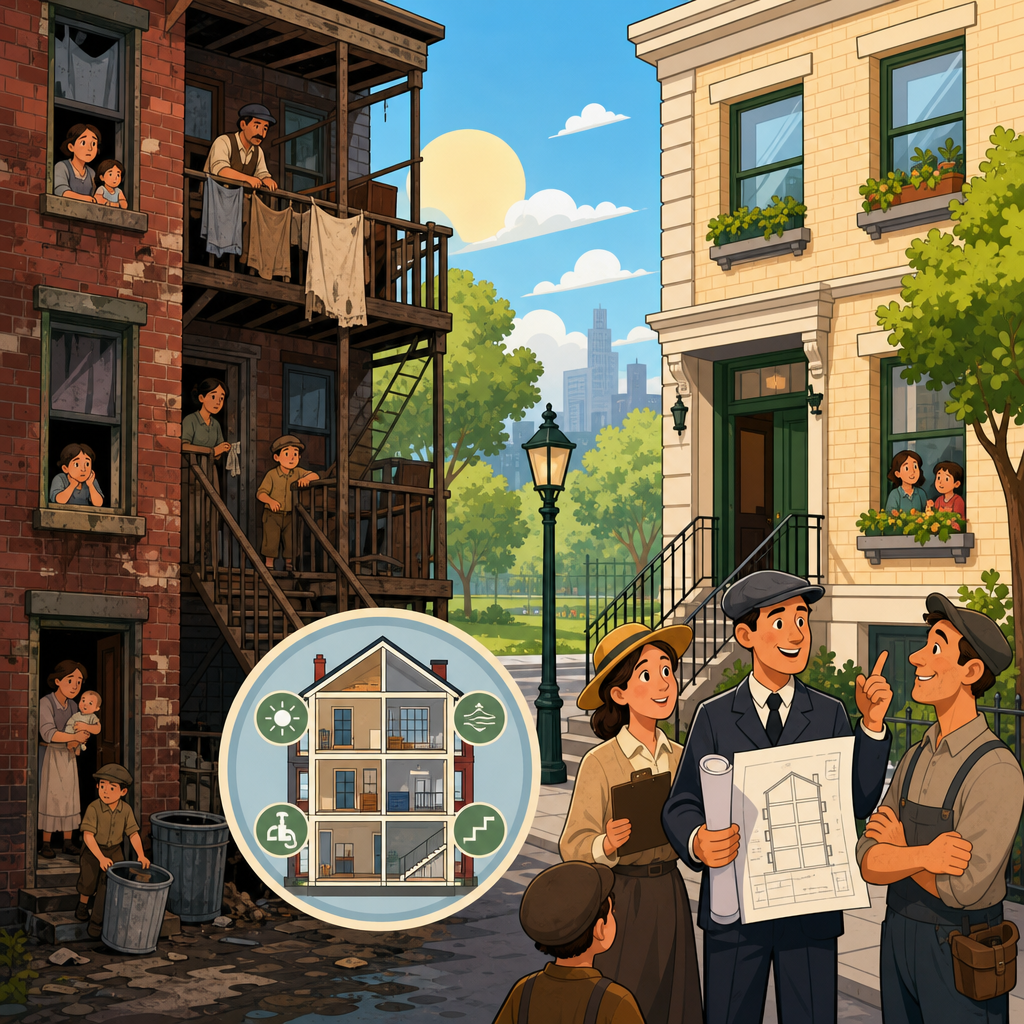
Tenement reform and the origins of housing codes sit at the center of modern urban planning because they show how cities moved from tolerating dangerous private housing to regulating it as a matter of public health, safety, and civic order. A tenement was originally a multi-family urban building, but in the nineteenth and early twentieth centuries the term became closely associated with overcrowded, poorly ventilated dwellings occupied by working-class residents and new immigrants. Housing codes are the legal standards that govern light, air, sanitation, occupancy, fire protection, maintenance, and, later, structural and environmental performance. These rules did not appear suddenly. They emerged from decades of reform campaigns, disease outbreaks, investigative journalism, municipal reports, court battles, and hard lessons learned in neighborhoods where rent was collected reliably while habitability was ignored. Understanding this history matters because current debates over affordability, zoning, code enforcement, landlord responsibility, and healthy housing still depend on principles first developed during the tenement era.
In practice, tenement reform was never just about architecture. It was about how industrial cities grew faster than their institutions. In New York, Chicago, Boston, Philadelphia, and other rapidly expanding places, speculative builders packed narrow lots with rear houses, dumbbell plans, cellar rooms, and privies shared by multiple families. I have worked through historic housing ordinances and inspection reports, and the pattern is consistent across cities: where land values rose and wages stayed low, owners increased occupancy long before governments created enforceable minimum standards. Reformers responded by documenting mortality, mapping crowding, counting toilets, measuring lot coverage, and linking disease to built form. Their arguments helped establish a lasting public principle: housing conditions are not merely private contractual matters but legitimate subjects of municipal regulation, inspection, and enforcement.
How Tenements Became a Defining Urban Problem
Tenements became a defining urban problem during the industrial revolution, when migration and factory employment concentrated large populations in limited urban land areas. In the United States, New York City became the best-known example, but similar conditions appeared in European capitals and in fast-growing American manufacturing centers. Builders often subdivided former single-family houses or erected new structures specifically to maximize rental income on twenty-five-foot lots. The result was a building type that could legally house many families while providing too little daylight, cross-ventilation, drainage, or open space.
Several conditions made these buildings hazardous. First was density without infrastructure. Water service, sewer connections, and garbage removal lagged behind population growth. Second was internal layout. Windowless interior rooms, narrow air shafts, and minimal courtyards trapped heat, odors, and smoke. Third was shared sanitation. Outdoor privies or hallway water closets served dozens of people, creating constant hygiene failures. Fourth was fire risk. Wood stairs, combustible finishes, overcrowded rooms, and obstructed exits turned ordinary accidents into mass-casualty events. These were not isolated defects. They were systemic outcomes of unregulated speculative housing.
Public concern intensified because the consequences were measurable. Reformers and health officials drew links between mortality and housing conditions, especially for tuberculosis, cholera, typhus, and infant diarrheal disease. Not every disease mechanism was understood at the time, but officials recognized that darkness, dampness, crowding, and poor waste disposal made outbreaks worse. As a result, the housing question shifted from charity to governance. The issue was no longer whether poor residents deserved better dwellings; it was whether cities could remain economically productive and politically stable while tolerating environments that spread illness and fire.
Investigation, Photography, and the Public Case for Reform
Housing reform advanced when evidence became vivid enough to overcome political inertia. One of the most influential figures was Jacob Riis, whose 1890 book How the Other Half Lives used flash photography and reporting to expose life in New York tenements. Riis did not invent concern about slum housing, but he transformed scattered complaints into a persuasive public narrative. Images of crowded sleeping rooms, dark alleys, and children in unsafe courts gave middle-class readers concrete proof that unhealthy housing existed within a few miles of civic monuments and commercial wealth.
Photography worked because it reinforced findings already emerging from sanitary science and municipal inspection. The New York State Tenement House Commission reports of the 1890s compiled testimony from physicians, engineers, landlords, tenants, and reform advocates. Similar investigations in London and other cities treated housing as a problem that could be counted and classified. Inspectors measured room sizes, noted absence of fire escapes, recorded basement occupancy, and compared block conditions. This administrative fact-gathering mattered as much as moral outrage. Lasting regulation depends on standards that can be inspected, cited, and defended in court.
Settlement house workers, clergy, physicians, and social investigators also broadened the case for action. Lillian Wald and other neighborhood reformers connected housing defects to school attendance, workplace fatigue, and family health. Their insight remains foundational in urban policy: bad housing generates costs far beyond the building itself. It increases disease burdens, strains hospitals, weakens labor productivity, and destabilizes neighborhoods. Once cities accepted that premise, housing reform became part of the emerging machinery of municipal administration.
The First Housing Laws and What They Required
The origins of housing codes can be traced through a sequence of increasingly specific laws. Early measures often addressed nuisances rather than comprehensive habitability. They regulated waste disposal, prohibited certain cellar occupations, or required basic fire escapes. Over time, lawmakers recognized that piecemeal rules could not correct a defective building type. New York’s tenement laws of 1867, 1879, and especially 1901 illustrate this progression. The 1867 law required a fire escape for every tenement, one privy for every twenty occupants, and basic ventilation standards. The 1879 law, associated with the dumbbell tenement, required each habitable room to have a window opening to air, but builders exploited narrow air shafts that met the letter of the law while failing its health purpose.
The 1901 New York State Tenement House Act was more transformative because it addressed building form, lot coverage, sanitation, and enforcement in a coordinated way. It mandated larger courtyards, indoor toilets in many cases, improved light and ventilation, and stricter limits on lot occupancy for new construction. Just as important, it created a stronger administrative structure for inspection. That combination of design requirements and enforcement capacity is the true beginning of modern housing codes.
| Law or phase | Main problem targeted | Typical requirement | Practical limitation |
|---|---|---|---|
| Early sanitary rules | Waste, odors, visible nuisances | Privies, drainage, cleanup orders | Weak inspection and narrow scope |
| 1860s to 1870s tenement laws | Fire and extreme crowding | Fire escapes, occupancy controls, ventilation language | Builders met minimums without improving livability |
| Late nineteenth-century reform commissions | Dark interior rooms and unsafe layouts | Window access, reporting, registration | Air shafts often performed poorly |
| Early twentieth-century code systems | Comprehensive habitability and enforcement | Light, air, toilets, courts, inspections | Existing buildings remained hard to retrofit |
Other cities adopted their own approaches, but the pattern was similar. First came recognition of a health threat. Next came limited nuisance rules. Then commissions assembled evidence and recommended standards. Finally, cities created dedicated agencies or empowered health and building departments to inspect, cite violations, and sometimes close unsafe dwellings. Modern property maintenance codes, occupancy standards, and rental inspections all descend from this incremental legal architecture.
Public Health, Police Power, and the Legal Basis for Housing Codes
Housing codes endure because courts accepted that governments have broad authority to regulate dwellings under the police power to protect health, safety, and welfare. This was a major shift. Nineteenth-century property owners often argued that regulation was an improper interference with private rights. Reformers succeeded when they demonstrated that unsafe housing imposed costs on the wider public, from epidemics and fires to disorder and emergency relief. Once that connection was established, minimum standards became legally defensible.
The public health movement supplied both language and institutional support. Boards of health, sanitary engineers, and later housing departments framed tenement regulation as prevention, not punishment. That distinction remains important. A housing code does not exist primarily to penalize landlords. It exists to set minimum conditions for lawful occupancy. Enforcement tools such as notices of violation, repair orders, civil penalties, and condemnation are methods for achieving compliance with those minimums.
Legal authority also expanded through building regulation. As cities professionalized code administration, they distinguished between construction codes for new buildings and housing or maintenance codes for existing ones. That distinction solved a practical problem. A tenement built decades earlier might be structurally stable yet still unhealthy because of crowding, bad plumbing, or inadequate egress. Housing codes allowed cities to regulate ongoing conditions of use and maintenance, not just initial construction. This is why the origins of housing codes cannot be reduced to one statute. They emerged where public health law, fire regulation, nuisance doctrine, and building administration converged.
What Tenement Reform Changed in Urban Planning and Policy
Tenement reform changed urban planning by proving that the physical form of housing shapes health outcomes and that municipal government can regulate that form systematically. It influenced setbacks, lot coverage rules, minimum court dimensions, street widths, and open-space expectations. Many later zoning ideas, though distinct in purpose, developed in a policy environment already transformed by housing regulation. Reformers had shown that density itself was not the only issue; unmanaged density in poorly designed buildings was the issue.
The movement also professionalized inspection and recordkeeping. Registration systems, violation logs, and routine inspections created administrative data that cities could use to prioritize interventions. In my experience reviewing older code regimes, this bureaucratic infrastructure is one of the most underrated legacies of tenement reform. Standards matter, but standards without inspections are mostly aspiration. The enduring lesson is that enforcement capacity, staffing, and political independence are as important as the text of the code.
There were limits and failures. Some reforms improved conditions in new buildings while leaving existing tenements crowded for decades. Code compliance could raise operating costs, and those costs were sometimes passed to tenants. Slum clearance policies later used the language of reform but often displaced communities without producing enough affordable replacement housing. These tradeoffs are part of the history. Good housing policy needs minimum standards, but it also needs realistic financing, tenant protection, and a supply strategy that prevents safety from becoming scarcity.
Why This History Still Matters Now
The origins of housing codes still shape current debates about rentals, inspections, healthy homes, and urban equity. When a city requires smoke alarms, lead hazard control, minimum heat, safe wiring, mold remediation, or limits on illegal basement occupancy, it is acting on principles forged in the tenement era. The core idea is unchanged: habitable housing is a public concern because substandard dwellings harm not only occupants but the wider city.
Today’s hazards are not identical to those of 1890, yet the policy logic is familiar. Old buildings may contain lead paint, deteriorated plumbing, inadequate ventilation, or unsafe electrical retrofits. Climate change adds heat stress and flood risk, especially in low-income housing. Informal overcrowding persists in expensive metropolitan areas. Modern codes address these issues with more technical precision, drawing on standards from bodies such as the International Code Council, local health departments, and fire codes. Still, the essential enforcement challenge remains the same as it was in early tenement reform: how to identify unsafe conditions quickly, require corrections fairly, and avoid displacing residents into worse alternatives.
For planners, policymakers, preservationists, and housing advocates, the practical takeaway is straightforward. Effective housing regulation must combine clear standards, competent inspection, legal authority, and affordability policy. Remove any one piece and the system weakens. The history of tenement reform shows why cities need all four.
Tenement reform and the origins of housing codes reveal how modern cities learned to treat housing quality as basic civic infrastructure. Reform did not begin with theory alone. It grew from crowded rooms, repeated epidemics, fatal fires, investigative reporting, and the steady work of officials and advocates who translated visible suffering into enforceable standards. Their achievement was not merely cleaner buildings. It was a durable public principle that private housing must meet minimum conditions of safety, sanitation, light, ventilation, and maintenance if it is to be legally occupied.
The most important lesson is that codes work best when they are specific, enforceable, and paired with broader housing policy. Strong standards without inspections fail. Aggressive enforcement without affordable alternatives can displace vulnerable tenants. New construction rules without maintenance oversight leave older stock behind. The cities that improved living conditions most effectively were the ones that linked design standards, health administration, landlord accountability, and practical implementation.
As a hub within urban planning and policy, this topic provides the historical foundation for understanding rental inspection systems, building regulation, public health law, code enforcement, overcrowding policy, and healthy housing initiatives. If you want to make sense of present-day housing debates, start with the tenement era. Study how reformers identified harm, how governments justified intervention, and how standards evolved from nuisance control into comprehensive housing codes. That history remains the clearest guide for building safer, fairer cities today.
Frequently Asked Questions
What were tenements, and why did they become a major public concern?
Tenements were multi-family urban buildings designed to house several households within a relatively small footprint, but in the nineteenth and early twentieth centuries the term came to signify a particular kind of overcrowded and unhealthy housing. In rapidly growing cities, especially industrial centers, tenements often packed working-class families and newly arrived immigrants into cramped apartments with little light, poor ventilation, inadequate sanitation, and limited access to clean water. Many buildings were constructed primarily to maximize rental income, not to support health or safety, which meant rooms without windows, shared privies, unsafe stairways, and heightened fire risk were common features rather than rare exceptions.
They became a major public concern because the problems inside tenements did not remain private. Disease spread easily in densely occupied buildings and surrounding neighborhoods, linking housing conditions to broader public health crises such as cholera, tuberculosis, and other infectious illnesses. Reformers, journalists, physicians, and settlement workers documented how poor housing contributed to infant mortality, workplace instability, and social disorder. As a result, tenements helped change the way city governments thought about housing: what had once been treated as a private matter between landlord and tenant increasingly came to be seen as a public issue affecting the welfare, safety, and stability of the entire city.
Why is tenement reform considered so important to the history of housing codes?
Tenement reform is important because it marks the transition from informal concern about bad housing to formal legal regulation of residential buildings. Before this shift, many city governments lacked clear standards for light, air, occupancy, sanitation, fire protection, and maintenance in multi-family dwellings. Reform movements pushed municipalities and states to establish rules that landlords were legally required to follow, creating the foundation for what later became modern housing codes, building codes, and health regulations.
The significance of tenement reform also lies in the fact that it connected housing to measurable civic responsibilities. Reformers argued that cities had a duty to prevent conditions that endangered life and encouraged disease. This led to requirements for windows, air shafts, indoor plumbing, sewer connections, safer exits, and inspections. In other words, the tenement question helped define a new governing principle: decent housing was not simply a market commodity but a matter subject to public oversight. That principle remains central to urban planning today, where minimum habitability standards, occupancy limits, and code enforcement all trace part of their lineage to the tenement reform era.
What conditions inside tenements led reformers to demand stronger regulation?
Reformers focused on a cluster of recurring hazards. Overcrowding was one of the most visible problems, with multiple family members, and sometimes boarders, sharing very small rooms. Many units lacked direct sunlight and cross-ventilation, which created stale, damp interiors that were believed, often correctly, to worsen disease. Sanitation was another major issue. In many buildings, toilets were shared by numerous households, waste disposal was poor, and access to clean water was inconsistent. These conditions made everyday life difficult and also raised serious concerns about contamination and outbreaks of illness.
Fire danger and structural safety were equally important. Narrow hallways, insufficient exits, combustible materials, and poorly planned staircases made tenements especially dangerous during emergencies. Some buildings were cheaply built or poorly maintained, leaving residents vulnerable to collapse, leaks, rot, and vermin infestation. Reformers also objected to the social consequences of such environments, arguing that constant crowding undermined privacy, family life, and neighborhood stability. Their investigations, photographs, and reports helped persuade the public that these were not isolated failures but systemic problems requiring legal standards and regular enforcement.
How did early housing codes change city planning and government responsibility?
Early housing codes changed city planning by giving local government a more active role in shaping the residential environment. Instead of merely reacting to disasters, cities began to set preventive standards for how housing should be designed, occupied, and maintained. This expanded the scope of urban governance. Planners, health officials, building inspectors, and lawmakers increasingly worked together to regulate density, sanitation infrastructure, lot coverage, ventilation, and fire safety. Housing was now being considered alongside streets, sewers, water systems, and public health administration as part of a coordinated urban system.
These early codes also broadened the idea of government responsibility. Municipal authorities claimed a stronger legal basis for intervening in private property when unsafe conditions threatened the public. This was a major change in political and legal culture. Once governments accepted that housing conditions affected the city as a whole, they could justify inspections, penalties, mandatory repairs, and standards for new construction. Over time, those practices influenced zoning, public housing debates, neighborhood regulation, and the wider belief that healthy cities require enforceable rules about the built environment, not just reliance on private market choices.
Did tenement reform solve the housing problem, or did it create new challenges as well?
Tenement reform brought meaningful improvements, but it did not solve the housing problem on its own. Stronger codes reduced some of the worst dangers by requiring better sanitation, more windows, safer layouts, and regular oversight. In many cities, these reforms improved day-to-day living conditions and established the idea that residents were entitled to minimum standards of safety and habitability. They also generated valuable data about urban housing, helping officials better understand density, disease, and infrastructure needs.
At the same time, reform created new challenges and exposed deeper structural issues. Upgrading buildings could raise costs for landlords and sometimes rents for tenants, while strict standards without adequate affordable housing alternatives could contribute to displacement or housing shortages. Enforcement was often uneven, with poorer neighborhoods receiving attention only after scandals or crises. Some reforms were also shaped by paternalistic or nativist attitudes toward immigrant communities, meaning the politics of reform were not always purely humanitarian. Even so, the broader legacy of tenement reform remains vital: it established that safe housing is a legitimate public concern and that cities have both the authority and the obligation to regulate living conditions in the interest of health, safety, and civic order.


