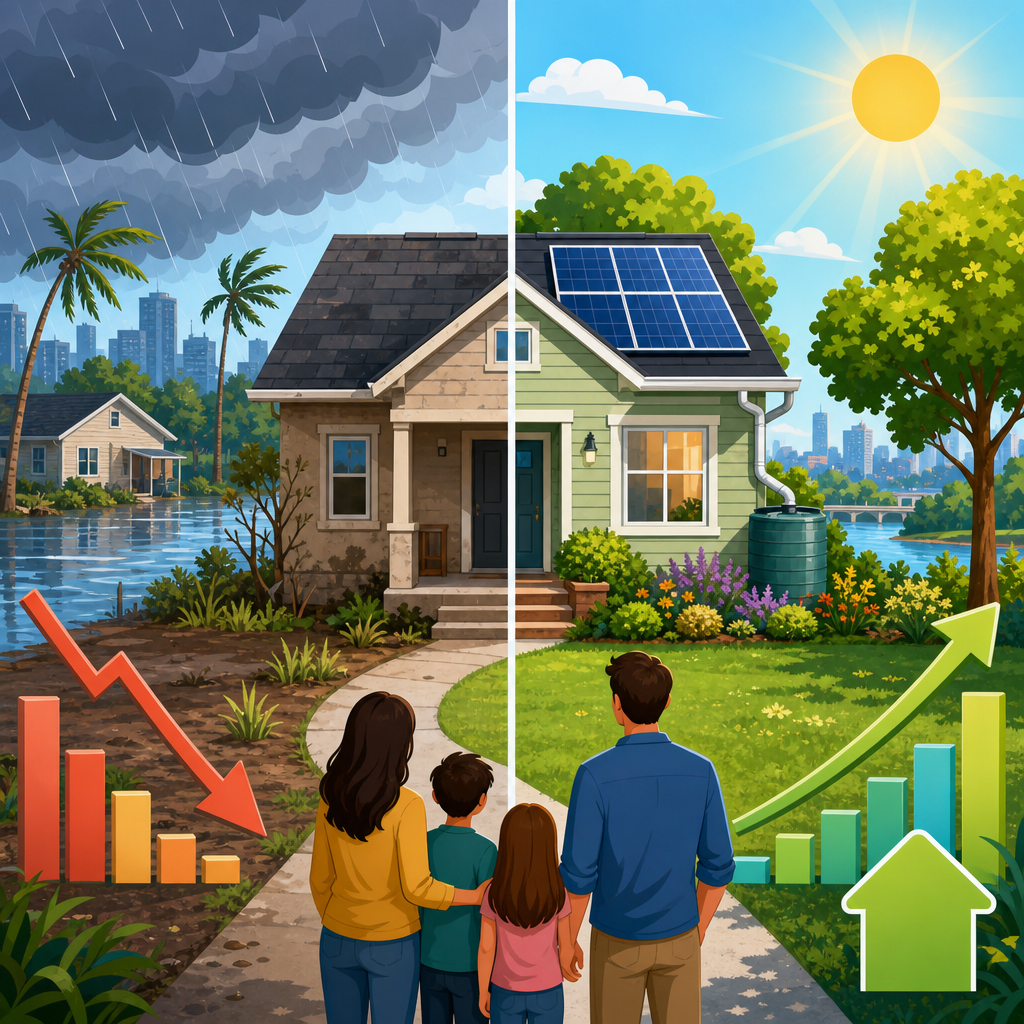
Climate adaptation investments are rapidly becoming a defining factor in residential real estate, shaping not only how homes perform during floods, heat waves, droughts, storms, and wildfire seasons, but also how buyers, lenders, insurers, and appraisers judge value. In housing market terms, climate adaptation investments are upgrades, site improvements, building-system changes, and neighborhood-scale protections designed to reduce physical risk and speed recovery after extreme weather. They include elevating a house above base flood elevation, adding impact-rated windows, installing cool roofs, creating defensible space against wildfire, upgrading drainage, hardening utilities, and supporting community infrastructure such as seawalls, retention basins, shade canopies, and microgrids.
I have worked on housing content and valuation analysis long enough to see a clear shift: adaptation used to be treated as a niche resilience topic, but it now sits inside mainstream pricing, insurance underwriting, buyer due diligence, and municipal planning. That shift matters because home value is not just a function of square footage, school districts, and finishes anymore. It is increasingly tied to expected carrying costs, insurability, downtime after disasters, and confidence that a property will remain functional over the life of a mortgage. When households ask whether climate adaptation investments increase home values, the accurate answer is yes, but unevenly. The value effect depends on hazard type, local building codes, insurance markets, income levels, neighborhood adoption, and whether the upgrade is visible, documented, and recognized during appraisal.
Understanding this topic requires a practical definition of value. In real estate, value can mean market price, appraised value, days on market, rent potential, financing terms, or avoided losses. Adaptation can improve all of those, though not always at the same time. A backflow preventer may not impress a casual buyer during a showing, but it can prevent tens of thousands of dollars in water damage and help preserve habitability. A cool roof may trim summer cooling costs and extend roof life, which supports affordability more than headline sale price. In contrast, elevating a coastal home can produce a measurable insurance discount and a stronger resale story, especially in markets where flood disclosures are prominent. That is why this article looks at adaptation investments through the full housing-market lens, not only through renovation aesthetics.
It also matters because the market is separating into resilient and vulnerable assets. Public agencies, insurers, and data firms now map flood depth, wildfire probability, heat exposure, storm surge, and urban heat island intensity at parcel or neighborhood scale. Buyers can see those risks before making an offer. Lenders and servicers monitor them. Municipalities revise codes around stormwater, energy efficiency, fire-resistant materials, and backup power. As information becomes easier to access, adaptation investments are moving from hidden technical features to explicit pricing signals. Owners who understand which upgrades matter, how to document them, and where they generate the strongest return are better positioned to protect equity and marketability.
How climate risk changes residential value
Climate risk affects home values through four main channels: physical damage, insurance cost, financing friction, and buyer perception. Physical damage is the most obvious. Repeated flooding, smoke intrusion, heat stress on mechanical systems, and storm damage shorten building component life and create repair costs. Insurance cost is now often the sharper market signal. In many coastal, wildfire-prone, and convective-storm regions, premiums have risen faster than wages and faster than many owners expected. When insurance becomes expensive or unavailable, buyers lower bids, lenders apply tighter scrutiny, and some transactions simply fail.
Financing friction follows from risk visibility. Mortgage investors and regulators increasingly care about exposure concentration. Even if a lender will finance the property, reserve requirements, inspection conditions, or documentation requests can lengthen closing timelines. Buyer perception then amplifies the effect. A house that feels exposed, hard to insure, or likely to lose power during heat waves may sit longer on the market even when it is visually appealing. Conversely, a house with documented resilience features often commands stronger interest because buyers interpret those upgrades as future cost control and safety, not just maintenance.
These value impacts are highly local. A sump pump with battery backup can be meaningful in a Midwestern basement market, while the same feature is nearly irrelevant in a desert subdivision. Defensible space and ember-resistant vents matter in California foothill communities because wildfire spread is heavily influenced by ignition points around structures. Reflective roofing, insulation, shade trees, and high-efficiency heat pumps matter more in hot metros where cooling demand, grid stress, and heat-health risks are rising. Adaptation investment must match the hazard profile, or the market will not fully reward it.
Which home upgrades influence price most
The most valuable climate adaptation investments are those that measurably reduce loss severity and operating costs. For flood risk, the strongest interventions include elevation, flood vents where appropriate, wet- or dry-floodproofing for allowed building types, site grading, larger drainage capacity, backflow valves, sump systems, and relocation of electrical panels, HVAC equipment, and water heaters above expected flood levels. For wind and hurricanes, impact-rated windows, reinforced garage doors, roof deck attachment improvements, sealed roof decks, hurricane straps, and secondary water barriers are among the upgrades insurers and buyers recognize most readily.
For wildfire, I consistently see the market respond to Class A roofs, noncombustible siding details, ember-resistant vents, tempered glass near high-exposure areas, enclosed eaves, ignition-resistant decking, and professionally maintained defensible space. For heat, buyers increasingly value high-performance envelopes, cool roofs, exterior shading, modern heat pumps, better attic ventilation, and backup power for cooling during outages. In drought-prone regions, efficient irrigation, rainwater capture where permitted, native landscaping, and leak-monitoring systems can improve affordability and reduce landscape failure, which indirectly supports curb appeal and resale.
| Hazard | Adaptation investment | Main value mechanism | Typical market signal |
|---|---|---|---|
| Flood | Elevation, drainage, backflow prevention | Lower expected damage and insurance cost | Stronger resale confidence in at-risk zones |
| Hurricane | Impact windows, roof reinforcement | Reduced repair costs and premium credits | Higher buyer trust and fewer objections |
| Wildfire | Defensible space, ember-resistant materials | Improved survivability and insurability | Better marketability in high-risk communities |
| Extreme heat | Cool roof, insulation, heat pump, shade | Lower utility bills and outage resilience | Appeal to cost-conscious buyers |
| Drought | Xeriscaping, efficient irrigation, leak control | Lower water costs and easier upkeep | Improved affordability and appearance |
Visible upgrades tend to help listing performance fastest, but hidden systems can matter just as much if properly documented. I advise owners to keep permits, contractor invoices, product specifications, insurance inspection reports, and before-and-after photos. Appraisers can only give credit for what they can verify and compare. If the listing agent can package resilience features in a way that links them to lower premiums, lower utility bills, code compliance, and post-disaster functionality, buyers are more likely to pay attention.
How insurers, lenders, and appraisers shape the payoff
Insurance is often the bridge between adaptation and home value. If a mitigation measure earns a premium reduction, broadens eligibility, or makes a property insurable in a stressed market, the upgrade can translate into affordability immediately. State and carrier rules differ, but recognized mitigation standards already influence pricing in many regions. For example, wind mitigation inspections in Florida can document roof geometry, attachment methods, opening protection, and other features that reduce premiums. In flood-prone areas, elevation certificates and finished-floor elevation relative to flood maps can materially affect National Flood Insurance Program pricing and private flood quotes.
Lenders care because insurance and operating costs affect debt-to-income ratios and payment stability. If resilience upgrades lower annual carrying costs, they can support qualification at the margin. Community-scale adaptation matters too. Better stormwater systems, maintained levees, shaded streets, and resilient power infrastructure reduce neighborhood disruption, which protects collateral performance across many loans. From a market standpoint, that means adaptation is not only a single-home story; it is also a subdivision, ZIP code, and municipal finance story.
Appraisers are improving, but the industry is still catching up. The Appraisal Institute, Fannie Mae forms, and green and energy-efficient addenda have helped standardize some property characteristics, yet climate resilience is not uniformly captured. In practice, the cleanest valuation evidence comes from paired sales, lower insurance quotes, utility savings, repair history, and reduced time on market. An elevated home beside a non-elevated one in the same flood-exposed neighborhood provides a strong comparison when all else is similar. The same is true when hardened homes in wildfire zones continue to transact while more exposed homes see buyer resistance.
Neighborhood effects and public adaptation projects
Individual property upgrades matter, but neighborhood-level adaptation often exerts the bigger pricing effect because it changes the story buyers tell themselves about the entire area. Large drainage tunnels, restored wetlands, living shorelines, wildfire fuel breaks, urban tree canopies, cooling centers, district stormwater systems, and resilient substations can all preserve livability and reduce disruption. When local government invests consistently and communicates clearly, private buyers tend to interpret that as a sign of long-term viability. That can stabilize values even before every household completes its own retrofits.
I have seen this dynamic in coastal and riverine markets where one side of town benefits from drainage expansion and pumping upgrades while another side remains prone to street flooding. The better-protected area not only suffers fewer losses; it often records faster sales and stronger buyer turnout. Public adaptation can also protect access routes, schools, and commercial corridors, which matters because homes are valued partly by the function of the places around them. If residents cannot reliably reach work, groceries, or medical care after storms, the housing market notices.
There are limits, however. Public projects can create false confidence if they are undersized for new climate conditions or if maintenance is weak. Seawalls can shift erosion. Fuel breaks do not eliminate ember storms. Tree canopy lowers heat exposure but can conflict with drought restrictions if species selection is poor. Buyers and owners should evaluate whether a project reduces risk frequency, severity, or both, and whether that reduction is durable over decades rather than election cycles.
Where adaptation investments deliver the best returns
The best return on climate adaptation investment usually appears where three conditions overlap: the hazard is already affecting transactions, the mitigation is recognized by insurers or buyers, and the cost of inaction is easy to understand. Coastal flood zones, wildfire-interface communities, and heat-stressed Sun Belt metros fit this pattern. In these markets, adaptation is no longer a theoretical future benefit. It addresses a current pricing problem. A buyer comparing two similar homes will often prefer the one that can obtain insurance at a reasonable rate, stay cooler during peak summer demand, or avoid repeated water intrusion.
That does not mean every adaptation project raises sale price dollar for dollar. Some mainly protect downside by preventing value erosion. In my experience, that is still a successful outcome. Preserving liquidity, reducing time on market, and avoiding steep buyer discounts are valuable in their own right. Owners should also think in terms of stacked returns: avoided damage, lower premiums, lower utilities, improved comfort, fewer vacancies for rentals, and stronger resale positioning together can justify an upgrade even when no single metric tells the whole story.
For investors and homeowners alike, the smartest approach is to start with a parcel-specific risk assessment, match improvements to the dominant hazard, use code-compliant contractors, and maintain documentation from day one. Then connect the work to listing strategy, appraisal support, and annual insurance review. Climate adaptation investments affect home values because they convert uncertainty into evidence. They show that a property is not simply located in a changing climate, but prepared for it. If you own, buy, sell, or invest in housing, review the resilience profile of your property now and prioritize the upgrades that your local market will recognize and reward.
Frequently Asked Questions
1. What are climate adaptation investments in residential real estate, and why do they matter for home values?
Climate adaptation investments are improvements made to a home, lot, or surrounding neighborhood to reduce damage and disruption from climate-related hazards such as flooding, extreme heat, drought, severe storms, and wildfire. At the property level, these can include elevating utilities, installing flood vents, improving drainage, adding a fortified roof, replacing combustible landscaping, upgrading insulation, using impact-resistant windows, adding backup power, or installing more efficient cooling systems. At the community level, they can include seawalls, stormwater infrastructure, shaded streets, firebreaks, water storage systems, and resilient power or transportation networks. These investments matter because they directly affect how a home performs during extreme events and how expensive it is to own, insure, finance, and maintain over time.
From a value perspective, buyers increasingly look beyond curb appeal and square footage. They want to know whether a house will stay habitable during a heat wave, whether it is likely to flood, whether insurance premiums are manageable, and whether the neighborhood can recover quickly after a disaster. Lenders and insurers are also paying closer attention to physical climate risk because those risks can affect loan performance and claims exposure. As a result, homes with credible adaptation features may stand out as lower-risk, more durable, and less costly to operate, which can support stronger demand and better pricing. In contrast, homes in exposed areas with few protective measures may face discounts, longer selling times, or higher ownership costs that weigh on value.
2. Do climate adaptation upgrades always increase a home’s market value?
Not always, but they can materially influence value when the risk is real, the improvements are well matched to that risk, and the market recognizes their benefits. Real estate value is ultimately determined by what buyers are willing to pay, what lenders are willing to finance, and how appraisers interpret comparable sales. If a property is in a flood-prone area, for example, and the owner has invested in elevation, drainage improvements, flood-resistant materials, and utility protection, those features may make the home more attractive than similar nearby properties without those protections. That can translate into a higher sale price, reduced time on market, and lower buyer resistance during negotiations.
However, adaptation investments do not operate like a simple dollar-for-dollar value formula. Some upgrades provide strong functional protection but are not always fully reflected in appraisals if comparable properties with similar features are limited. Market awareness also varies by region. In places where climate hazards are already shaping consumer behavior, resilient homes may command clearer premiums. In markets where risk is underappreciated, the same improvements may show up more subtly through easier insurability, lower expected maintenance costs, or stronger buyer confidence rather than an obvious pricing jump. In many cases, the biggest financial benefit is preserving value and marketability that might otherwise be lost due to rising climate risk.
3. Which types of climate adaptation investments tend to have the strongest effect on resale appeal?
The most influential investments are usually the ones that clearly reduce major local hazards and can be explained in practical terms to buyers. In flood-prone areas, that often means elevating mechanical systems, installing flood vents, improving site grading, adding sump pumps with battery backup, using flood-damage-resistant materials in lower levels, and creating drainage paths that move water away from the structure. In hurricane or severe storm zones, reinforced roofing systems, impact-rated windows and doors, storm shutters, secured garage doors, and roof-to-wall tie-downs can strongly improve buyer confidence. In wildfire-prone markets, defensible space, ember-resistant vents, ignition-resistant siding and roofing, tempered glass, and strategic landscaping are highly relevant. In hot climates, high-performance insulation, reflective roofing, shade design, efficient HVAC, smart thermostats, and backup power can appeal to buyers concerned about comfort, utility costs, and grid outages.
What makes these investments especially valuable is not just the physical upgrade itself, but the way it changes the ownership experience. Buyers respond well to features that lower insurance friction, reduce the chance of catastrophic repair bills, support year-round comfort, and make post-disaster recovery faster. Documentation matters too. Permits, engineering reports, insurance mitigation certificates, maintenance records, and before-and-after project details help prove the investment is real and professionally executed. A resilient feature that is visible, understandable, and tied to local risk tends to have the strongest resale impact because it is easier for agents, appraisers, and buyers to factor into decision-making.
4. How do insurers, lenders, and appraisers influence the value of homes with climate adaptation features?
These three groups have become increasingly important in translating climate adaptation into market value. Insurers affect affordability by setting premiums, deductibles, coverage limits, and eligibility. If a home has mitigation features that reduce expected losses, an insurer may view it more favorably, potentially leading to lower premiums or better access to coverage. In some high-risk regions, the difference between an insurable and hard-to-insure home can have a major impact on saleability. Buyers may be willing to pay more for a property that comes with manageable insurance costs and fewer coverage complications, especially when compared with similar homes that face steep premiums or restricted policies.
Lenders matter because financing is tied to risk, property condition, and long-term collateral value. If climate threats are likely to impair a home’s durability or marketability, lenders may become more cautious. Adaptation investments can help reassure underwriters that a property is better positioned to withstand foreseeable hazards. Appraisers, meanwhile, play a key role in assigning supported market value. They may consider whether adaptation features improve condition, functional utility, energy performance, durability, and comparative desirability. The challenge is that appraisal recognition depends on available market evidence. When resilient homes are beginning to separate themselves from vulnerable homes in terms of price, speed of sale, and buyer demand, appraisers have a stronger basis for adjustment. As data improves, adaptation features are likely to become more visible in formal valuation processes.
5. How should homeowners decide whether climate adaptation investments are worth making before selling?
Homeowners should evaluate adaptation spending the same way they would any major capital improvement: by weighing cost against risk reduction, ownership benefits, resale positioning, and local market expectations. Start with the hazards most relevant to the property. A home in a low-lying coastal area may benefit far more from drainage, elevation-related measures, and flood-hardening than from wildfire mitigation, while a house in a hot inland market may gain more from cooling efficiency, shade, and backup power. The smartest investments are usually those that address the most probable and most financially damaging risks. Homeowners should also consider whether the upgrade will improve insurance availability, reduce operating costs, limit future repair expenses, or make the property more competitive compared with nearby listings.
Before spending heavily, it helps to talk with local real estate agents, insurers, contractors, and, if possible, an appraiser familiar with climate-sensitive valuation. Ask which features buyers already recognize, which improvements may qualify for insurance discounts, and which projects are considered essential versus optional in that neighborhood. It is also important to keep detailed records and communicate the benefits clearly at listing time. Sellers who can show how a property has been adapted for floods, heat, storms, drought, or wildfire often tell a stronger story about durability and long-term ownership costs. In many cases, the payoff is not simply a higher asking price. It may be a broader buyer pool, fewer objections during due diligence, smoother financing and insurance approval, and better protection of value in a market where climate resilience is becoming a core part of what makes a home desirable.