
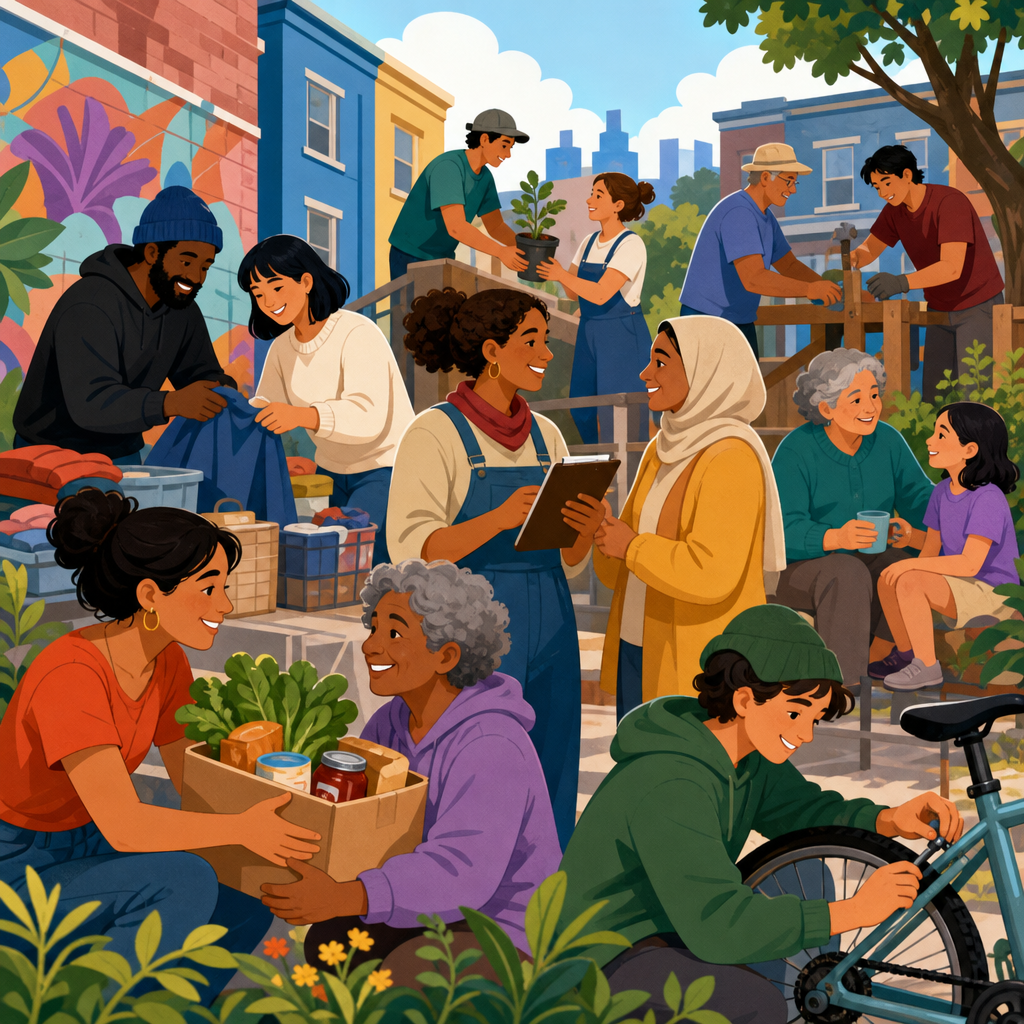
Mutual aid, informal networks, and community resilience are often discussed during crises, but their daily importance becomes clearest in neighborhoods where affordable housing is under pressure. Mutual aid refers to people voluntarily sharing money, time, skills, food, transportation, childcare, information, or space to meet one another’s needs. Informal networks are the webs of relatives, neighbors, faith groups, tenants, workers, and local organizers who solve problems outside formal institutions. Community resilience is a neighborhood’s ability to absorb shocks, adapt to stress, and recover without losing the relationships and local capacity that make life workable. In affordable housing, these ideas matter because rent burdens, eviction risk, overcrowding, utility debt, and unstable employment are rarely solved by housing supply alone. I have seen residents stay housed because a neighbor watched children during a second shift, a church member covered a security deposit, or a tenant group shared an attorney referral before a lockout happened. Those acts are not side stories. They are housing infrastructure hiding in plain sight, and they shape who can remain in place when costs rise, public systems move slowly, or disasters disrupt normal support.
For planners, housing advocates, landlords, local governments, and residents, understanding this hidden side of community resilience changes how affordable housing is evaluated. Standard metrics track units built, subsidy levels, vacancy rates, and cost burden. Those indicators are necessary, but they miss how households actually survive instability. A building with low rents but weak social ties may be more fragile than a slightly more expensive block where residents exchange meals, tools, job leads, and emergency cash. Likewise, a city can expand affordable housing programs while undermining resilience if redevelopment scatters families and breaks trust-based support systems. This hub article explains how mutual aid and informal networks function, what they do well, where they fall short, and how housing policy can strengthen rather than erase them. It also lays the groundwork for deeper articles on tenant organizing, eviction prevention, social infrastructure, care networks, disaster recovery, and neighborhood stabilization. The central point is straightforward: affordable housing policy works best when it recognizes that homes are not just units of shelter but nodes in living systems of reciprocity.
How mutual aid supports housing stability before crisis hits
Most people encounter mutual aid as an emergency response, yet in housing it usually operates long before a crisis becomes visible. Households patch together affordability through everyday exchanges that reduce cash expenses and spread risk. A grandmother provides after-school care so parents can keep jobs with variable hours. A neighbor shares rides to work when a car breaks down. A tenant with internet access helps others complete recertification paperwork for housing benefits. Someone with basic repair skills fixes a leaking sink before damage escalates into a code problem or conflict with management. In practice, these small supports can be the difference between paying rent on time and falling into arrears. Researchers studying social capital have repeatedly found that strong local ties improve access to information and practical help, especially for lower-income households navigating fragmented systems.
These networks are especially important in communities facing language barriers, immigration concerns, disability, aging, or distrust of institutions. Formal services often require documentation, digital access, transportation, or comfort with bureaucracy. Informal networks lower those barriers because help moves through trust. In many immigrant neighborhoods, for example, housing leads circulate through kinship and workplace networks before listings appear publicly. New arrivals may find rooms, learn which landlords are flexible, and get guidance on utility setup through community insiders rather than agencies. In manufactured housing communities, informal repair cooperatives often emerge because residents cannot easily afford contractors and need immediate help with weatherproofing, plumbing, or accessibility modifications. These practices do not replace the need for tenant protections or public investment, but they materially extend housing security in ways official datasets rarely capture.
The hidden economics of informal networks in affordable housing
Informal networks function like a parallel economy that subsidizes housing costs without appearing on a lease or budget sheet. If a household receives free childcare from relatives, occasional meals from neighbors, shared bulk grocery purchases, or short-term loans from friends, its effective cost of staying housed declines. Economists would describe this as nonmarket exchange and risk pooling; community organizers usually call it helping each other get by. Either way, the economic effect is real. When I have worked with housing groups reviewing resident needs, the same pattern appears: households are rarely surviving on wages and subsidy calculations alone. They are surviving because social ties convert relationships into time savings, reduced service costs, and emergency liquidity.
That hidden economy matters for policy design. A rent increase that appears modest on paper can become destabilizing if it coincides with the loss of nearby family support after relocation. Moving a household to a cheaper unit farther away may reduce nominal rent burden while increasing transportation costs, childcare costs, and unpaid care obligations. Likewise, redevelopment plans often assume residents are interchangeable within a metropolitan market, when in reality each move can sever a carefully built web of reciprocity. Housing professionals should therefore assess not only affordability ratios such as the common 30 percent threshold, but also proximity to support networks, access to walkable services, and continuity of community ties. The strongest preservation strategies treat social infrastructure as part of housing value, not as an optional neighborhood amenity.
Why trust, proximity, and repeated contact matter
Mutual aid is not magic. It depends on conditions that allow people to know one another well enough to exchange help with confidence. Trust grows through repeated contact in hallways, courtyards, laundromats, schools, bus stops, playgrounds, community rooms, and local shops. Proximity matters because support is often time sensitive: a child needs pickup now, a ride is needed in twenty minutes, groceries are carried upstairs tonight, not after a caseworker call next week. Stable tenancy also matters because reciprocity strengthens when people expect to remain in contact. High turnover, aggressive screening, frequent displacement, and hostile property management all weaken the relational base that makes informal support possible.
Design and governance choices can either reinforce or erode these conditions. Buildings with secure common areas, visible management, and spaces for residents to gather tend to produce more interaction than isolated complexes with no social spaces. Resident councils, tenant associations, and participatory budgeting processes help transform casual familiarity into organized capacity. On the other hand, over-policing common areas, banning informal gatherings, or communicating only through impersonal digital portals can suppress the very relationships that improve stability. This is one reason social infrastructure, a term popularized by sociologist Eric Klinenberg, belongs in affordable housing conversations. Libraries, parks, schools, stoops, recreation centers, and corner stores are not peripheral conveniences. They are places where resilience is built through ordinary contact.
What informal networks do that formal systems often cannot
Formal housing systems have clear strengths: legal authority, funding streams, scale, and standards. They can finance developments, enforce habitability, issue vouchers, and administer eviction diversion programs. Yet they are often slow, eligibility bound, and fragmented. Informal networks fill three gaps particularly well: speed, cultural competence, and flexibility. When a resident receives a shutoff notice, a trusted neighbor may respond that day. When a family fears asking an agency for help because of immigration status confusion, a community contact can translate options safely. When a worker’s hours are cut for two weeks, a rotating meal train or small cash contribution can bridge the gap without formal intake procedures.
The balance is not either-or. The most resilient communities combine strong informal support with reliable formal systems. During the COVID-19 pandemic, this became undeniable. Mutual aid groups delivered food, medicine, masks, rental assistance information, and technology help to households that institutions missed. At the same time, neighborhoods with legal aid, emergency rental assistance, public health outreach, and trusted nonprofit intermediaries were better positioned to convert informal identification of need into durable protection. The lesson for affordable housing is practical: policy should not treat community networks as substitutes for underfunded public systems, but as essential partners that improve reach, responsiveness, and legitimacy.
| Function | Informal networks | Formal housing systems | Best combined use |
|---|---|---|---|
| Emergency response speed | Immediate, trust based, local knowledge | Often delayed by intake and verification | Neighbors identify need; agencies fund larger assistance |
| Eligibility and access | Flexible, low barrier, relationship driven | Rule bound, documented, standardized | Community groups help residents complete applications |
| Scale and durability | Limited by volunteer capacity and burnout | Can operate citywide with sustained budgets | Public systems institutionalize what networks surface |
| Local knowledge | High awareness of household realities | Often incomplete or outdated | Resident leaders guide program targeting |
Limits, risks, and the danger of romanticizing mutual aid
Mutual aid deserves serious attention, but it should never be romanticized. Informal networks can be uneven, exclusionary, and fragile. People with weak ties, new arrivals, survivors of domestic violence, disabled residents facing isolation, or households stigmatized by race, caste, sexuality, religion, or criminal records may not benefit equally. Support can also depend on gendered expectations, with women disproportionately carrying unpaid care labor. In some neighborhoods, the same tight networks that protect residents can enforce conformity or silence abuse. From a housing perspective, another risk is burnout. Communities under chronic economic stress cannot endlessly compensate for policy failure through volunteer effort and personal sacrifice.
There are also real financial limits. A network can often cover groceries, temporary childcare, moving help, or a small utility bill; it cannot reliably replace long-term rent subsidies, major capital repairs, or legal remedies against unlawful eviction. I have seen organizers struggle when outsiders praised community resilience while ignoring the fact that residents were using resilience to survive avoidable harm. That distinction matters. Resilience should mean the capacity to adapt with dignity, not the obligation to absorb unlimited extraction. Sound affordable housing strategy therefore pairs respect for mutual aid with stronger tenant protections, preservation funding, living wages, anti-displacement tools, and public investment in supportive services.
How housing policy can strengthen rather than disrupt community resilience
The first principle is simple: avoid unnecessary displacement. Preservation of naturally occurring affordable housing, right-to-counsel programs, just-cause eviction standards, rent stabilization where legally available, and targeted emergency assistance all help keep relationships intact. The second principle is to design housing around connection. Community rooms, shared outdoor space, accessible laundry areas, and resident communication systems may seem secondary to financing, yet they directly affect whether neighbors can form helpful ties. The third principle is to compensate community expertise. Resident leaders, tenant association officers, promotoras, block captains, and mutual aid coordinators often do work that saves agencies time and improves outcomes. Paying stipends or funding partner organizations is more sustainable than treating this labor as free.
Public agencies and nonprofit developers can also map social vulnerability with greater precision. That means looking beyond census indicators to understand who residents rely on, what institutions anchor trust, which buildings house elders caring for grandchildren, where informal childcare clusters exist, and how transit connects households to support. Tools such as social network analysis, participatory research, and resident surveys can reveal whether a proposed move or redevelopment plan will fracture critical ties. Hospitals and health systems increasingly use community health worker models to bridge formal care and local trust; housing systems can do something similar by embedding resident navigators and peer ambassadors in affordable properties. The goal is not to formalize every relationship, but to create conditions in which support networks can thrive alongside durable rights and resources.
Why this hub matters for the affordable housing conversation
Affordable housing debates often narrow into production versus preservation, market incentives versus subsidy, or zoning reform versus tenant protection. Those debates are important, but they become incomplete when they ignore the hidden architecture of mutual aid and informal networks. A home is more than a roof at a given price point. It is access to care, trust, familiarity, practical knowledge, emergency backup, and social recognition. When communities lose those assets, housing instability deepens even if a replacement unit exists somewhere else on paper. When communities retain and strengthen those assets, households are better able to withstand rent shocks, health problems, job loss, extreme weather, and administrative barriers.
This hub frames the subtopic as a central part of affordable housing rather than a soft add-on. The key takeaway is that community resilience grows where stable housing, social infrastructure, tenant power, and responsive institutions reinforce one another. Mutual aid can prevent crises, informal networks can translate systems people do not trust, and both can reveal what policy misses. But neither should be asked to carry the weight of structural underinvestment alone. If you work in housing, start evaluating neighborhoods not just by unit counts and rents, but by the strength of the relationships that help residents remain housed. If you live in one of these communities, support tenant groups, local organizations, and neighbor-to-neighbor efforts that keep people connected. Affordable housing lasts longer when the networks around it are protected too.
Frequently Asked Questions
What is mutual aid, and how is it different from charity or formal social services?
Mutual aid is the practice of people directly supporting one another by sharing resources, labor, knowledge, and care to meet everyday needs. That can include helping with rent, delivering groceries, offering rides to medical appointments, sharing childcare, translating documents, fixing a neighbor’s appliance, or passing along information about jobs, eviction defense, and public benefits. What makes mutual aid distinct is that it is rooted in reciprocity, trust, and collective survival rather than a one-way relationship between a giver and a recipient.
Unlike charity, mutual aid does not usually assume that one side permanently has resources and the other side permanently has needs. People may give in one moment and receive in another. It is also different from formal social services, which are typically structured through agencies, eligibility rules, funding cycles, and institutional priorities. Mutual aid can move faster, respond more flexibly, and reach people who are excluded by bureaucracy, stigma, language barriers, immigration concerns, or lack of documentation.
In communities under housing pressure, this difference matters greatly. When rents rise, wages stagnate, and displacement becomes a constant threat, people often cannot wait for slow systems to respond. Informal support networks help fill urgent gaps in food, transportation, temporary shelter, school pickup, elder care, and emotional support. These efforts may be small and local, but together they reveal an important truth: community resilience is not only built through policies and institutions, but also through everyday relationships that make it possible for people to remain housed, connected, and safe.
Why do informal networks matter so much for community resilience, especially in neighborhoods facing housing instability?
Informal networks matter because they are often the first and most reliable line of support when people are navigating instability. In neighborhoods where affordable housing is shrinking, residents depend on webs of relationships to manage crises before those crises become catastrophic. A neighbor might watch children during a work shift, a local faith group may organize a meal train after an illness, tenants may warn each other about landlord harassment, and extended family members may pool money to prevent an eviction. These actions may not always be visible in official data, but they are central to how communities endure pressure.
Community resilience is often described in terms of recovery after disasters, but resilience is also built in ordinary time. It grows through repeated acts of cooperation, familiarity, and shared responsibility. Informal networks help people circulate practical information quickly, identify vulnerabilities early, and create a sense of belonging that reduces isolation. When residents know who can lend tools, share food, provide translation, or explain a housing notice, they are better equipped to solve problems before they spiral.
Housing instability makes these networks even more valuable because displacement disrupts more than an address. It breaks school routines, caregiving systems, transportation patterns, trust, and local knowledge. Informal networks hold much of that social infrastructure together. They allow people to adapt, redistribute pressure, and preserve continuity in the face of uncertainty. In that sense, resilience is not just about bouncing back. It is about maintaining the relationships that help people stay grounded, informed, and supported every day.
How do mutual aid and informal networks support people outside of major emergencies or disasters?
Although mutual aid gets the most attention during pandemics, storms, or economic shocks, its daily role is often even more important. Most people experience strain not only through headline-making emergencies, but through ongoing challenges such as high rent, unstable work hours, healthcare costs, unreliable transportation, school closures, caregiving demands, and rising food prices. Mutual aid helps people navigate these pressures in practical, immediate ways that formal systems often overlook.
On an ordinary week, mutual aid can look like neighbors sharing bulk groceries, exchanging school uniforms, organizing rides to work, rotating childcare, helping someone move before a rent increase takes effect, or checking on an elder who lives alone. Informal networks also provide guidance that can be just as valuable as money. Residents share leads on affordable apartments, explain how to contest utility shutoffs, connect one another to legal clinics, and teach skills that reduce costs, such as home repair, food preservation, or digital access. These are not side activities. They are part of the hidden labor that keeps households functioning.
This everyday support strengthens community resilience because it reduces the damage caused by chronic stress and makes people less vulnerable when a larger crisis does occur. Communities with strong informal ties do not need to start from zero when trouble arrives. They already know how to communicate, coordinate, and respond. In that way, the daily work of mutual aid is not separate from emergency preparedness. It is the foundation that makes collective action possible when stakes become even higher.
Can mutual aid replace government programs, affordable housing policy, or nonprofit support?
No. Mutual aid is powerful, but it should not be treated as a substitute for public responsibility or structural solutions. Strong communities can share food, time, money, and care, but they cannot solve systemic housing shortages, wage inequality, predatory landlord practices, underfunded schools, or gaps in healthcare through volunteer effort alone. When people rely on mutual aid to survive, that often reflects both community strength and institutional failure.
Affordable housing policy, tenant protections, eviction prevention, accessible healthcare, living wages, public transit, and adequately funded social services remain essential. These systems operate at a scale that informal networks cannot consistently sustain by themselves. Mutual aid can bridge urgent gaps, protect people in moments of crisis, and build solidarity across a neighborhood, but it is often stretched thin when underlying conditions remain unchanged. Expecting communities to permanently absorb the impact of disinvestment can place unfair burdens on the very people already experiencing the most pressure.
The strongest approach is not choosing one or the other. It is understanding how mutual aid, informal networks, nonprofits, and public systems can complement each other. Informal networks often identify needs quickly, reach people others miss, and build trust where institutions have lost credibility. Public policy, in turn, can provide scale, stability, legal protections, and long-term investment. Community resilience becomes more durable when grassroots care and structural support work together rather than being forced to compete.
How can neighborhoods strengthen mutual aid and informal networks in a sustainable way?
Strengthening mutual aid starts with recognizing that many communities already practice it, even if they do not use that language. The first step is to make existing support visible. Neighborhoods can map who offers childcare, rides, translation, food sharing, tenant advice, elder check-ins, or emergency funds. Local groups can create phone trees, text chains, bulletin boards, shared spreadsheets, or regular meetups that help people connect needs with available resources. The goal is not to formalize every relationship, but to make it easier for trust-based support to circulate.
Sustainability also depends on reducing burnout and distributing responsibility. Mutual aid works best when care does not fall on the same small group of people every time. Communities can rotate tasks, set realistic expectations, build teams around specific needs, and create systems for rest and backup. Clear communication matters as well. Residents are more likely to participate when requests are specific, roles are manageable, and people know how decisions are made. Small practices, such as checking in consistently, documenting local knowledge, and welcoming new neighbors, can strengthen the network over time.
Finally, sustainable mutual aid grows when communities invest in relationships before a crisis. Block gatherings, tenant associations, school-based parent networks, faith communities, worker groups, and neighborhood events all create opportunities for people to build familiarity and trust. These connections become invaluable when housing costs rise, a family faces displacement, or an emergency unfolds. Community resilience is not built only through heroic moments. It is built through repeated, ordinary acts of showing up for one another, sharing what is possible, and treating survival as a collective responsibility.


