
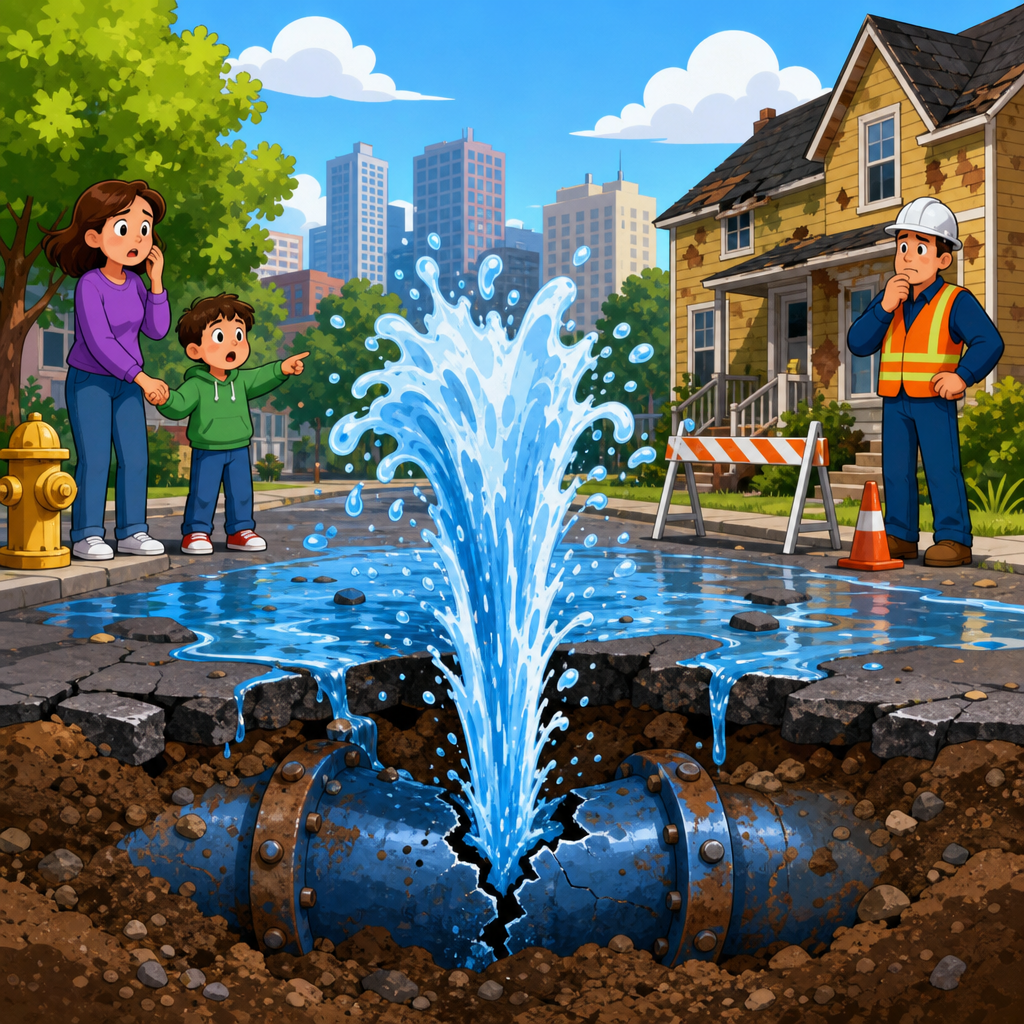
Water main breaks are one of the clearest signs that hidden infrastructure debt has become a public safety problem. A water main is the large pressurized pipe that carries treated drinking water beneath streets, sidewalks, and buildings. A break happens when that pipe cracks, splits, or fails at a joint, releasing water into surrounding soil and often onto the surface. Deferred maintenance means repairs, renewal, and replacement are postponed beyond the point that engineers would consider prudent. Public risk includes direct dangers such as flooding, traffic crashes, boil-water advisories, fire suppression failures, contamination events, and service interruptions for homes, hospitals, schools, and businesses.
I have worked with municipal asset plans, emergency response protocols, and post-failure reviews, and the same pattern appears repeatedly: the pipe that fails is rarely an isolated problem. It is usually part of a wider system shaped by age, material choice, soil chemistry, freeze-thaw cycles, pressure fluctuations, utility conflicts, and budget decisions made over decades. The break in the street is visible; the underlying issue is often an invisible mismatch between infrastructure condition and available capital. That mismatch matters because drinking water networks are foundational public assets. When they fail, the effects spread quickly across transportation, health, commerce, and trust in local government.
Across North America and Europe, many buried water systems were installed in waves during the late nineteenth and twentieth centuries. Cast iron, ductile iron, asbestos cement, steel, concrete cylinder pipe, copper, and various plastics were selected according to local standards of the time. Many of those assets have outlived their original design expectations or are operating in harsher conditions than planned. The American Water Works Association, the U.S. Environmental Protection Agency, and utilities worldwide have documented the scale of renewal needs. Yet utilities still face a practical question that every elected official, public works manager, and resident should understand: when maintenance is deferred, what risks increase, who bears them, and how should cities respond?
This article serves as a comprehensive hub for understanding water main breaks, deferred maintenance, and public risk within urban planning and policy. It explains why breaks happen, how agencies assess condition, what failures cost, which neighborhoods are most exposed, and what policy tools actually reduce risk. It also connects operational practices such as leak detection and valve exercising to strategic issues including capital planning, rate design, resilience, equity, and climate adaptation. If you want a plain-language guide to the mechanics, consequences, and governance of water main failures, this is the place to start.
Why Water Mains Break and What Failure Really Means
Water mains fail because materials deteriorate, loads change, and systems are operated under real-world stresses that compound over time. The immediate trigger may be cold weather, a pressure surge, nearby excavation, corrosion, or ground movement, but failure usually develops through a chain of causes. In older gray cast iron pipe, graphitization and brittleness can reduce structural strength. In ductile iron, external corrosion can create wall loss if protection is inadequate. In asbestos cement pipe, age and cyclic stress can increase the likelihood of cracking. Prestressed concrete cylinder pipe can fail dramatically if wire breaks go undetected. Plastic pipes resist corrosion well, but installation quality, bedding, and long-term loading still matter.
Utilities use different terms for different events, and precision matters. A leak is not always a break, and a main failure is not always catastrophic. Some leaks remain hidden for months, wasting treated water and eroding soil while never reaching the surface. Others cause sinkholes, undermine pavement, or flood basements within minutes. A transmission main carries large volumes over long distances and can disrupt whole districts if it fails. A smaller distribution main may affect a few blocks but still create substantial local harm. The public often sees water in the street and assumes the problem is simple. In practice, operators must isolate valves, redirect flows, protect water quality, assess pavement stability, coordinate traffic control, notify customers, and sometimes issue boil-water guidance depending on pressure loss and intrusion risk.
Failure also has a systems dimension. One break can expose operational weaknesses elsewhere: inoperable valves, incomplete asset records, insufficient redundancy, weak emergency communication, or overreliance on a single feed to a hospital district. I have seen utilities discover during an incident that a valve thought to isolate one block actually affects a much larger service area because records were outdated after prior street reconstruction. That is why modern water management treats each break as both an emergency and a diagnostic event. The point is not merely to restore service but to learn whether the wider network is entering a higher-risk phase.
Deferred Maintenance as Infrastructure Debt
Deferred maintenance is often described as a budget tactic, but in infrastructure terms it functions like debt with compounding interest. When a utility postpones routine renewal, condition assessment, cathodic protection upgrades, valve replacement, hydrant maintenance, or service line coordination, it is not avoiding cost. It is shifting cost forward while increasing the probability that future work will be more expensive and more disruptive. A planned replacement completed in summer under traffic control is fundamentally different from a winter emergency excavation at 2 a.m. with police support, overtime labor, pavement restoration, customer claims, and potential contamination investigation.
The reason deferral persists is straightforward. Buried assets are politically hard to fund because success is invisible. A new park, station, or streetscape is easier to explain than replacing a pipe that residents never see. Water utilities also face competing obligations: treatment upgrades, regulatory compliance, cyber hardening, lead service line replacement, labor shortages, and energy costs. In some municipalities, rates are held artificially low for years, which creates a structural funding gap. In others, fragmented governance means road resurfacing, sewer renewal, and water replacement are not coordinated, so the city paves a street shortly before the water main beneath it fails. That sequence is not bad luck; it is an asset management failure.
Professional practice offers a better framework. ISO 55000 asset management principles, AWWA guidance, and utility risk models all emphasize lifecycle planning. The central idea is simple: assets should be maintained, renewed, and replaced according to condition, criticality, and consequence of failure, not just age. Age matters, but pipe cohorts behave differently by material, diameter, soil environment, installation era, and operating pressure. A hundred-year-old cast iron main in stable soil may outlast a younger steel main in corrosive ground. Deferring maintenance without that analytic discipline turns uncertainty into avoidable public risk.
How Utilities Prioritize Risk and Plan Renewal
Utilities do not need perfect data to make better decisions, but they do need a repeatable framework. Most mature programs combine probability of failure with consequence of failure. Probability is informed by break history, material, age, soil corrosivity, pressure zone, freeze exposure, acoustic leak trends, wall-thickness testing, and inspection results. Consequence considers customer count, hospitals, schools, fire flow needs, traffic importance, environmental sensitivity, and the presence of critical businesses or emergency routes. A pipe under a major arterial serving a medical campus should not be treated the same as a short low-demand segment on a cul-de-sac.
Data quality is a recurring obstacle. Many cities still rely on legacy maps, partial GIS records, and handwritten break logs. The strongest utilities integrate GIS, computerized maintenance management systems, hydraulic models such as EPANET or InfoWater, SCADA data, and work-order histories. They also normalize failure rates by length and material cohort so they can distinguish random incidents from statistically significant deterioration. In practice, the planning process often starts with simple screening: which mains are breaking repeatedly, where are losses high, and which segments would cause the worst disruption if they failed tomorrow? Then it advances toward more formal risk scoring and capital programming.
| Planning factor | What utilities examine | Why it matters |
|---|---|---|
| Probability of failure | Break history, age, material, corrosion, pressure transients | Shows where failure is most likely next |
| Consequence of failure | Hospitals, schools, arterial roads, fire protection, customer count | Identifies segments with the highest public impact |
| Operational resilience | Valve spacing, redundancy, alternate feeds, repair access | Determines how fast service can be restored |
| Coordination opportunities | Street paving, sewer projects, utility trench sharing | Reduces total cost and repeat disruption |
| Funding readiness | Rates, grants, debt capacity, procurement timeline | Turns asset plans into executable projects |
Prioritization is not purely technical. Policy choices shape the outcome. Some cities focus first on the most breaks per mile; others prioritize social vulnerability, road hierarchy, or water loss reduction. In my experience, the most defensible plans state their criteria clearly, publish them, and update them annually. That transparency matters when residents ask why one neighborhood received replacement funding before another. A city does not need to promise zero breaks. It does need to show that limited funds are being directed by evidence rather than by crisis, habit, or political pressure.
Public Health, Safety, and Economic Consequences
The public risk from water main breaks extends far beyond wet pavement. The first concern is safety at the scene. Fast-moving water can destabilize trenches, create icy roadways, obscure lane markings, and undermine asphalt. Vehicles can strike flooded hazards, and pedestrians can fall where washout has weakened sidewalks. If pressure drops sharply, the utility must evaluate whether contamination could have entered the system through cracks, joints, or cross-connections. That can trigger boil-water advisories, flushing programs, bacteriological sampling, and public notification protocols. Water quality protection is not automatic after a repair; it requires controlled disinfection, verification, and documentation.
Fire protection is another major consequence. During a break, hydrant performance in the affected pressure zone may drop below what the fire department expects for suppression. That risk is especially serious in dense districts with older buildings, warehouses, or institutional campuses. Hospitals, dialysis centers, food processors, laboratories, and high-rise buildings may have immediate operational problems if pressure fluctuates or service is interrupted. For residents, the impact can mean no drinking water, no sanitation, flooded basements, damaged appliances, lost wages, and complicated insurance claims. Small businesses often absorb losses that never appear in utility accounting.
The economic burden of reactive management is substantial. Emergency repairs cost more per linear foot than planned renewals because crews mobilize under urgent conditions, often outside regular hours and in poor weather. Roads, transit routes, and commercial corridors can be disrupted for days. Utilities also lose treated water before the break is isolated, increasing non-revenue water and energy waste. At city scale, repeated failures damage confidence in local government competence. Residents may tolerate one incident, but a pattern of recurring breaks signals that infrastructure stewardship is falling behind basic expectations.
There is also an equity dimension. Low-income neighborhoods and historically underserved areas are often more vulnerable to service interruptions because residents have fewer resources to absorb disruption, less flexible work schedules, and older building plumbing that may be more sensitive to pressure changes. If utilities respond only to visible emergencies without analyzing spatial patterns, they can unintentionally reproduce unequal risk. Good policy asks not only where pipes are oldest, but where failure would compound existing social disadvantage.
Prevention, Resilience, and Better Policy Choices
The most effective response to water main breaks is not faster patching alone; it is a prevention strategy tied to resilience policy. Utilities reduce failure risk through active leak detection, pressure management, corrosion control, valve exercising, hydrant maintenance, condition assessment, and targeted renewal. Acoustic monitoring and correlators can identify hidden leaks before they become major breaks. Satellite leak detection and inline inspection tools are increasingly useful for large systems, though they should be validated against field conditions. Pressure transient control through pump operations, surge protection, and district metering can reduce cyclic stress that shortens pipe life.
Replacement strategy matters as much as replacement volume. Cities that coordinate water renewal with street reconstruction, sewer separation, transit upgrades, and broadband trenching consistently reduce lifecycle cost and neighborhood disruption. Material selection should reflect local soil conditions, expected loading, water chemistry, and maintenance capacity. Utilities also need contingency planning: current valve maps, mutual aid agreements, spare parts inventories, emergency contracts, backup power, and communication templates for residents and institutions. The strongest utilities rehearse incident command, not just repair methods.
Funding policy determines whether these practices scale. Sustainable rate structures, dedicated capital improvement programs, state revolving funds, infrastructure grants, and prudent debt can all support renewal, but only if leaders explain the tradeoff honestly. Paying more now to replace a high-risk main is usually cheaper than paying later for emergency repair, water loss, pavement collapse, and business disruption. The public responds well when agencies connect capital spending to visible outcomes: fewer breaks, lower outage duration, safer roads, and more reliable fire flows. Clear metrics build trust.
For urban planners and policymakers, the lesson is direct. Water main breaks are not isolated utility incidents; they are land use, mobility, public health, resilience, and governance issues. Cities should integrate water asset data into capital planning, hazard mitigation, climate adaptation, and emergency management. They should publish risk-based renewal criteria, track performance, and align investment with both engineering evidence and community need. When deferred maintenance is treated as a strategic risk instead of a bookkeeping convenience, public systems become safer, more dependable, and more equitable. Review your city’s capital plan, ask how water main risk is prioritized, and push for renewal before the next break forces the issue.
Frequently Asked Questions
What is a water main break, and why is it considered more than just a plumbing problem?
A water main break is the failure of a large underground pipe that carries treated drinking water under pressure to homes, businesses, schools, hospitals, and fire hydrants. When that pipe cracks, splits, corrodes through, or fails at a joint, water escapes into the surrounding soil and often rises to the street surface. While it may look like a localized leak or an inconvenient street flooding event, a water main break is usually a sign of a deeper infrastructure problem. These pipes are part of a public system that people rely on every day for sanitation, health, fire protection, and economic activity.
The reason it is more than a simple plumbing issue is scale and consequence. A household plumbing leak is private and relatively contained. A water main break can undermine roads, weaken sidewalks, flood basements, interrupt traffic, reduce water pressure across a neighborhood, and disrupt firefighting capacity. In some cases, the loss of pressure can increase the risk that contaminants enter the system if proper safeguards are not maintained. For residents, that means property damage, business interruption, boil water advisories, and possible public health concerns. For cities and utilities, it means emergency repair costs, service disruption, and evidence that hidden infrastructure debt may be catching up with the system.
In practical terms, a break is often one of the most visible warnings that a water distribution network has aged beyond the point where spot repairs alone are enough. It reflects not only the condition of one pipe, but the condition of asset management, capital planning, inspection practices, and long-term investment decisions.
How does deferred maintenance contribute to water main breaks?
Deferred maintenance means that inspections, repairs, rehabilitation, and replacements are pushed off longer than engineers would consider prudent. In water systems, that delay can be especially risky because most of the infrastructure is buried and out of sight. Pipes may continue to function even as corrosion progresses, joints weaken, surrounding soil shifts, or repeated freeze-thaw cycles stress the material. Because the deterioration is hidden, it is easy for decision-makers to postpone action in favor of more visible priorities, at least until failures become frequent or severe.
Water mains rarely fail for a single reason. Breaks usually happen when several risk factors combine: aging pipe materials, corrosive soil conditions, heavy traffic loads above the pipe, fluctuating pressure, poor installation practices from decades earlier, and a lack of timely renewal. Deferred maintenance magnifies these conditions. Small leaks are left unaddressed, protective linings are not renewed, valves are not exercised, condition assessments are skipped, and replacement programs are underfunded. Over time, the pipe network becomes less resilient, so a cold snap, construction vibration, or pressure surge can trigger a break that might have been preventable.
This is why water main breaks are often described as symptoms of infrastructure debt. The utility may save money in the short term by delaying work, but the underlying risk does not go away. Instead, it accumulates. Eventually, the system pays for that delay through emergency repairs, service outages, pavement restoration, legal claims, and public frustration. In many cases, the cost of repeated emergency response exceeds what a planned maintenance and replacement strategy would have required.
What public safety risks can a water main break create?
The public safety risks from a water main break go well beyond wet roads. One major concern is loss of water pressure. If pressure drops significantly, homes and businesses may lose service, and fire hydrants in the area may not deliver the flow firefighters expect during an emergency. In a structure fire, even a short-lived reduction in water availability can increase danger to occupants, neighbors, and first responders.
There are also physical hazards at the surface. Escaping water can erode soil beneath pavement and create sinkholes or voids under streets, sidewalks, and driveways. That makes vehicle crashes, pedestrian injuries, and structural instability more likely. Fast-moving water can flood intersections, freeze into dangerous ice in winter conditions, and enter buildings, causing electrical hazards and mold-related damage. If the break is large enough, it can shut down roads and delay ambulances, school transportation, deliveries, and routine municipal operations.
Public health can also become a concern. Although treated water leaving the plant is safe, a break can create conditions where contamination risk must be carefully managed, especially if system pressure is lost. Utilities may need to isolate sections of pipe, flush the system, disinfect repaired lines, and issue precautionary boil water notices depending on local regulations and the nature of the event. The bigger point is that a water main break can quickly evolve from an infrastructure failure into a multi-layered public risk event involving transportation, emergency response, sanitation, and community trust.
Why do municipalities keep deferring water infrastructure work if the risks are so serious?
The short answer is that underground infrastructure competes for limited public money, and buried assets are politically easy to overlook. Water mains are essential, but they are largely invisible when they are working. Elected officials and budget planners often face pressure to fund schools, police, parks, visible road improvements, and other immediate community needs. When budgets are tight, it can be tempting to postpone pipe renewal because the consequences are not always immediate or obvious.
There are also structural reasons. Many utilities inherited systems built generations ago, with portions of the network reaching or exceeding their expected service life at the same time. Replacing those assets systematically requires long-term capital planning, accurate condition data, rate structures that support investment, and public willingness to pay for work no one will see once the street is repaved. In some communities, rates have been held artificially low for years, which may be popular in the short term but leaves little revenue for proactive maintenance and replacement.
Another challenge is uncertainty. Utilities do not always have complete records on pipe age, material, break history, soil conditions, or true remaining life. Without strong asset management data, leaders may rely on reactive repairs rather than risk-based planning. Unfortunately, reactive management tends to reward delay until the failures become impossible to ignore. That is why experts often stress that deferred maintenance is not simply a technical issue; it is a governance, funding, and risk communication issue. Communities that explain the stakes clearly and invest consistently are generally better positioned to reduce breaks and protect the public.
What can be done to reduce water main breaks and lower public risk over time?
Reducing water main breaks starts with moving from emergency response to proactive asset management. Utilities need a clear inventory of their system, including pipe age, material, diameter, break history, soil environment, pressure zones, and consequence of failure. With that information, they can prioritize the highest-risk segments for inspection, rehabilitation, or replacement rather than waiting for pipes to fail one by one. This kind of risk-based planning helps direct limited funds where they will do the most to improve reliability and public safety.
Preventive actions can include leak detection, corrosion control, valve maintenance, pressure management, condition assessment technologies, and scheduled replacement of mains that have reached the end of their useful life. Not every old pipe must be replaced immediately, but utilities should be able to justify why a segment remains in service and what monitoring is in place. Emergency preparedness also matters. Good utilities have response plans for isolation, traffic control, customer notification, water quality testing, and coordination with fire departments, public works, and health agencies.
At the policy level, sustained investment is essential. That may mean updating water rates, pursuing state or federal infrastructure funding, issuing bonds for capital projects, and coordinating water work with road reconstruction to minimize long-term cost. Public communication is equally important. When residents understand that a water main break is not a random accident but often the result of aging infrastructure and postponed renewal, they are more likely to support long-term solutions. The goal is not merely fewer leaks. The goal is a safer, more resilient water system that protects health, property, mobility, and confidence in essential public services.


