
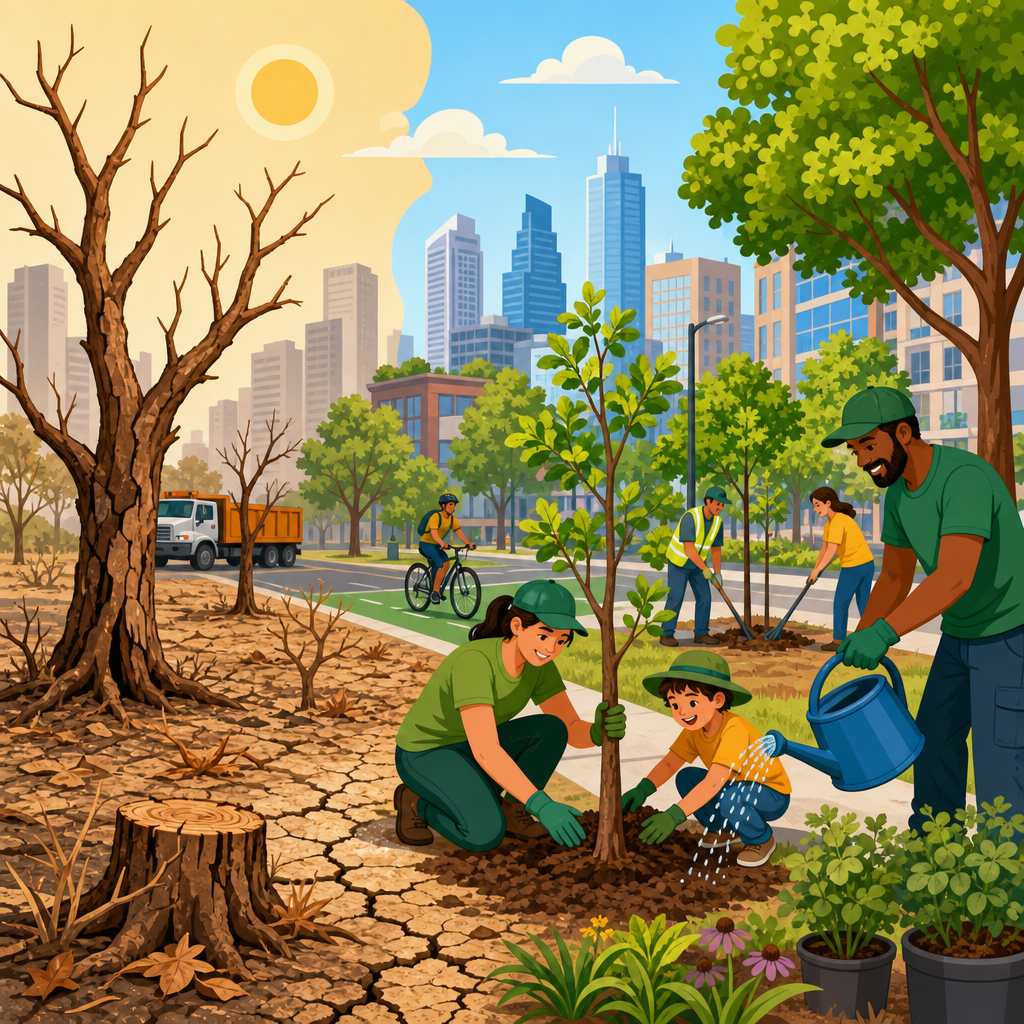
Urban tree loss during drought is no longer a seasonal concern managed by parks departments; it is a core urban planning and policy issue that affects public health, infrastructure performance, equity, and municipal budgets. In practical terms, urban tree loss means the decline or death of street trees, park trees, and privately owned canopy within city boundaries when prolonged water stress overwhelms normal maintenance. Drought, in this context, is not simply a few dry weeks. It includes meteorological drought, when rainfall drops below normal; hydrological drought, when reservoirs and groundwater decline; and ecological drought, when soil moisture becomes too limited to sustain vegetation. Cities respond through policy, operations, and design: they change watering rules, prioritize high-value trees, adjust planting standards, revise species lists, and use data to direct scarce resources.
I have worked with municipal landscape and resilience teams during dry years, and the recurring lesson is straightforward: tree mortality arrives faster than most budgets and ordinances are built to handle. Urban trees live in constrained planting pits, compacted soils, heat islands, and fragmented root zones. Even mature trees that survived past dry spells can fail after repeated stress, especially when drought combines with construction damage, pests, or extreme heat. Young trees are even more vulnerable because their root systems are shallow and dependent on scheduled irrigation. Once mortality accelerates, cities lose shade, stormwater interception, air pollutant removal, carbon storage, habitat value, and neighborhood comfort at the same time.
This matters because urban trees are infrastructure. The U.S. Forest Service’s i-Tree tools have long helped cities quantify tree benefits in avoided runoff, energy savings, and air quality improvement. Public health research also links tree canopy with lower surface temperatures and reduced heat exposure, which becomes critical during drought-driven heat waves. When canopy declines, asphalt and building surfaces absorb more solar radiation, nighttime temperatures stay elevated, and vulnerable residents face higher health risks. Tree loss also raises replacement costs. Removing a dead street tree, grinding the stump, restoring the site, and replanting can cost far more than preserving an existing tree through targeted watering and soil care.
Because this article serves as a hub for the urban planning and policy dimensions of the issue, it covers the full response system rather than one narrow tactic. The central questions city leaders ask are consistent across climates: which trees are most at risk, how do drought restrictions affect maintenance, what policies protect canopy during water scarcity, how should budgets be structured, and what long-term changes reduce future losses? The strongest city responses combine emergency action with structural reform. They treat drought as a recurring planning condition, not an exceptional event, and they integrate forestry decisions with water management, zoning, capital planning, and climate adaptation.
Why Urban Trees Die Faster in Cities During Drought
Urban trees are exposed to drought differently than forest trees. In a city, soils are often compacted to support pavement and utilities, which reduces pore space, limits infiltration, and cuts off oxygen exchange around roots. Tree pits may hold only a fraction of the soil volume a mature canopy requires. Impervious surfaces accelerate runoff, so even when rain falls, much of it reaches storm drains instead of infiltrating to root zones. Add reflective heat from roads and facades, and evapotranspiration demand rises sharply. The result is chronic water stress layered on top of acute drought.
Species selection also explains mortality patterns. Cities frequently inherit legacy plantings chosen for aesthetics, rapid growth, or nursery availability rather than drought tolerance. Species such as birch, ash in stressed settings, or shallow-rooted ornamentals often struggle when irrigation is reduced. By contrast, well-sited oaks, hackberries, elms bred for urban conditions, and many regionally adapted species can persist longer, though no species is drought proof when planting conditions are poor. Age matters too. Newly planted trees may need regular watering for two to three growing seasons. Large mature trees have more stored energy, but once decline sets in, recovery can be slow or impossible.
Drought rarely acts alone. In many cities, tree death follows a compound stress pathway: dry soil reduces vigor, weakened trees attract borers or fungal pathogens, heat damages leaf tissue, and then watering restrictions prevent intervention. Construction trenching can sever roots months before visible decline. De-icing salt history can worsen osmotic stress. Poor mulch practices, turf competition, and mower injury add smaller but cumulative effects. For planners, this means canopy loss data must be interpreted as a systems problem rather than a weather-only event.
How Cities Assess Risk and Set Priorities
The first operational task is triage. No city has enough crews or water to treat every stressed tree equally during severe drought. Urban forestry teams usually combine inventory data, condition ratings, species information, age class, and site context to identify priority trees. A mature street tree shading a bus stop, school route, or senior housing block may deliver more immediate public benefit than a similar tree in a low-use setting. Landmark trees, newly planted trees, and trees in heat-vulnerable neighborhoods often rise to the top of response lists.
Good inventories matter here. Cities using GIS-based tree inventories, remote sensing, and work-order systems can map canopy gaps and mortality in near real time. Tools from Esri, Trimble, and Davey Resource Group are common in municipal operations. Some cities pair these inventories with heat maps, equity indices, and water district data to direct limited irrigation where social and climate benefits overlap. This is a significant policy shift: instead of treating all blocks the same, cities explicitly prioritize survival where canopy loss would deepen existing inequities.
| Response area | Typical city action during drought | Why it matters |
|---|---|---|
| Inventory and monitoring | Update condition ratings, map mortality hotspots, track young trees weekly | Directs crews to the highest-risk sites before decline becomes irreversible |
| Emergency watering | Deep-water priority trees, deploy water trucks or slow-release bags | Preserves high-value canopy at lower cost than removals and replacements |
| Water policy coordination | Create exemptions for establishment watering and critical public trees | Avoids blanket restrictions that unintentionally kill recent plantings |
| Species and design standards | Revise approved species lists, require larger soil volumes, improve mulch rules | Reduces future losses by aligning planting practice with hotter, drier conditions |
| Equity targeting | Prioritize low-canopy, heat-exposed neighborhoods for preservation and replanting | Protects residents facing the highest heat burden and lowest environmental access |
Assessment should distinguish between preservation and replacement decisions. In my experience, cities lose money when they keep watering trees that have crossed into irreversible decline while ignoring viable trees nearby that could recover with timely care. Certified arborists use indicators such as live crown ratio, dieback extent, bud viability, trunk injury, and pest presence to determine whether intervention is justified. Policy should support this judgment with clear thresholds so staff can act consistently and explain decisions to residents.
Emergency Drought Response Measures That Actually Work
During active drought, the most effective response is targeted deep watering. Light, frequent sprinkling does little for established trees because it evaporates quickly and encourages shallow roots. Cities instead use slow application methods that penetrate the root zone, often applying water less frequently but in higher volume. Young trees may need weekly or biweekly establishment watering depending on soil texture and heat. Mature trees need wider root-zone coverage, not just water poured at the trunk flare. Mulching with wood chips two to four inches deep, while keeping mulch off the trunk, reduces evaporation and moderates soil temperature.
Water restrictions can undermine these basics if urban forestry is not coordinated with water utilities. Strong city programs write exemptions for hand watering, drip irrigation, reclaimed water use, and watering of newly planted public trees. Some utilities support drought response with nonpotable water fill stations or temporary rate adjustments for tree establishment. Where reclaimed water networks exist, cities may redirect supply to parks and civic landscapes, though salinity and infrastructure limits must be managed carefully. The important point is administrative alignment: tree survival should be considered when drought ordinances are drafted, not after losses begin.
Public communication is another decisive tool. Residents often assume brown leaves mean a tree is dead, or they overwater in ways that waste scarce supply. Cities that publish simple watering guidance, species-specific advisories, and authorized watering windows get better outcomes. Volunteer stewardship programs can extend staff capacity if they are structured with maps, assigned trees, and basic training. Without that structure, goodwill produces uneven coverage. Crews also need safety protocols because drought-stressed trees can shed limbs unexpectedly, especially after sudden storms following long dry periods.
Long-Term Policy Changes That Reduce Future Tree Loss
The best drought response begins years before the next drought. Urban planning departments influence tree survival through zoning, development review, street standards, and capital projects. A common mistake is setting ambitious canopy goals while approving site designs that leave trees with undersized soil volumes and excessive paving. Modern standards increasingly require larger continuous soil cells, structural soils where appropriate, suspended pavement systems, and wider planting strips. These design choices improve root access to water and oxygen, making trees more resilient under dry conditions.
Species policy also needs revision. Cities should diversify both species and genera to avoid large-scale failure from any one drought-sensitive group or pest outbreak. The old informal rule against overreliance on a single species still holds, but drought planning adds a second filter: each approved species list should be tested against projected summer heat, lower soil moisture, and maintenance capacity. Native species can perform exceptionally well when matched to site conditions, yet native status alone does not guarantee urban drought resilience. Planners need regionally informed performance data from arboreta, extension services, and municipal trials.
Budget structure is equally important. Many municipalities fund planting more visibly than maintenance because ribbon-cuttings are easier to celebrate than watering schedules. That imbalance is expensive. A realistic urban forestry budget reserves money for establishment care, mulching, pruning for structure, inventory updates, and drought contingencies. Some cities now tie developer tree-planting requirements to multiyear maintenance bonds, which helps prevent early losses. Others adopt tree preservation ordinances that protect mature canopy during redevelopment, recognizing that saving large existing trees usually delivers greater short-term climate benefit than planting many small replacements.
Equity must be embedded, not appended. Heat and canopy studies repeatedly show that lower-income neighborhoods and historically disinvested areas often have less tree cover and higher land-surface temperatures. If drought kills trees fastest in those same places, standard citywide averages can hide disproportionate harm. Effective policy sets neighborhood-level canopy and survival targets, pairs forestry investment with cooling strategies, and tracks outcomes publicly. That turns tree preservation from a beautification program into a measurable resilience commitment.
What Urban Tree Loss Means for Planning, Infrastructure, and Public Health
When trees die during drought, the effects ripple across city systems. Transportation departments may see hotter sidewalks and bus stops. Stormwater managers lose interception and infiltration benefits, increasing runoff during intense rain that often follows dry periods. Energy demand rises as shaded buildings absorb more heat. Public health agencies face greater exposure risk during heat emergencies, especially for older adults, outdoor workers, and residents without reliable cooling. Schoolyards and parks become less usable during summer afternoons. These are not secondary effects; they are direct service impacts with budget consequences.
There is also a timing problem. Canopy recovery is slow. A large street tree that dies today may take decades to replace functionally, even if a new tree is planted tomorrow. This is why mature tree preservation deserves special emphasis in drought planning. Newly planted trees are essential for future canopy, but they cannot immediately restore the shade, cooling, and habitat of large existing trees. In policy terms, cities need a two-track strategy: protect high-performing mature trees while establishing the next generation under more climate-ready standards.
For city leaders, the practical takeaway is clear. Urban tree loss during drought should be managed as essential infrastructure risk. Build inventories, prioritize survival, coordinate water rules, redesign planting standards, fund maintenance, and target equity gaps before the next dry cycle arrives. If your city is updating its comprehensive plan, climate adaptation strategy, zoning code, or capital improvement program, make drought-resilient urban forestry part of that work now. The cities that respond early keep more canopy, spend less on avoidable losses, and protect residents when heat and water stress intensify.
Frequently Asked Questions
What does urban tree loss during drought actually mean for a city?
Urban tree loss during drought refers to the decline, severe stress, or death of trees within city limits when prolonged water shortages exceed what normal maintenance practices can handle. That includes street trees, trees in parks, schoolyards, public housing sites, commercial corridors, and privately owned residential canopy. In other words, this is not just a landscaping issue. When drought persists, trees can lose leaves early, show dieback in branches, become more vulnerable to pests and disease, and eventually fail or die. Even trees that survive may suffer long-term damage that reduces their shade, lifespan, and environmental benefits for years.
For cities, the consequences are broad and expensive. Trees help moderate heat, reduce stormwater runoff, improve air quality, protect pavement from extreme surface temperatures, and support public health by making neighborhoods more livable. When canopy declines, urban heat intensifies, energy demand rises, streets and sidewalks can degrade faster, and residents lose a key form of everyday environmental protection. Tree loss also has equity implications because lower-income neighborhoods and historically underserved communities often begin with less canopy and face greater heat exposure. That means drought-driven tree mortality can worsen existing disparities unless cities respond with targeted policy, funding, and long-term planning.
Why is drought-related tree loss now considered an urban planning and policy issue rather than just a parks department problem?
Drought-related tree loss has moved beyond routine arboriculture because the effects touch nearly every part of city operations. Parks departments may manage many public trees, but they do not control all the systems that influence tree survival. Water policy, land use, housing, transportation design, stormwater management, public health planning, emergency preparedness, and capital budgeting all shape whether urban trees can withstand prolonged dry periods. A city that plants trees without changing irrigation standards, soil requirements, heat-resilient street design, or maintenance funding is likely to see repeated losses during severe drought.
This is why cities increasingly treat urban forests as critical infrastructure rather than optional amenities. Tree canopy affects roadway temperatures, pedestrian safety, building cooling demand, neighborhood livability, and climate adaptation performance. Decisions about zoning, redevelopment, utility work, and streetscape standards can either protect canopy or accelerate its decline. Policy also matters because many urban trees are on private property, meaning citywide outcomes depend on incentives, ordinances, education, and coordinated drought response rather than public maintenance alone. In practice, a serious response requires cross-department action, clear canopy goals, better data, and funding models that support survival, replacement, and long-term resilience.
How do cities typically respond when drought begins to threaten urban trees?
Cities usually respond in stages, starting with monitoring and triage. Urban forestry teams and public works staff may track soil moisture, canopy stress, mortality hotspots, and species-specific vulnerability across neighborhoods. They often prioritize watering for newly planted trees, high-value mature trees, and trees in the hottest or most exposed locations such as downtown streets, transit corridors, and low-canopy residential areas. During severe drought, cities may adjust watering schedules, deploy emergency watering crews, use reclaimed or non-potable water where feasible, and temporarily shift budgets from beautification projects to tree preservation.
More advanced city responses go beyond emergency watering. Municipalities may revise planting lists to favor drought-tolerant and site-appropriate species, improve soil volume standards for new developments, expand mulch programs, retrofit tree pits, and integrate tree survival goals into climate resilience plans. Some also create public education campaigns to help residents care for privately owned trees during water restrictions, since a large share of urban canopy often lies outside direct city control. The strongest responses are strategic rather than reactive: they connect drought planning with heat mitigation, equity mapping, infrastructure design, and long-term asset management so that tree loss is reduced not only during one dry season, but across future climate conditions as well.
Which neighborhoods are most vulnerable to urban tree loss during drought, and why does equity matter?
The neighborhoods most vulnerable to drought-related tree loss are often the ones already facing high heat, low canopy cover, older infrastructure, limited green space, and fewer financial resources for tree care. These areas may have more impervious surfaces, compacted soils, narrower planting strips, and less access to irrigation, all of which make trees more vulnerable when rainfall declines and temperatures rise. In many cities, these same neighborhoods are home to residents who are more exposed to health risks from extreme heat, including children, older adults, outdoor workers, and people with preexisting medical conditions.
Equity matters because tree loss does not happen evenly, and neither do its consequences. A drought that kills trees in a well-resourced neighborhood is serious, but those trees may be replaced faster and supported by private maintenance. In lower-income communities, losing canopy can mean fewer shade options for walking, waiting at transit stops, or spending time outdoors safely. It can also mean higher cooling costs, reduced comfort in public spaces, and slower neighborhood recovery. An equitable city response therefore targets funding, replanting, maintenance, and outreach where need is greatest, not just where losses are easiest to address. That may include heat-vulnerability mapping, free tree care support, community partnerships, and policies that ensure all neighborhoods benefit from long-term urban forest investment.
What long-term strategies help cities reduce tree loss and build a more drought-resilient urban forest?
The most effective long-term strategies combine better tree selection, better site design, better maintenance, and better governance. Cities can improve resilience by diversifying species so the urban forest is not overly dependent on a small number of trees with similar drought vulnerabilities. They can require adequate soil volume, reduce compaction during construction, expand permeable surfaces, and design planting sites that capture stormwater rather than shedding it immediately into drains. These physical changes matter because even drought-tolerant trees struggle in undersized pits, overheated pavement environments, and damaged root zones.
Resilience also depends on policy and funding consistency. Cities that treat trees as assets typically maintain tree inventories, monitor canopy trends, assign performance goals, and budget for watering, pruning, replacement, and risk management over the full life of the urban forest. Development regulations can protect existing mature trees, while capital projects can include green infrastructure that supports both flood control and soil moisture retention. Public engagement is equally important, especially where private property contains a large share of canopy. When residents, utilities, planners, transportation agencies, and urban foresters work from the same drought-response framework, cities are far better positioned to preserve tree cover, reduce heat risk, and avoid the compounding costs that come with widespread canopy decline.


