
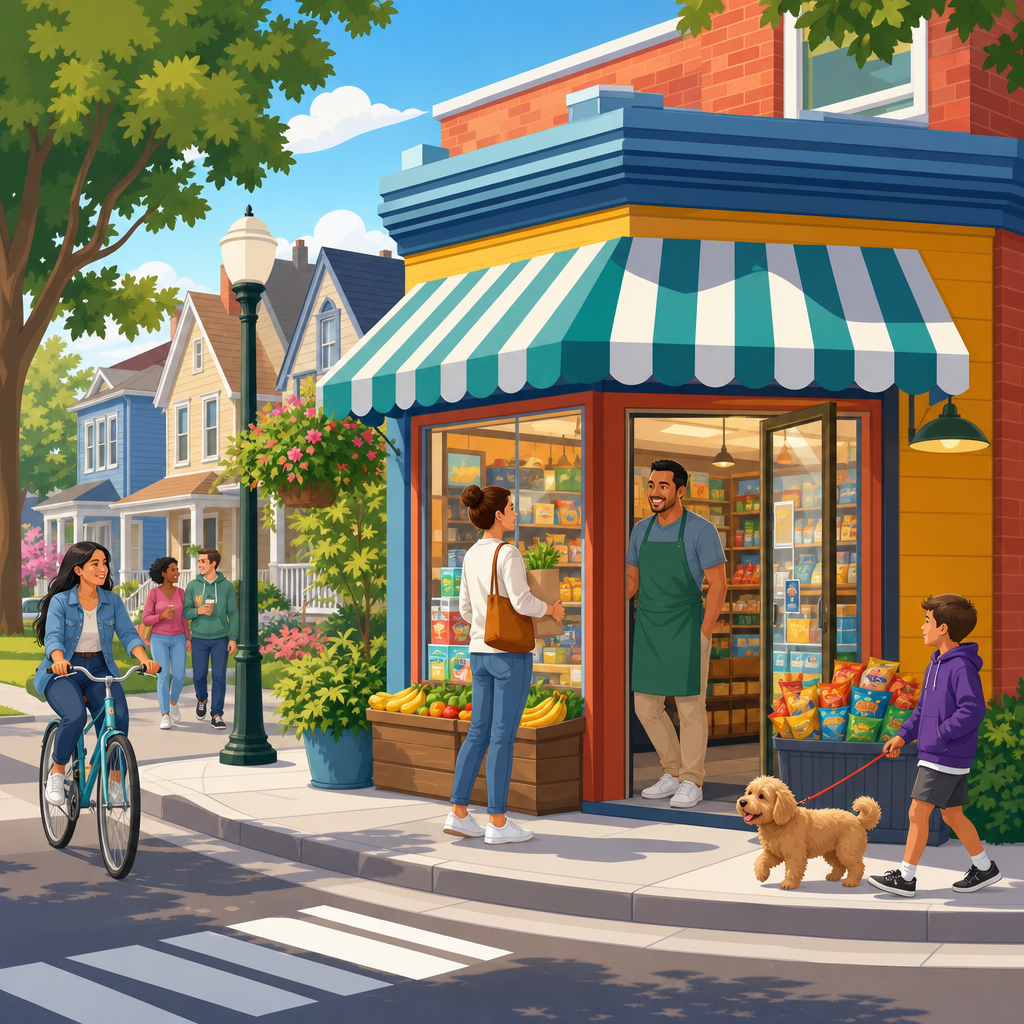
Allowing corner stores in residential neighborhoods is one of the simplest urban planning reforms available to cities that want more walkable streets, stronger local economies, and daily convenience without major public expense. A corner store is a small retail business, usually located on a residential block or at the edge of a neighborhood, that sells everyday items such as milk, bread, fruit, prepared foods, toiletries, and household basics. In planning terms, the debate is really about neighborhood mixed use: whether homes and low-intensity shops can coexist safely and comfortably within the same district. I have worked on zoning updates and neighborhood plans where this issue repeatedly surfaced, and the same pattern appeared every time. Residents often say they want shorter errands, safer sidewalks, and more small businesses, yet existing codes ban the exact building type that delivers those outcomes. That mismatch matters because zoning shapes daily life more than most people realize. It determines whether a parent can walk for cough medicine after dinner, whether an older adult can reach groceries without driving, and whether a vacant house lot can become a useful community-serving business.
The case for allowing corner stores is not nostalgic. It is practical. For most of the twentieth century, many neighborhoods included small grocers, pharmacies, bakeries, and markets embedded among homes. Postwar zoning separated nearly every land use, often requiring retail to cluster only on arterial roads or in shopping centers with parking minimums. That model assumed routine car ownership and abundant road capacity. Today, cities face different conditions: housing shortages, higher transportation costs, aging populations, climate targets, and demand for local entrepreneurship. Reintroducing neighborhood-serving retail addresses several of those pressures at once. It can reduce short car trips, support “15-minute neighborhood” access, and create a modest commercial space for first-time business owners who cannot afford large storefronts. The policy question is not whether every block needs a store. It is whether codes should permit carefully scaled stores where demand exists, subject to rules on size, deliveries, hours, lighting, waste, and noise. When framed that way, the issue becomes less ideological and more about matching regulation to how neighborhoods actually function.
Why corner stores improve everyday access
The strongest argument for allowing corner stores in residential neighborhoods is access to necessities within walking distance. Transportation research consistently shows that many urban car trips are short, often under two miles, and a meaningful share are errands for small purchases. When milk, diapers, coffee, fruit, batteries, or a sandwich are available a few blocks away, residents save time and avoid unnecessary driving. That is especially important for people who do not drive, including teenagers, older adults, lower-income households, and people with disabilities who can walk or roll short distances but cannot easily reach auto-oriented retail corridors. In practice, corner stores do not replace full-service supermarkets. They complement them by covering frequent, small-volume needs between larger shopping trips.
Good access also has a public safety dimension. A neighborhood with destinations creates more consistent pedestrian activity, which improves natural surveillance on the street. Jane Jacobs described this as “eyes on the street,” and the principle remains valid: sidewalks feel safer when people are present for ordinary reasons throughout the day. I have seen this in residential districts where a café, deli, or market near a bus stop turned an empty intersection into a place with routine foot traffic, better lighting, and more passive oversight. Parents stopping for snacks after school and workers picking up food on the way home create a steady stream of users that supports both transit ridership and perceived safety.
Economic benefits for neighborhoods and cities
Corner stores also create disproportionate economic value relative to their size. Because they occupy small footprints, they lower the barrier to entry for independent operators, immigrant entrepreneurs, and family businesses. A 600- to 1,500-square-foot shop can be financially viable where a larger leased space would not be. That matters because small-format retail is often where local business ecosystems begin. Many successful restaurant owners, grocers, and specialty retailers started with a compact neighborhood storefront, learned inventory management and labor scheduling at a manageable scale, and then expanded. From a city perspective, that pattern supports business diversity and local wealth creation rather than concentrating commerce only in large chains and shopping centers.
There is also a property and fiscal benefit. Small commercial nodes can stabilize underused parcels, activate corner lots, and increase the usefulness of existing housing areas without requiring expensive infrastructure extension. A corner store served by existing streets, sidewalks, water lines, and utility connections usually costs the public less than greenfield retail development. For local governments, that means better use of sunk infrastructure. In neighborhoods where vacancies or disinvestment are concerns, a permitted store can provide a productive reuse that adds activity and tax value. The effect is not automatic, and poor store management can weaken support, but well-run neighborhood retail often becomes an anchor that helps adjacent homes retain desirability.
Design, scale, and operating standards matter
Allowing corner stores does not mean allowing any commercial format anywhere. The best policies are specific about form and operations. Most successful neighborhood-store ordinances cap floor area, limit late-night hours, regulate outdoor speakers, require shielded lighting, and control loading. They often permit retail by right only on corner lots or collector streets, while requiring a conditional review in more sensitive locations. These standards matter because the central planning challenge is compatibility. A small market with daytime deliveries and no dedicated parking can fit comfortably on a residential corner; a high-turnover convenience store with heavy truck traffic and alcohol sales may not.
The distinction should be made in code rather than left to ad hoc politics. Cities can define “corner store” based on size, product mix, and expected intensity, then attach performance standards. That gives neighbors predictability and business owners a clear path to approval. In my experience, much of the opposition to mixed use comes from fear of the worst-case scenario. Good regulations narrow the range of outcomes. If rules prohibit drive-throughs, large signs, idling deliveries, and 24-hour operation, most reasonable residents can picture a low-impact shop rather than a noisy gas-station mart. Architecture helps too. Entrances facing the sidewalk, transparent windows, modest signage, screened trash storage, and bicycle parking all strengthen neighborhood fit.
| Policy issue | Poorly designed rule | Better neighborhood-compatible rule |
|---|---|---|
| Store size | No limit on floor area | Cap at 1,500 square feet or similar local threshold |
| Hours | Open all night | Limit hours, such as 7 a.m. to 10 p.m. |
| Deliveries | Unrestricted truck access | Set delivery windows and smaller vehicle requirements |
| Parking | Large off-street minimums | No minimums or very low minimums near homes and transit |
| Operations | Undefined nuisance standards | Clear rules on noise, lighting, trash, and loitering |
Health, food access, and transportation outcomes
Critics sometimes argue that corner stores mainly sell packaged snacks and alcohol. That can happen, but it is not an inherent feature of the building type. Policy design influences inventory. Some cities tie neighborhood-store permits or incentives to healthy food standards, refrigeration grants, or participation in nutrition assistance programs such as SNAP and WIC. Public health departments have successfully partnered with small stores to add produce, dairy, and staple items by helping owners source equipment and connect with wholesalers. The result is more equitable food access without waiting years for a full supermarket project that may never pencil out.
Transportation and climate outcomes are equally important. Short car trips generate emissions, congestion, and curb friction that are rarely discussed because each trip seems trivial. In aggregate, they are not trivial. When a resident can walk five minutes to buy eggs or cold medicine instead of driving ten or fifteen minutes round trip, vehicle miles traveled decline. That reduction will not solve climate goals alone, but it is a practical, cumulative gain produced by land-use reform rather than by asking people to change behavior against the grain of their environment. Neighborhood retail supports walking because it creates reasons to walk. It also pairs well with transit by making the trip to and from a bus stop more useful.
Common objections and how cities can address them
The most common objections to corner stores involve noise, parking spillover, litter, alcohol sales, and the fear that a residential block will become commercialized. These concerns are legitimate and should be answered directly. First, parking impacts are often overstated because neighborhood stores attract many customers on foot from nearby homes. Where streets are already constrained, cities can prohibit new curb cuts, remove parking minimums that force larger paved lots, and manage parking through permits or time limits. Second, litter and loitering are management issues, not arguments against the use itself. Conditions of approval can require trash receptacles, routine cleanup, contact information for complaints, and revocable permits for repeat violations.
Alcohol is a separate issue and should be regulated separately. A city can allow neighborhood grocery retail while restricting or prohibiting package alcohol sales in residential districts. That distinction is important because debates about corner stores are often derailed by concerns tied to one product category rather than the broader value of daily-needs retail. Finally, commercialization fears can be contained through geographic and design limits. Allowing stores only on corners, capping frontage, and requiring residentially scaled façades prevents a chain reaction in which every house on a block becomes a shop. The goal is selective permeability, not a free-for-all.
What effective zoning reform looks like
For cities considering reform, the best approach is to legalize small neighborhood-serving retail in low-density and medium-density residential districts with objective standards. Start with a clear definition of permitted uses: small grocery, bakery, café, pharmacy counter, or general daily-needs market. Exclude auto-oriented uses, bars, and high-impact entertainment. Set a maximum floor area, prohibit drive-throughs, eliminate parking minimums, and require pedestrian-facing design. Add operational standards for hours, deliveries, refuse storage, and mechanical equipment. Where political resistance is high, begin with a pilot overlay near schools, parks, and transit stops, then evaluate complaints, sales performance, and walking rates after one or two years.
Implementation matters as much as the ordinance text. Cities should coordinate licensing, inspections, and small-business support so applicants are not trapped in a maze of departments. Façade improvement grants, healthy food financing, and technical assistance on refrigeration, accounting, and permitting can make the difference between a legal but infeasible use and a thriving local amenity. The most successful cases combine zoning permission with economic development tools. Portland, Minneapolis, and other reform-oriented cities have shown that modest mixed-use allowances can work when rules are understandable and enforcement is consistent. The lesson is straightforward: if a city wants neighborhood convenience, safer walking conditions, and more local enterprise, it must stop zoning those outcomes out of existence.
Allowing corner stores in residential neighborhoods is a practical policy with benefits that reach far beyond shopping convenience. It improves daily access to essentials, supports people who cannot or do not want to drive, strengthens sidewalk activity, and creates a realistic entry point for local entrepreneurs. It also helps cities use existing infrastructure more efficiently and reduce some short vehicle trips without expensive new programs. None of these benefits require abandoning residential character. They require writing better rules. Size caps, delivery limits, design standards, and clear operating conditions can make neighborhood stores compatible with nearby homes while still giving residents the convenience they repeatedly say they want.
The main takeaway is simple: many neighborhoods already have the population, sidewalks, and demand to support a small store, but outdated zoning codes make that impossible. Reforming those codes is not radical. It is a return to a durable pattern of urban development that served communities well before rigid use segregation became standard practice. Cities that legalize carefully scaled corner stores gain more resilient neighborhoods and more choices for residents. If you are reviewing local land-use policy, start by asking a direct question: can someone buy basic necessities within a short walk of home? If the answer is no because the code forbids it, that is where reform should begin.
Frequently Asked Questions
What is a corner store, and why does allowing one in a residential neighborhood matter?
A corner store is a small neighborhood-scale retail business that serves everyday needs close to where people live. It typically sells basic groceries, snacks, drinks, toiletries, household supplies, and sometimes simple prepared foods such as coffee, sandwiches, or soup. The policy question is not really about one specific type of shop. It is about whether cities should continue separating housing from small-scale daily commerce so strictly that even a modest convenience store becomes difficult or illegal to open on a residential block.
Allowing corner stores in residential neighborhoods matters because it brings common errands within walking distance. That changes daily life in practical ways. Residents can pick up milk, bread, fruit, medicine, or paper goods without needing to drive across town. Parents, older adults, teenagers, and people without cars gain more independence. Neighborhoods also become more active throughout the day, with more people walking, greeting one another, and informally watching the street.
From an urban planning standpoint, this is one of the simplest ways to create a more walkable and complete neighborhood without expensive infrastructure projects. A single small store will not replace a supermarket, but it does reduce the number of short car trips for routine purchases. It can also support a local entrepreneur, keep spending closer to home, and make residential areas more convenient and resilient. In that sense, corner stores are less about retail alone and more about restoring a traditional pattern of neighborhood life that many zoning codes gradually removed.
How do corner stores improve walkability and reduce car dependence?
Corner stores improve walkability by placing useful destinations inside the neighborhood itself. People are much more likely to walk when a trip is short, direct, and tied to an immediate need. If a resident can buy eggs, toothpaste, fruit, or a quick meal within a few blocks, that errand becomes a walk instead of a drive. Over time, many of these short trips add up. That matters because a large share of urban driving consists of small, repetitive errands that could be handled on foot if the destination existed nearby.
Walkability is not only about sidewalks or street design. It also depends on having places worth walking to. A quiet residential area with no nearby services may technically have sidewalks, but it still forces people into cars for basic needs. Corner stores help solve that by adding daily-use destinations at a small scale. They make neighborhood streets feel more purposeful and lived-in rather than serving only as corridors for homes and parking.
Reducing car dependence also has social and financial benefits. Households save time and money when fewer trips require fuel, parking, and vehicle wear. Children, seniors, and residents who cannot drive gain access to essentials without having to arrange transportation. For cities, this kind of reform is especially attractive because it can support better transportation outcomes without major public spending. Instead of building expensive new systems to connect people to distant stores, cities can simply allow more daily needs to be met closer to home.
Do corner stores actually help local economies, or do they mainly provide convenience?
They do both. Convenience is the most obvious benefit, but the economic impact is also meaningful. A corner store creates an opportunity for small business ownership in places where zoning may otherwise allow only housing. That can open the door for local entrepreneurs, immigrant business owners, and family-run enterprises that often struggle to find affordable commercial space in larger retail districts. Because corner stores are small, they usually require less capital to start than a full-scale grocery business or restaurant.
These stores also help keep more spending within the neighborhood. When residents can buy routine items close to home, some of that money stays with a nearby business rather than being spent at a distant chain accessible mainly by car. The store owner may hire local workers, purchase from local suppliers, or reinvest in the property and surrounding area. Even modest retail activity can contribute to a stronger neighborhood economy by adding jobs, services, and a more diverse local business base.
There is also a broader economic value in making neighborhoods more attractive and functional. Areas with nearby conveniences are often more desirable because they save residents time and improve quality of life. That does not mean every block should become commercial, but it does mean that carefully allowing small shops can add value beyond the cash register. In many cases, the most important economic argument is not that a corner store will transform a city’s economy by itself, but that it is a low-cost, incremental reform that supports entrepreneurship, neighborhood vitality, and more efficient land use all at once.
What about concerns over noise, traffic, parking, and neighborhood character?
These are the most common objections, and they should be taken seriously, but they are usually manageable through thoughtful rules about scale and operations rather than outright bans. A true corner store is small and neighborhood-serving. It is not a big-box retailer, a late-night entertainment venue, or a destination drawing large regional traffic. When cities allow only modest floor areas, limit delivery intensity, set reasonable hours, and focus on pedestrian-friendly design, the impacts can remain quite compatible with residential surroundings.
In fact, a well-placed corner store can reduce some traffic by cutting down on short car trips that residents would otherwise make to more distant commercial areas. Parking concerns are often overstated because neighborhood stores typically rely heavily on nearby foot traffic. Not every customer needs a parking space if the store exists primarily for local residents. Many successful urban corner stores operate with little or no dedicated parking because their business model depends on convenience, not volume.
As for neighborhood character, much depends on how character is defined. If character means quiet, safety, and livability, a small store can support those goals by bringing more eyes to the street and making daily life easier. If character is understood to mean strictly residential separation with no local commerce at all, then the concern is really about preserving a specific zoning pattern rather than responding to unavoidable harm. Historically, many neighborhoods included corner shops as a normal part of community life. Reintroducing them in a limited, context-sensitive way can actually restore a more traditional neighborhood pattern instead of undermining it.
How can cities allow corner stores without opening the door to inappropriate development?
Cities can do this by writing clear, narrow rules that permit small-scale neighborhood retail while still preventing uses that are too intense for residential settings. The key is to legalize the concept thoughtfully rather than treating all commercial activity as the same. Zoning codes can define a corner store by size, product type, building form, and operating conditions. For example, a city might allow only small shops under a certain square footage, require them to fit within residential-scale buildings, and prohibit drive-throughs, large parking lots, heavy truck deliveries, or uses with significant late-night activity.
Location standards can help too. Cities may choose to allow these stores on corner lots, along neighborhood edges, on existing collector streets, or in buildings that already have a mixed-use history. Design requirements can ensure that storefronts face the sidewalk, signs remain modest, lighting is appropriately shielded, and outdoor activity is limited to a scale that suits the block. Operational standards, such as reasonable business hours and waste management rules, can address quality-of-life concerns directly.
Perhaps most importantly, cities should avoid making approval so difficult that only large, well-funded projects can navigate the process. If corner stores are technically allowed but require lengthy hearings, expensive studies, or discretionary approvals for every proposal, the reform will not produce much real change. A better approach is simple by-right permission with clear standards. That gives neighbors predictability, gives entrepreneurs a realistic path to opening a business, and allows cities to support walkable neighborhoods through an incremental, practical reform rather than a complicated special exception process.


