
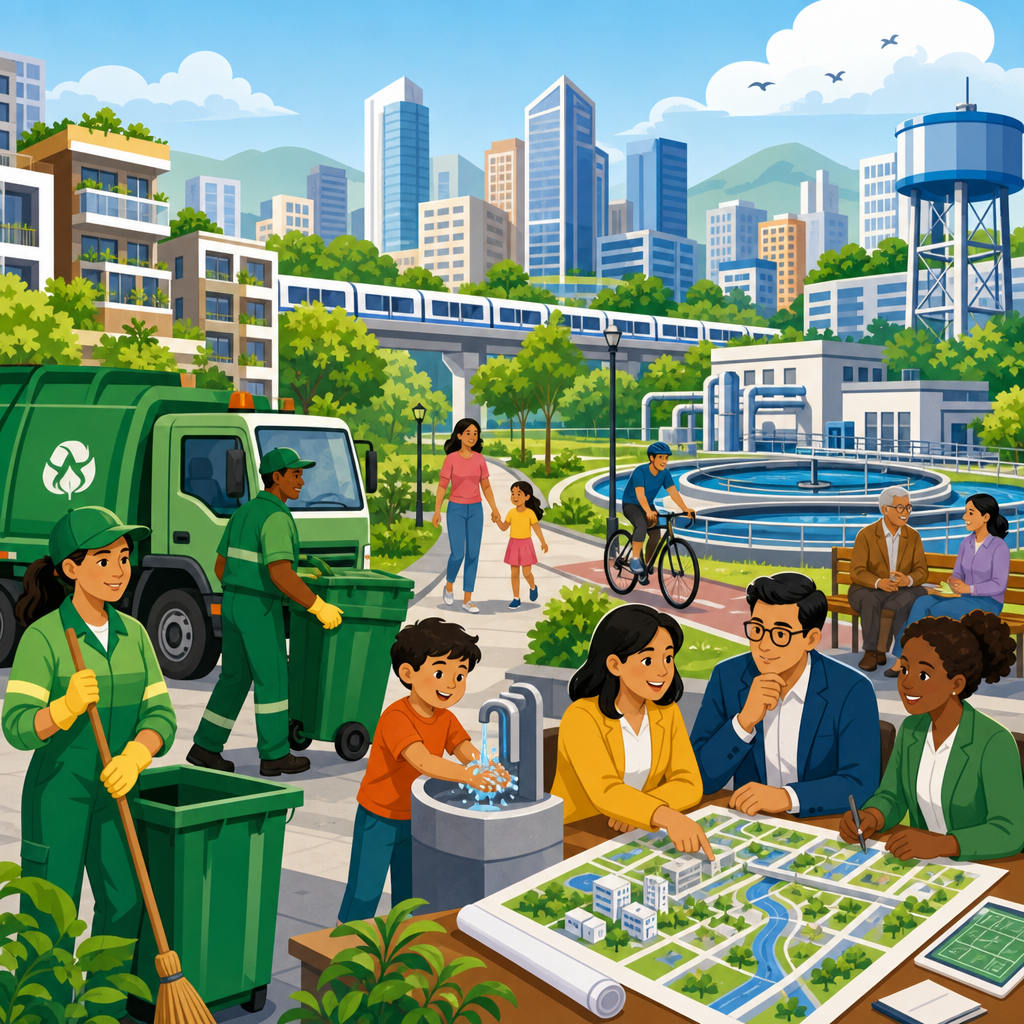
Sanitation, public health, and modern planning institutions grew together because cities could not survive industrialization without organized systems for water, waste, streets, and housing oversight. In urban planning, sanitation means the infrastructure and regulations that remove human waste, control drainage, protect water supplies, and reduce exposure to disease. Public health refers to the organized effort to prevent illness across whole populations rather than treating one patient at a time. Modern planning institutions are the public bodies, legal powers, technical departments, and professional practices that coordinate land use, infrastructure, environmental control, and urban growth. These ideas matter because the city itself became a health technology: sewers, building codes, street widths, zoning, parks, and inspection systems all emerged partly to prevent epidemics and stabilize urban life. I have worked through historic plans, sanitary reports, and contemporary infrastructure programs, and the pattern is unmistakable. Major planning institutions did not begin with abstract design theory alone. They were built in response to cholera outbreaks, polluted wells, overcrowded tenements, open drains, unmanaged burial grounds, and factories discharging waste beside homes. The history of urban planning is therefore not only a story of streets and land values. It is also a story of microbes, mortality statistics, and governments learning that health required spatial action. Understanding that connection helps explain why planning departments still regulate drainage, environmental hazards, density, housing quality, transportation access, and resilience today.
Why sanitation became the foundation of city governance
Before the nineteenth century, many towns handled waste through cesspits, privies, night soil collection, and informal drainage. Those systems could function at low densities, but industrial cities changed the scale of risk. As populations surged in London, Paris, New York, Manchester, Hamburg, Bombay, and other ports and manufacturing centers, water sources became contaminated and streets filled with refuse, animal waste, and stagnant runoff. Mortality was not evenly distributed. Overcrowded working-class districts with poor ventilation, limited drainage, and shared latrines suffered the highest burden from diarrheal disease, typhus, tuberculosis, and repeated cholera epidemics. City leaders gradually recognized that disease was not simply an individual problem caused by personal behavior. It was embedded in the physical arrangement of neighborhoods and services.
Cholera was especially important because its explosive outbreaks forced administrative change. In 1832, 1848, 1854, and 1866, cholera exposed the weakness of fragmented local authority in Britain. Similar episodes elsewhere pushed municipal reform. At first, many officials still believed in miasma theory, the idea that foul air spread disease. Even when the mechanism was misunderstood, the practical response often improved cities: clearing refuse, widening streets, draining low land, and moving waste away from homes reduced exposure. Later, germ theory clarified why source protection and sewage treatment mattered, but institutions had already begun forming around inspection, engineering, and regulation. In practice, planning and public health developed through this layered transition from environmental suspicion to microbial science.
The key shift was administrative. Sanitation required taxation, mapping, standards, enforcement, and long-term capital works. No household could build a citywide sewer interceptor or protect an upstream watershed alone. Municipal boards of health, water authorities, drainage commissions, and public works departments emerged because collective risk demanded collective action. These bodies established recurring practices that remain central to planning: surveying land, recording deaths by district, issuing permits, setting minimum standards, coordinating infrastructure, and justifying intervention through evidence. Once governments accepted responsibility for urban health, they also gained a durable rationale for reshaping streets, housing, and land use.
From epidemics to institutions: the nineteenth-century turning point
Several nineteenth-century reforms show how health crises produced modern planning capacity. In Britain, Edwin Chadwick’s 1842 Report on the Sanitary Condition of the Labouring Population assembled data linking poverty, bad drainage, overcrowding, and premature death. Chadwick was not right about every medical mechanism, but his administrative logic was transformative. He argued that preventive infrastructure was cheaper and more humane than allowing disease to spread. That reasoning supported the Public Health Act of 1848, which created a General Board of Health and enabled local boards to build drains, regulate nuisances, and improve water supply. The act did not solve urban disease immediately, yet it established the principle that central government could push local sanitation reform.
London’s response to the Great Stink of 1858 and repeated cholera waves remains one of the clearest examples of sanitation driving planning institutions. Joseph Bazalgette, chief engineer of the Metropolitan Board of Works, designed an integrated sewer network with intercepting sewers, pumping stations, and embankments. This was not just an engineering feat. It required metropolitan-scale governance, financing, rights-of-way, and coordinated execution across jurisdictions. The project reduced sewage discharge into central urban reaches of the Thames and helped reorganize the relationship between engineering and city management. Similar processes occurred in Paris under Baron Haussmann and engineer Eugène Belgrand, where sewer expansion, boulevards, aqueducts, and street improvements were tied to administrative centralization.
In the United States, the sanitary idea shaped both health departments and city planning. New York’s Metropolitan Board of Health, established in 1866, gained powers to inspect tenements, address nuisances, and collect health data. The Tenement House Acts later linked housing standards to urban governance, requiring ventilation, fire safety features, and sanitation improvements. Boston, Philadelphia, and Chicago followed with sewer expansion, water filtration, and street regulation. By the early twentieth century, the city planning movement inherited a framework already tested by sanitary reformers: diagnose urban problems spatially, gather statistics, standardize interventions, and treat infrastructure as a public obligation rather than a private convenience.
The tools that turned sanitation into planning practice
Modern planning institutions were built through a set of practical tools, many of which originated in sanitary administration. Mapping was foundational. John Snow’s 1854 cholera map around the Broad Street pump is famous because it showed how spatial analysis could identify a disease source. Just as important were routine mortality maps, nuisance registers, cadastral surveys, and engineering plans. Once a city could map wells, drains, burial grounds, slaughterhouses, and overcrowded blocks, it could prioritize interventions and justify budgets. Today’s geographic information systems continue that lineage, integrating sewer capacity, flood risk, heat exposure, and health vulnerability in one decision environment.
Inspection was another durable tool. Early public health inspectors checked privies, cellars, lodging houses, water storage, and waste disposal practices. Their reports translated household conditions into governable categories. Over time, inspection expanded into building departments, environmental agencies, housing authorities, and planning code enforcement. Standards followed inspection. Minimum lot sizes, setbacks, light courts, ventilation requirements, pavement specifications, drainage gradients, and waste collection schedules all represented the same institutional impulse: convert recurring urban hazards into enforceable rules. That is a defining feature of planning institutions today.
Finance and engineering capacity mattered just as much as rules. Sewer systems, waterworks, filtration plants, pumping stations, and treatment facilities require high capital expenditure and long asset lives. Cities therefore developed bond financing, rate structures, special assessment districts, and public utility models. Professional engineering offices became permanent parts of municipal government. Planning institutions later broadened beyond sanitation, but they retained this capital-program mindset. Comprehensive plans, capital improvement plans, stormwater utilities, and asset management systems all descend from the era when cities learned to manage pipes, grades, and treatment processes at metropolitan scale.
| Sanitary challenge | Institutional response | Lasting planning legacy |
|---|---|---|
| Contaminated drinking water | Municipal water authorities, source protection, filtration | Regional infrastructure governance and watershed planning |
| Open sewage and poor drainage | Sewer departments, drainage boards, public works finance | Capital planning, utility coordination, stormwater management |
| Overcrowded unsafe housing | Tenement laws, housing inspection, occupancy standards | Building codes, housing regulation, health-based land-use control |
| Industrial smoke and waste | Nuisance law, smoke abatement offices, zoning controls | Environmental review and separation of incompatible uses |
| Unequal disease burden by neighborhood | Health surveillance, district-level reporting, targeted works | Data-driven planning and equity analysis |
Housing, zoning, and environmental regulation as health measures
Planning institutions expanded when officials realized that sewers alone could not solve urban health problems. Housing form mattered. Dark interior rooms, damp basements, shared yards, and absent ventilation contributed to respiratory illness and infectious spread. Reformers therefore pushed housing codes that specified window area, courtyard dimensions, occupancy limits, and access to toilets and water. These rules were often imperfect and sometimes paternalistic, but they established a health basis for regulating the built environment. In practice, many of the first sustained intrusions into private property were justified not by aesthetics but by sanitation and safety.
Zoning also has a public health lineage. Early zoning ordinances in places such as New York, Los Angeles, and other rapidly growing cities were shaped by concerns about smoke, noise, overcrowding, and incompatible land uses. Euclidean zoning later became associated with use segregation and automobile-oriented growth, and that legacy deserves criticism. Yet its initial appeal rested partly on health protection: separating residences from noxious industry, preserving light and air, and controlling densities where services were inadequate. Courts often accepted planning powers because they could be tied to the police power to protect health, safety, and welfare.
Environmental regulation deepened this connection in the twentieth century. The sanitary city evolved into the environmental city as officials addressed air pollution, solid waste disposal, hazardous industry, and water quality at larger scales. In the United States, the Clean Water Act of 1972 and Safe Drinking Water Act of 1974 formalized standards that reshaped planning, engineering, and local compliance. Wastewater treatment upgrades, combined sewer overflow controls, source water protection, and permitting systems required coordination between planners, utility managers, public health agencies, and environmental regulators. Similar frameworks developed globally through ministries of health, environmental protection agencies, and metropolitan utilities.
What this history means for contemporary urban planning and policy
The relationship between sanitation and planning is not historical residue; it is a live operating principle. Fast-growing cities still face familiar problems in altered forms: informal settlements without sewer connections, failing septic systems at the urban edge, lead service lines, stormwater flooding, heat islands, and unequal exposure to pollution. When I review current infrastructure plans, the strongest ones treat public health as a measurable planning outcome rather than a side benefit. They connect land use to utility capacity, transportation to air quality, parks to heat mitigation, and housing quality to chronic disease prevention. This integrated approach is exactly what modern planning institutions were created to do.
Climate change has made the sanitation-health-planning nexus even more important. Intense rainfall overwhelms legacy combined sewers, causing basement backups and sewage overflows into rivers. Drought reduces dilution capacity and stresses water supply systems. Sea level rise threatens treatment plants, pump stations, and low-lying septic areas. Extreme heat worsens ozone formation and indoor health risks in substandard housing. The planning response cannot be isolated within one department. Cities need watershed-based stormwater management, green infrastructure, capital resilience planning, floodplain regulation, and public health surveillance that identifies who is most vulnerable before disaster strikes.
Equity is the defining modern test. Sanitary reform improved average urban health, but benefits were often distributed unevenly. Wealthier districts typically received infrastructure first, while marginalized communities endured industrial exposure, underinvestment, and aggressive clearance policies. Contemporary planning institutions have better tools and clearer obligations. They can use disaggregated health data, environmental justice screening, affordability analysis, and participatory budgeting to direct improvements where need is greatest. The core lesson from the sanitary era is not simply that infrastructure matters. It is that institutions matter because they determine whose risks are counted, whose neighborhoods are mapped, and whose health is protected.
Sanitation, public health, and modern planning institutions are inseparable because cities became governable by treating health risks as spatial problems that required collective solutions. The progression ran from cesspits and epidemics to boards of health, sewer authorities, housing codes, zoning powers, environmental regulation, and integrated capital planning. Historic reforms in London, Paris, New York, and other industrial cities showed that infrastructure and governance had to evolve together. Mapping, inspection, engineering, finance, and enforceable standards created the durable machinery of urban planning. That machinery still shapes how cities manage water, housing, land use, pollution, resilience, and equity.
The main benefit of understanding this history is practical clarity. Planning is not just about urban form or development control. At its strongest, it is a public health discipline expressed through streets, pipes, parcels, buildings, and institutions. That perspective helps policymakers make better decisions about sewer upgrades, housing standards, flood mitigation, industrial siting, and neighborhood investment. It also helps readers see why local planning debates are rarely narrow technical matters; they affect disease exposure, life expectancy, safety, and daily dignity.
Use this hub as a starting point for deeper study across urban planning and policy. Follow the connected topics on housing, infrastructure, zoning, environmental regulation, and governance, and evaluate every planning question with one test in mind: will this decision make urban life healthier, safer, and more resilient for everyone?
Frequently Asked Questions
What is the connection between sanitation, public health, and the rise of modern planning institutions?
The connection is foundational. As cities industrialized and populations grew rapidly, older informal systems for water supply, waste disposal, drainage, and street maintenance stopped working at scale. Overcrowded neighborhoods, polluted wells, open sewers, and unmanaged refuse created conditions where disease could spread quickly through entire urban populations. Public health emerged as the organized effort to prevent that kind of widespread illness, while planning institutions developed as the bodies capable of coordinating land use, infrastructure, housing oversight, and urban services across whole cities.
In practice, sanitation and public health made modern planning necessary. It was not enough to rely on private households or scattered local customs to manage wastewater, stormwater, clean drinking water, and street conditions. Cities needed maps, standards, inspections, engineering departments, building regulations, and administrative authority. Planning institutions helped turn health concerns into long-term urban policy by deciding where pipes would go, how neighborhoods would be laid out, what housing conditions would be allowed, and how growth would be managed.
This is why the history of planning is closely tied to disease prevention. Modern planning institutions did not arise only to beautify cities or organize traffic; they also emerged to reduce cholera, typhoid, tuberculosis, and other illnesses linked to overcrowding, contaminated water, poor ventilation, and inadequate waste systems. In that sense, sanitation and public health were not side issues in urban planning—they were among its core original purposes.
Why did industrial cities need organized sanitation systems instead of relying on private or informal solutions?
Industrial cities needed organized sanitation systems because the scale and density of urban life changed faster than traditional systems could adapt. In smaller settlements, households might draw water locally, dispose of waste in relatively simple ways, and depend on open land, low density, or slow growth to absorb mistakes. In industrial cities, however, thousands or millions of people lived close together, often near factories, polluted waterways, and overcrowded housing. Under those conditions, one household’s waste could quickly become an entire district’s health problem.
Private or informal solutions also failed because sanitation works as a network, not just as an individual service. Clean water depends on protecting the source, treating the supply, and maintaining distribution systems. Waste removal depends on sewers, drainage design, collection systems, treatment capacity, and rules about where and how disposal occurs. Streets need grading, paving, and maintenance to prevent standing water and facilitate cleaning. Housing conditions affect ventilation, crowding, and exposure to contamination. None of these can be managed effectively by isolated actors working without coordination.
Another reason is that disease does not respect property lines. If one landlord neglects drainage, if one factory pollutes water, or if one neighborhood lacks sewer access, the resulting health risks can spread widely. That reality pushed cities toward collective systems backed by regulation, taxation, and public administration. Organized sanitation became a public responsibility because urban health depended on shared infrastructure and enforceable standards, not simply on personal choice or market provision.
How did sanitation reforms influence the structure and authority of planning institutions?
Sanitation reforms expanded both the structure and the authority of planning institutions by showing that urban health required coordinated intervention across many parts of city life. Once officials understood that disease was linked to drainage, water contamination, street layout, overcrowding, and building conditions, city governments needed institutions that could act systematically rather than react case by case. That led to stronger municipal departments, health boards, engineering offices, inspection systems, and eventually formal planning agencies with broader oversight powers.
These institutions gained authority because sanitation problems could not be solved through narrow technical fixes alone. A sewer line, for example, is not just an engineering project; it depends on street alignments, development patterns, topography, property access, public finance, and long-term growth management. Likewise, improving health conditions in housing required rules about lot coverage, setbacks, light, air, occupancy, and building materials. Planning institutions became the place where these issues could be connected and managed over time.
Sanitation reforms also encouraged the use of data and administrative tools that remain central to planning today. Cities began collecting mortality statistics, mapping disease outbreaks, surveying slums, inspecting tenements, and documenting infrastructure conditions. Those practices helped justify public action and made urban governance more evidence-based. Over time, that strengthened the legitimacy of planning institutions by demonstrating that the physical design and regulation of cities had direct consequences for population health, economic stability, and social order.
What kinds of urban planning measures were used to improve sanitation and public health?
A wide range of planning measures were used, and they extended far beyond simply building sewers. Cities invested in protected water supplies, filtration systems, sewer networks, storm drainage, paved streets, waste collection, and treatment facilities to reduce direct exposure to contamination. These were some of the most visible and expensive improvements, but they were only part of the larger public health planning framework.
Housing regulation was another major tool. Reformers and planning officials pushed for standards related to ventilation, window access, occupancy limits, fire safety, lot density, and sanitation facilities within or near dwellings. These measures were especially important in overcrowded working-class districts, where poor building conditions could amplify the spread of disease. In many places, tenement laws and housing inspections became as important to public health as sewer construction.
Street planning and land-use control also played important roles. Better street layouts improved drainage, circulation, access for cleaning, and the routing of infrastructure. Zoning and other land-use controls were later used to separate especially noxious industrial activities from residential areas, protect water sources, and guide urban expansion in more manageable ways. Parks and open spaces were often promoted as health assets as well, partly for fresh air, recreation, and relief from dense built-up conditions. Taken together, these measures show that public health planning was never just about disease treatment; it was about reshaping the urban environment to make healthier life possible on a citywide scale.
Why does this history still matter for urban planning today?
This history matters because it explains why planning is fundamentally tied to health, infrastructure, and public welfare rather than being limited to aesthetics or real estate management. Many of the most important planning responsibilities today—water resilience, sewer capacity, stormwater control, housing quality, environmental justice, street design, and emergency preparedness—are direct descendants of earlier efforts to protect urban populations from preventable harm. The basic lesson remains the same: cities function well only when their physical systems are designed and governed collectively.
It also matters because current health challenges still reflect unequal access to safe and well-maintained urban environments. Flooding, aging water systems, inadequate sanitation, overcrowded housing, heat vulnerability, and pollution burdens often fall hardest on lower-income communities. Looking back at the rise of sanitation and public health institutions helps clarify that these are not purely technical issues; they are planning issues shaped by political decisions, institutional capacity, and investment priorities.
Finally, this history reminds planners and policymakers that prevention is often more effective and more just than crisis response. Modern planning institutions grew because cities learned, sometimes painfully, that waiting for disease outbreaks or infrastructure collapse was costly in human and economic terms. That insight still applies. Whether the challenge is wastewater management, climate adaptation, housing standards, or neighborhood environmental conditions, the long-term role of planning is to build systems that protect population health before emergencies occur.


