
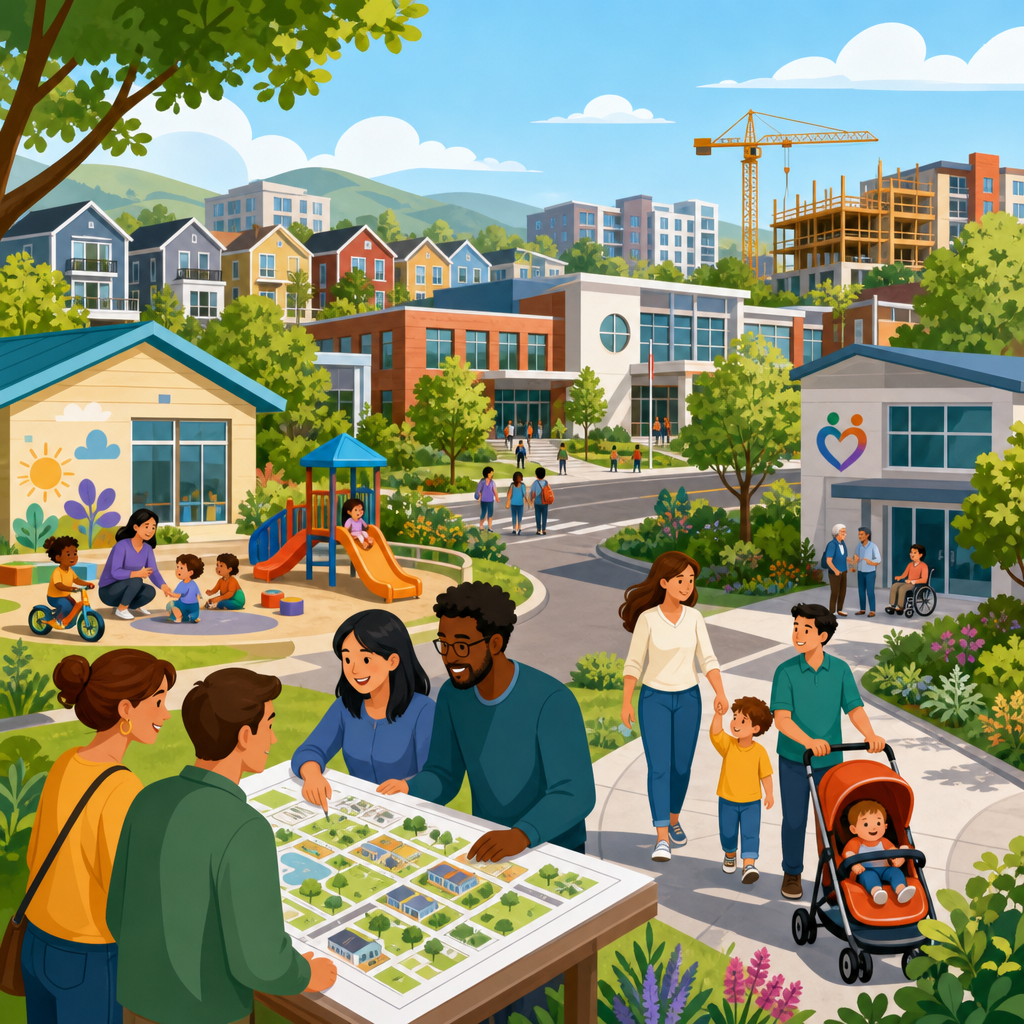
Planning for child care, schools, and social infrastructure in new neighborhoods determines whether growth feels livable or chaotic. When a housing project opens before families can access early learning, classrooms, parks, clinics, libraries, and safe walking routes, the result is predictable: long commutes, overcrowded services, stressed parents, and weaker community ties. In urban planning, social infrastructure means the public and community-serving facilities that support daily life and human development. It includes child care centers, K-12 schools, playgrounds, health services, recreation spaces, community halls, transit access, and the streetscape that connects them. These assets are not secondary amenities added after construction; they are core systems that shape inclusion, public health, educational outcomes, and neighborhood trust.
I have worked on growth area planning where the pressure to deliver housing quickly was intense, and one lesson is constant: if planners do not reserve land, align capital budgets, and phase delivery early, social deficits become expensive and politically difficult to fix. Families adapt in the short term, but the city pays later through emergency modular classrooms, transport strain, inequitable access, and reduced confidence in new development. This matters even more in greenfield communities and large infill districts where population can arrive faster than public agencies can design, fund, and build facilities. Good planning therefore starts with realistic demographic forecasting, service standards, cross-agency coordination, and development agreements that tie growth to community needs. The goal is simple to state but hard to execute: every new neighborhood should open with a credible pathway to care, learning, social connection, and healthy daily routines.
The challenge is that demand is dynamic. A neighborhood may attract more young families than a model predicted, or age faster if housing types skew smaller, pricier, or investor-owned. School enrollment can spike, then stabilize. Child care demand can remain high even after school capacity catches up because workforce patterns and affordability pressures change family choices. Social infrastructure planning must therefore be both precise and flexible. It needs land reservations, adaptable building forms, temporary solutions where justified, and monitoring that continues after occupancy begins. The sections below explain how to plan child care, schools, and social infrastructure in new neighborhoods in a way that is practical, evidence-based, and resilient.
Start with population forecasting and household mix
The first question in planning for child care and schools is not how many buildings to provide. It is who will live here, when they will arrive, and how their needs will change over time. Reliable forecasts use dwelling yield, bedroom mix, tenure, affordability profile, migration patterns, and local birth rates rather than simple population-per-unit averages. In practice, a neighborhood of 2,000 apartments near a rail station may generate fewer elementary students than 2,000 townhouses on peripheral land, but it may still create heavy demand for infant and toddler care if many households are dual-income and space constrained.
Planners usually model population in phases because timing matters as much as totals. If 3,000 residents move in during the first two years, a school opening in year six is effectively late even if final capacity looks adequate on paper. I have seen this mismatch force parents into daily cross-city trips, which in turn increased peak-hour traffic and reduced confidence in the project. Good forecasts therefore identify peak family formation years, likely enrollment bulges, and service catchments beyond the site boundary. They also test scenarios: higher fertility, lower household size, delayed build-out, and tenure shifts from ownership to rental. Scenario testing is not a theoretical exercise; it helps agencies decide whether to reserve one school site or two, whether a child care center should open early, and whether a community building should be designed for later conversion or expansion.
Household mix is especially important. Studio and one-bedroom units rarely generate school enrollments at the same rate as three-bedroom homes, yet family-sized apartments increasingly house children in expensive cities. That means planners cannot rely on outdated assumptions that dense housing equals low family demand. The better approach is to pair unit mix data with local evidence from comparable districts and update assumptions every year as leasing and sales patterns emerge.
Plan child care as essential infrastructure, not retail filler
Child care is often treated as a ground-floor commercial use that the market will sort out later. That approach fails because early learning provision depends on licensing rules, outdoor play requirements, staffing ratios, accessibility, and operating economics that ordinary retail shells rarely satisfy. A viable center needs the right floor plate, safe drop-off conditions, kitchen and washroom layouts, acoustic separation, secure entry, and dedicated outdoor space or approved alternatives. In many jurisdictions, infant rooms require stricter staffing and spatial standards than preschool rooms, which affects both design and financial feasibility.
Demand planning should separate age groups because infant, toddler, and preschool needs differ. Families usually feel shortages most acutely for children under three, where staff ratios are tighter and costs are higher. In new neighborhoods, an early child care center can reduce household transport burdens immediately, support labor force participation, and create a daily social node that helps residents build networks. I have found that centers co-located with parks, schools, libraries, or community hubs perform better than isolated sites because parents can chain trips and operators gain visibility and shared amenities.
Affordability matters as much as supply. A neighborhood can technically have enough licensed places and still be underserved if fees are unaffordable or operating hours do not match local work patterns. Development approvals can help by requiring suitable premises, subsidized lease terms in civic buildings, or contributions toward nonprofit provision. Public agencies should also map nearby existing centers because some demand can be absorbed across catchments if walking, cycling, and transit links are strong. The key principle is clear: child care should be planned early, spatially embedded, and matched to licensing and operator realities.
Align school planning with land reservation, phasing, and access
School planning succeeds when education agencies are involved before subdivision lines harden and land values escalate. The most important action is timely site reservation. Once a neighborhood fills in, acquiring a large, well-located school parcel becomes expensive and politically contentious. School sites should be central enough to support walking and cycling, yet large enough for play space, bus access where needed, and future expansion. Shape matters too. Awkward leftover parcels from road design or stormwater corridors rarely function well for modern campuses.
Phasing is the next issue. Elementary schools typically need to open earlier than secondary schools because young children benefit most from proximity and because family cohorts appear quickly in new subdivisions. Temporary accommodation can bridge gaps, but it should not become the default strategy. Portable classrooms are useful for short-term enrollment volatility, not for replacing proper planning. A better model is staged delivery: reserve the full site, build core facilities early, and expand as enrollment rises. This reduces up-front capital pressure while preserving long-term functionality.
Safe access cannot be an afterthought. A school surrounded by wide arterials, incomplete sidewalks, or chaotic drop-off loops will push families back into cars. School travel planning should include protected crossings, traffic calming, bike storage, shade, lighting, and separation between pedestrians and service vehicles. These details sound small, but they determine whether a school genuinely serves as neighborhood infrastructure or simply sits inside it. Where possible, shared use agreements with parks and recreation departments can increase field capacity and improve public value, provided maintenance, scheduling, and security are clearly defined.
Use integrated social infrastructure networks instead of isolated facilities
Strong neighborhoods are built from networks, not stand-alone buildings. A school next to a library, community center, health clinic, sports field, and transit stop creates more value than each facility would create alone. Shared parking can reduce paved area. Joint foyers and multipurpose rooms can host after-school programs, immunization clinics, language classes, and local events. Parents can complete several tasks in one trip. Older residents gain reasons to visit the district during the day, which increases passive surveillance and social mixing.
Integrated hubs also improve resilience. If enrollment fluctuates, extra rooms may host community programs. If a child care operator expands, nearby public space and community facilities can absorb related demand. During emergencies, civic hubs can act as cooling centers, information points, or relief distribution sites. In projects I have reviewed, the most successful hubs were located on high-visibility corners, connected to transit, and designed with flexible rooms, durable materials, and clear management agreements from the start.
| Infrastructure type | Primary planning question | Best location pattern | Common mistake |
|---|---|---|---|
| Child care center | Are age-specific licensing needs and outdoor play space met? | Near parks, schools, and daily services | Using an unsuitable retail shell |
| Elementary school | Can most children walk safely within the catchment? | Central site with expandable layout | Delaying land reservation |
| Community hub | Can multiple services share space and operating costs? | Transit-served civic cluster | Overbuilding single-purpose rooms |
| Parks and play space | Do all homes have close access to usable open space? | Distributed network linked by safe streets | Counting leftover land as recreation |
The network approach also supports internal linking within policy and implementation systems because each asset can reinforce another. A school travel plan relates to street design standards. A child care center relates to mixed-use zoning. A park relates to stormwater design and heat mitigation. When agencies plan these connections intentionally, neighborhoods function better and budgets go further.
Design for equity, inclusion, and changing family needs
Equity in social infrastructure planning means more than geographic distribution. It means recognizing who faces the highest barriers and designing services, spaces, and governance accordingly. Families with low incomes, single parents, caregivers with disabilities, shift workers, migrants, and multigenerational households often experience the sharpest gaps in new neighborhoods. If the only child care option is expensive and car-dependent, or if school enrollment requires digital literacy and local documentation that newcomers lack, formal provision exists but practical access does not.
Inclusive planning addresses these barriers directly. Universal design should shape paths, entries, toilets, classrooms, and play spaces. Multilingual signage and enrollment support improve uptake. Community rooms can host parenting groups, legal aid clinics, and settlement services. Public spaces should include seating, shade, drinking water, and toilets because caregivers with young children need them daily. Teenagers also need attention. New neighborhoods frequently plan play areas for small children but underprovide youth spaces, leading to conflict in plazas and commercial forecourts. Courts, rehearsal rooms, study areas, and supervised recreation can make a measurable difference in belonging and safety.
Cultural fit matters too. In some communities, intergenerational programming and faith-linked social services are central to neighborhood life. In others, outdoor communal gathering is a stronger driver than indoor programming. Good planners consult early and repeatedly, then translate what they hear into briefs, budgets, and operating models. Equity is not achieved by adding a sentence to a strategy document. It is achieved when people with different needs can actually use the neighborhood with dignity.
Fund, govern, and monitor delivery over time
Even excellent plans fail without funding, governance, and accountability. Social infrastructure in new neighborhoods is usually delivered through a mix of public capital budgets, development charges or impact fees, land dedications, negotiated agreements, school board investment, nonprofit partnerships, and sometimes employer or institutional contributions. Each source has rules, timing constraints, and political risks. The planner’s job is to map those constraints early and build a delivery schedule that matches occupancy phases. If a child care center depends on a grant program that has not opened, that risk should be visible to decision-makers before approvals are finalized.
Governance is equally important. Someone must own the land, someone must operate the service, and someone must coordinate data as the neighborhood matures. Clear responsibility prevents the common problem of every agency assuming another will fill the gap. Monitoring should track occupancy, births, waiting lists, school enrollment, mode share for school trips, facility utilization, and access gaps for protected groups. Dashboards are useful only if they trigger action, such as releasing a reserved site, funding modular expansion, or adjusting community space programming.
Tradeoffs should be acknowledged honestly. Full early delivery can be financially difficult in slower markets. Shared facilities can reduce cost but create scheduling conflicts. Temporary solutions can bridge demand but may lower perceived service quality if they persist too long. The answer is not perfection on day one. It is a transparent, sequenced plan with committed land, realistic triggers, and regular review. For urban planning and policy teams, that discipline is what turns a promising master plan into a neighborhood where families can actually thrive.
Planning for child care, schools, and social infrastructure in new neighborhoods is ultimately about sequencing growth with everyday life. Housing numbers alone do not create complete communities. Families need licensed care they can reach, schools on reserved and well-connected sites, parks that are usable, and community facilities that support health, learning, and belonging. The strongest plans begin with detailed demographic forecasting, test multiple scenarios, and treat service timing as seriously as service quantity. They also recognize that integrated hubs, safe walking routes, and flexible civic buildings create benefits that isolated facilities cannot.
The central lesson from practice is straightforward: reserve land early, coordinate agencies early, and monitor demand continuously after residents move in. That approach lowers long-term costs, reduces inequity, and improves public trust in new development. It also gives policymakers a clearer basis for developer contributions, capital planning, and operational partnerships. When social infrastructure is embedded from the start, a new neighborhood is more likely to function as a community rather than a collection of housing units.
If you are shaping a new district, reviewing a master plan, or updating urban planning and policy frameworks, audit the child care, school, and social infrastructure strategy now. Check the forecasts, the land reservations, the funding triggers, and the access plan. Small corrections made early are far cheaper than retrofits after families arrive.
Frequently Asked Questions
Why is it so important to plan child care, schools, and social infrastructure at the same time as new housing?
Because neighborhoods do not function well when homes arrive years before essential services do. Families need more than a place to live; they need child care, schools, parks, health services, libraries, community spaces, and safe streets that support daily routines. If these services are missing or delayed, parents often face long travel times to reach early learning centers or schools, children lose easy access to local opportunities, and public systems become strained as nearby districts and facilities absorb growth they were not designed for. That mismatch can quickly make a new development feel inconvenient and fragmented rather than stable and welcoming.
Planning social infrastructure alongside housing also helps local governments and developers make smarter long-term decisions. It allows planners to estimate how many children are likely to live in the area, what age groups will need support first, where safe walking and cycling routes are needed, and how public land should be reserved for future facilities. In practical terms, this means fewer emergency fixes later, lower pressure on neighboring communities, and a better chance of creating a neighborhood where families can settle and build routines early. When child care, schools, and community-serving amenities are treated as core infrastructure rather than afterthoughts, growth is far more likely to feel livable, connected, and resilient.
What does “social infrastructure” include in a new neighborhood?
Social infrastructure refers to the public, nonprofit, and community-serving facilities that support everyday life and help residents thrive. In a new neighborhood, this typically includes child care centers, preschools, primary and secondary schools, playgrounds, parks, libraries, clinics, maternal and child health services, recreation centers, youth spaces, senior services, community halls, public transit access, and safe walking and cycling connections. It can also include spaces for after-school care, family support programs, cultural activities, and informal gathering, all of which help strengthen community ties and reduce isolation.
What matters most is not just the presence of individual facilities, but how they work together as a system. A school without safe crossings, a park without shade or toilets, or housing without nearby family health services can still leave residents underserved. Strong social infrastructure is accessible, distributed sensibly, and designed around how people actually live day to day. For families with young children, this often means short travel distances, flexible service hours, affordable options, inclusive design, and facilities that can adapt as the neighborhood grows. In well-planned communities, social infrastructure is not seen as a bonus amenity; it is a basic foundation for health, education, social connection, and long-term neighborhood stability.
How do planners estimate how many child care places and school seats a new neighborhood will need?
Planners usually begin with population forecasts tied to the number, type, and timing of new homes. Different housing forms tend to attract different household structures, so a neighborhood with many family-sized apartments, townhouses, or detached homes may generate more demand for child care and school places than one dominated by smaller units. Analysts look at demographic trends, birth rates, household sizes, likely age distributions, and the pace of occupancy to estimate how many infants, preschoolers, and school-aged children may live in the area over time. They also review existing service capacity in surrounding districts to understand whether nearby providers and schools can absorb any part of the demand.
Good forecasting does not rely on a single number. It uses staged scenarios and recognizes that needs change as a neighborhood matures. Early years services may be needed first as young families move in, while demand for primary and then secondary education may rise later. The best planning processes also account for factors such as parental workforce participation, local income levels, travel behavior, and whether families are likely to prefer public, private, or community-based services. Because forecasts are never perfect, authorities often combine projections with land reservation, flexible facility design, and periodic review points. That approach allows them to scale services over time instead of waiting until overcrowding becomes a visible crisis.
What happens when schools, child care, parks, and family services are delivered too late?
When social infrastructure lags behind housing growth, the effects are immediate and cumulative. Parents may spend hours each week driving to distant child care centers or schools, which adds cost, stress, and traffic congestion. Nearby schools can become overcrowded, temporary classrooms may be required, and waiting lists for early learning or health services often grow. Children may have fewer chances to walk to school, play in safe outdoor spaces, or participate in local activities, which can affect both wellbeing and social development. The lack of accessible services also makes everyday life harder for families without flexible work schedules, private vehicles, or strong support networks.
Delayed infrastructure also weakens community formation. New residents have fewer shared places to meet, volunteer, learn, and build trust with neighbors. Parks, libraries, and community hubs often play a major role in creating a sense of belonging, especially in rapidly growing areas where residents are arriving at the same time and trying to establish routines. If those places are missing, neighborhoods can feel temporary, disconnected, or purely residential. Over time, late delivery usually becomes more expensive to correct, because land may be harder to secure, retrofits are less efficient, and political pressure rises once service gaps are already affecting daily life. In other words, postponing social infrastructure rarely saves money in the broader sense; it simply shifts costs onto families, institutions, and the future.
What are the best strategies for creating family-friendly, well-serviced new neighborhoods from the start?
The strongest strategy is integrated planning, where housing, transport, education, open space, and community services are coordinated from the earliest stages rather than handled separately. That means reserving land for schools and child care before sites become unavailable, setting clear infrastructure triggers linked to population growth, and aligning development approvals with realistic service delivery plans. It also means designing safe, connected streets so children and caregivers can reach schools, parks, libraries, and clinics without depending entirely on cars. Walkability, shade, crossings, bike routes, traffic calming, and proximity between daily destinations all matter because they shape whether services are truly usable in everyday life.
Equally important is flexibility and partnership. Neighborhoods change over time, so facilities should be planned with adaptable spaces, staged expansion options, and multi-use potential where appropriate. Governments, school systems, developers, child care providers, health agencies, and local communities all need to collaborate on timing, funding, and operations. In some cases, co-locating services such as early learning, family support, health care, and community rooms can improve convenience and reduce duplication. Listening to residents is also critical, especially families, educators, and caregivers who understand practical barriers firsthand. The most successful new neighborhoods are not those with the most buildings, but those where daily life has been thoughtfully planned: children can learn and play nearby, parents can manage routines without constant strain, and community institutions are in place early enough to support a strong social fabric.


