
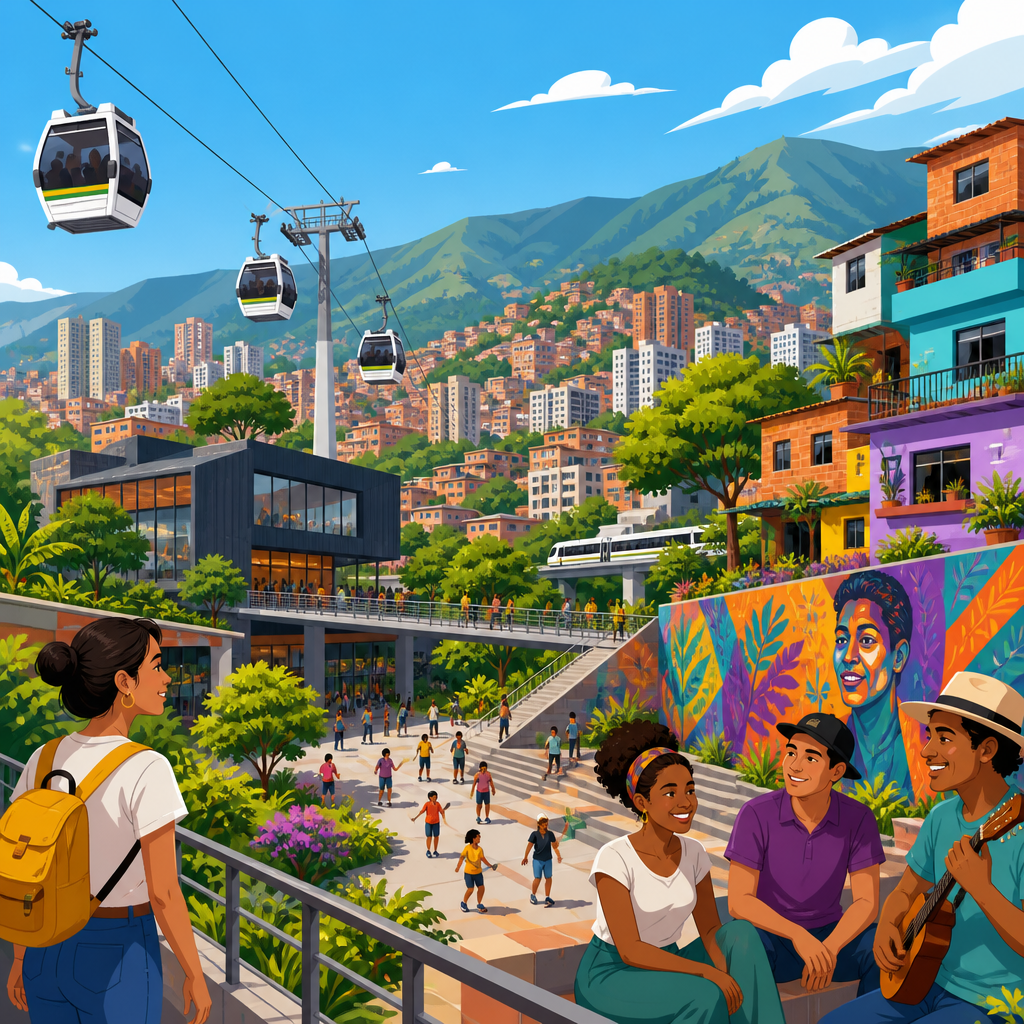
Medellín’s urban transformation is often reduced to a postcard image of cable cars gliding above steep hillsides, yet the city’s real story is broader, harder won, and far more instructive for anyone interested in urban planning and policy. To understand why Medellín changed, it helps to define the terms that planners use when describing it: urban transformation means sustained physical, social, institutional, and economic change across a city; social urbanism refers to pairing infrastructure investment with inclusion, public space, education, and services; integrated mobility means designing transport modes as one connected network rather than isolated projects. I have studied Medellín’s planning documents, transit maps, and project timelines closely, and the central lesson is clear: the cable cars mattered because they were embedded in a larger governance model. That model linked transport to libraries, schools, parks, land management, public utilities, and neighborhood upgrading. Medellín matters globally because it faced conditions that defeat many cities: rapid informal settlement, deep inequality, violent crime, fragmented topography, and weak trust in institutions. Its progress did not erase those problems, and the city still struggles with displacement pressure, air pollution, and uneven opportunity. Still, Medellín became a practical reference point because it showed that targeted public investment, if coordinated and spatially precise, can alter daily life in marginalized districts. For policymakers, the city offers neither a miracle nor a template to copy blindly. It offers a set of planning principles tested under pressure, with measurable results and visible limits.
The conditions that shaped Medellín before the turnaround
Any serious account of Medellín’s urban transformation must begin with geography and migration. The city sits in the Aburrá Valley, a narrow basin where steep slopes constrained expansion and pushed many low-income families to settle informally on hillsides. During the second half of the twentieth century, conflict and rural displacement accelerated population growth. Housing demand outpaced formal supply, producing self-built neighborhoods with limited roads, poor drainage, unstable slopes, and weak state presence. By the late 1980s and early 1990s, Medellín had become internationally associated with narcotics violence, but the deeper planning problem was territorial exclusion. Entire comunas were physically disconnected from jobs, schools, and health services below in the valley floor.
Violence and urban form reinforced each other. In neighborhoods where roads were narrow or absent, emergency response was slow, sanitation networks were incomplete, and police presence was inconsistent. Residents often spent long, costly commutes reaching employment centers. Public spaces that should have supported civic life were either missing or unsafe. Municipal institutions also faced a credibility gap. In practical terms, many residents experienced the state sporadically, through inadequate services or coercive security measures rather than reliable everyday investment. That context matters because Medellín’s later gains did not come from transport alone. They came from rebuilding state capacity at the neighborhood level and proving, project by project, that public works could reach areas long treated as peripheral.
Why the cable cars worked: integration, not symbolism
The Metrocable system became famous because it provided an elegant answer to a difficult topographic problem. Conventional metro rail serves high-demand corridors efficiently on flatter alignments, but hillside settlements require a feeder mode that can climb steep terrain without massive road building. Medellín’s first Metrocable line, Line K, opened in 2004 and connected northeastern hillside communities to the Metro network. That connection cut travel times, reduced transfer friction, and gave residents a dignified, legible route into the wider city. Fares were integrated with Metro operations, which is critical. A cable car without integrated ticketing behaves like a tourist attraction; a cable car within a unified transit system becomes a daily mobility tool.
Still, the popular narrative overstates what aerial cable transit can do on its own. Cable cars carry fewer passengers than heavy metro or bus rapid transit, and station spacing can limit fine-grained accessibility. They are highly effective where slopes are severe and rights-of-way are constrained, but they do not substitute for street improvement, drainage, schools, public safety, or local economic development. Medellín succeeded because planners treated Metrocable stations as anchors for broader intervention. Around them came public space upgrades, pedestrian links, escalators in selected districts, education facilities, and social services. In other words, mobility investment signaled where the city would also concentrate social and physical infrastructure.
That integrated logic is what many cities miss when trying to emulate Medellín. Installing a visually striking mode without governance alignment rarely produces transformation. What changed in Medellín was the relationship between accessibility and citizenship. When residents of peripheral comunas could travel more reliably and when the municipality invested visibly in their neighborhoods, the state became more present in ordinary life. Transport delivered practical benefits, but it also altered perception: marginalized districts were no longer being planned around; they were being planned with.
The wider toolkit: libraries, schools, parks, and public design
One reason Medellín became a touchstone in urban policy circles is that its leaders invested in civic architecture where many cities would have settled for basic upgrades. The library parks, including España, León de Greiff, and Belén, were not only service facilities. They were spatial statements that high-quality design belonged in low-income neighborhoods too. In planning terms, these projects used architecture as a distribution mechanism for dignity, learning, and public visibility. They created destinations for study, internet access, cultural programming, and community gathering. Their siting near underserved districts amplified the message that public investment would no longer concentrate only in already consolidated areas.
Education and public space were linked intentionally. Schools, childcare centers, pedestrian routes, and parks were planned to strengthen daily routines, especially for young people. This matters because urban transformation is cumulative. A safer stairway, a lit footpath, a sports court, or a library branch may look small in isolation, but together they increase supervised activity in public space and reduce the friction of accessing opportunity. Medellín’s programs also showed the value of design quality in public works. Residents notice whether a project feels temporary and low-status or permanent and respected. Durable materials, clear maintenance plans, and good architecture can improve use rates and civic trust.
Critics sometimes argue that iconic buildings risk becoming branding exercises. That risk is real, and some facilities have faced maintenance challenges over time. Yet the stronger judgment is that Medellín’s best projects were effective when paired with operations, staffing, programming, and access improvements. A library without trained staff or reliable transit is a weak intervention. A library connected to schools, walkways, and neighborhood services becomes a node in a functioning urban system.
Governance and finance: how projects moved from plans to reality
Urban transformation depends on institutions that can coordinate across sectors, sequence investments, and pay for them over multiple political cycles. Medellín benefited from stronger local administrative capacity than many Latin American cities, and one frequently cited factor is Empresas Públicas de Medellín, the municipally owned utilities company known as EPM. Its financial strength gave the city more room to invest, while Metro de Medellín provided an established transit institution with operational discipline and public legitimacy. Those assets did not solve politics, but they created implementation platforms that many cities lack.
The city’s planning approach also emphasized targeted intervention areas. Rather than dispersing resources thinly, Medellín concentrated effort in districts where mobility deficits, violence exposure, and service gaps overlapped. Integrated Urban Projects, or Proyectos Urbanos Integrales, exemplified this method by bundling transport links, public space, housing improvements, and social programs in defined territories. From a policy standpoint, this bundling matters because residents experience government as a package, not as separate departmental outputs. Coordinated works reduce duplication, make benefits visible faster, and create more opportunities for community participation.
Public participation itself was imperfect but important. Community engagement helped identify local priorities, route alignments, access paths, and safety concerns. In my review of Medellín case studies, the most durable interventions were not those with the largest capital budgets, but those with clear operating models and neighborhood legitimacy. Financing construction is easier than financing maintenance, staffing, and security over twenty years. Medellín’s record is strongest where those long-term commitments were built into the project logic from the start.
| Policy tool | Purpose | Medellín example | Main planning lesson |
|---|---|---|---|
| Integrated transit | Connect peripheral areas to jobs and services | Metro plus Metrocable fare integration | Mobility works best as one network |
| Targeted urban projects | Bundle physical and social investment | Integrated Urban Projects in hillside comunas | Concentrated spending creates visible change |
| Civic architecture | Expand education and public life | Library parks and school upgrades | Design quality can redistribute dignity |
| Public utilities capacity | Support municipal finance and implementation | EPM’s institutional role | Stable institutions enable long-term planning |
| Public realm upgrades | Improve safety and walkability | Stairs, paths, plazas, escalators | Small-scale access changes affect daily life |
What improved, what remained difficult, and what data really shows
Medellín’s transformation produced measurable benefits, but the evidence should be read carefully. Homicide rates fell dramatically from the crisis years of the early 1990s, although trends were shaped by multiple factors, including national security dynamics, local interventions, and shifts within armed groups. It would be inaccurate to attribute violence reduction solely to urban design. More defensible claims concern accessibility, public space provision, and service reach. Transit connections improved trip reliability for many hillside residents. New public facilities increased access to education, recreation, and digital resources. Upgraded pedestrian infrastructure reduced the physical burden of moving through steep neighborhoods.
At the same time, persistent limits complicate the success story. Inequality did not disappear, and economic mobility remained uneven across districts. Some flagship areas gained attention while other vulnerable neighborhoods continued facing service deficits. Property value increases around improved areas can benefit owners but pressure renters, creating displacement risks if housing policy does not keep pace. Medellín also continues to wrestle with metropolitan challenges, especially air quality in the valley basin, congestion, and the mismatch between formal housing supply and low-income demand. These are not side issues; they are reminders that transformation is ongoing, not completed.
There are also project-specific lessons. The famous outdoor escalators in Comuna 13 improved local circulation and became a global symbol, but tourism growth later introduced crowding and commercialization pressures. The España Library Park, widely celebrated at opening, later faced structural problems that forced closure and reconstruction, underscoring that maintenance, engineering oversight, and lifecycle budgeting matter as much as ribbon-cutting. These examples do not negate Medellín’s progress. They make the case more credible by showing that ambitious urban policy must account for long-term stewardship, not just initial impact.
What other cities can learn without copying Medellín blindly
The most useful lesson from Medellín is not “build cable cars.” It is “match interventions to local constraints, then integrate them institutionally.” In steep informal settlements, aerial transit can be appropriate. In flat peripheral districts, bus network redesign, protected walking routes, drainage works, or land readjustment may deliver greater benefit. Cities should begin with a diagnostic: where are residents losing time, money, safety, or access because of urban form? Which agencies control the relevant levers? What operating budgets exist after construction ends? Medellín’s achievements came from answering those practical questions, not from chasing novelty.
Replicability also depends on governance conditions. A city with fragmented transit operators, weak municipal finance, and no trusted implementing agency cannot import Medellín’s visible projects and expect similar outcomes. It may first need fare integration, cadastral reform, utility strengthening, procurement improvement, or participatory planning frameworks. Likewise, cities should be realistic about symbolic architecture. Signature public buildings can help rebalance attention toward neglected districts, but only when the surrounding street network, staffing model, security plan, and maintenance funding are solid.
For urban planning and policy practitioners, Medellín’s deeper contribution is methodological. It demonstrated the value of working across scales at once: metropolitan transit connectivity, district-level targeting, and block-level public realm improvement. It treated infrastructure as social policy and social policy as spatial policy. It accepted that trust in government can be rebuilt through repeated, competent delivery in places long excluded from investment. That is why Medellín remains relevant beyond the cable cars. Its transformation was neither simple nor complete, but it proved that coordinated planning can change how a city moves, how it serves, and how it values its most vulnerable neighborhoods.
Medellín’s urban transformation deserves attention because it shows what happens when a city addresses inequality through connected decisions rather than isolated projects. The cable cars became famous for good reason: they solved a real mobility problem and gave many residents faster, more dignified access to the city. But the larger achievement was the system around them, including integrated transit, library parks, schools, public space, utilities capacity, and targeted neighborhood upgrading. Taken together, these actions turned infrastructure into a tool for inclusion instead of a narrow engineering exercise.
The strongest takeaway is that visible change followed institutional discipline. Medellín aligned transport with land, design, service delivery, and local engagement. It concentrated investment where exclusion was deepest, and it used high-quality public works to signal that poor neighborhoods merited the same civic ambition as wealthier ones. The city also demonstrates the limits of any urban turnaround narrative. Crime reduction had multiple causes, social inequality persists, and maintenance, displacement pressure, and environmental stress remain active concerns. That balanced view makes the case stronger, not weaker.
For readers exploring urban planning and policy, Medellín offers a practical framework for evaluating any city: ask how mobility connects to opportunity, how public investment is distributed, which institutions can sustain projects, and whether residents experience change in daily routines rather than in press releases. If you want to understand urban transformation beyond symbols, use Medellín as a starting point, then examine the policies, budgets, and neighborhood-scale decisions that make lasting change possible.
Frequently Asked Questions
Why is Medellín’s urban transformation about more than just the cable cars?
Medellín’s cable cars became internationally famous because they offered a dramatic, highly visible symbol of change: public transport reaching steep, historically underserved hillside neighborhoods. But reducing the city’s transformation to that single image misses the deeper lesson. Medellín’s progress came from combining mobility improvements with long-term investments in public space, education, safety, local governance, and neighborhood-level urban design. In other words, the cable cars mattered not because they were spectacular, but because they were part of a larger system.
Urban transformation, in planning terms, means sustained change across multiple dimensions of city life. That includes physical upgrades such as transit, parks, schools, libraries, and street networks; social change such as improved access to services and stronger civic inclusion; institutional change such as better municipal coordination and more credible public agencies; and economic change such as greater access to jobs, legal commerce, and formal opportunity. Medellín’s story is important precisely because these pieces were connected rather than treated as isolated projects.
The city’s better-known interventions often worked as platforms for broader integration. New transit links reduced travel times, but they also connected residents to schools, employment centers, healthcare, and civic life. Public architecture in marginalized areas sent a message that these communities were worthy of investment and visibility. Streets, stairways, public escalators, libraries, and parks helped make neighborhoods safer, more accessible, and more legible to the wider city. The transformation was therefore not simply technological or aesthetic; it was political and spatial, aimed at reducing exclusion.
That is why planners continue to study Medellín. The city demonstrates that successful change usually depends less on one iconic piece of infrastructure and more on sustained, coordinated action that addresses inequality, access, and trust in public institutions. The cable cars are part of the story, but they are not the whole story—and arguably not even the most important part.
What does “social urbanism” mean in the context of Medellín?
Social urbanism refers to an approach in which infrastructure and urban design are deliberately paired with social investment, institutional presence, and equity goals. In Medellín, this meant that physical improvements were not treated as ends in themselves. A new transit connection, library park, school, plaza, or pedestrian link was expected to serve broader social purposes: expanding opportunity, improving dignity, reducing isolation, and integrating peripheral communities into the life of the city.
This idea emerged in response to a very specific urban condition. Medellín’s steep topography, rapid informal growth, and history of violence had produced intense territorial inequality. Many low-income communities were physically separated from economic opportunity and often lacked high-quality public amenities. Social urbanism recognized that these neighborhoods did not just need roads or stations; they needed visible, well-designed public investments that addressed both mobility and social exclusion. That is why planners placed importance on where projects were built, how they connected to other services, and what symbolic role they played.
In practice, social urbanism often involved “integrated urban projects,” where multiple interventions were coordinated within a territory rather than scattered randomly across the city. A transport investment might be accompanied by upgraded public spaces, educational facilities, safer pedestrian routes, environmental improvements, and community participation processes. This territorial logic helped ensure that investment had cumulative effects. Residents experienced not just easier travel, but better everyday urban life.
The concept also carries an important governance lesson. Social urbanism requires capable institutions that can plan across departments and maintain projects over time. It is not enough to build an admired structure; cities need mechanisms for maintenance, programming, safety, and public accountability. Medellín’s example is useful because it shows that equity-oriented urbanism works best when physical design, social policy, and public administration reinforce one another.
How did transportation fit into Medellín’s broader transformation strategy?
Transportation was central to Medellín’s transformation, but its significance went far beyond moving people from one place to another. The city used mobility as a tool for urban integration. By linking isolated hillside communities to the metro system and to the rest of the metropolitan area, transit investments reduced the penalties of geography. For many residents, that meant shorter, cheaper, and more reliable trips to work, school, healthcare, and public services.
The key point is that transportation was planned as part of a network. The metro, cable cars, bus systems, pedestrian infrastructure, outdoor escalators in steep settlements, and surrounding public-space improvements worked together to create accessibility. This is what made the mobility strategy more transformative than a stand-alone engineering project. It acknowledged that access depends not only on major lines but also on the “first and last mile”: the walk to a station, the safety of streets, the quality of stairways, and the ease of moving through difficult terrain.
Transit also carried symbolic weight. In many cities, poor peripheral areas receive low-quality, purely utilitarian infrastructure. Medellín challenged that pattern by placing ambitious, well-designed public investments in neighborhoods that had long been stigmatized. This helped signal that peripheral residents were entitled to high-quality public services and full membership in the city. That symbolic recognition can matter because it affects public trust, civic identity, and the legitimacy of government action.
At the same time, transportation alone could not solve structural inequality. Better mobility improves access, but it does not automatically create jobs, end violence, or eliminate poverty. Medellín’s broader lesson is that transport is most effective when coordinated with land-use planning, social programs, education, environmental management, and local economic development. In that sense, the city did not treat mobility as a silver bullet; it treated it as a backbone for wider urban inclusion.
What role did public space, architecture, and neighborhood investment play in Medellín’s success?
Public space and civic architecture played a major role because they helped translate policy goals into visible, everyday change. Medellín became known for building libraries, schools, parks, plazas, and pedestrian connections in areas that had historically suffered from neglect and stigma. These projects were not merely beautification efforts. They were intended to improve quality of life, create safe places for gathering, support education and culture, and rebalance the geography of public investment.
Well-designed public spaces can have multiple effects at once. They provide places for recreation, social interaction, and community events. They improve walkability and strengthen links between homes, schools, transit stations, and local commerce. They can also increase the sense that government is present in a constructive way. In Medellín, placing high-quality architecture in marginalized neighborhoods sent a powerful message: these communities were not disposable edges of the city, but central to its future.
Neighborhood investment also mattered because transformation had to be territorial, not abstract. Residents experience a city through streets, corners, staircases, parks, and local institutions, not through citywide statistics alone. By upgrading daily environments, Medellín addressed the lived realities of exclusion. Better lighting, safer routes, cleaner public areas, and accessible community facilities can alter how neighborhoods function socially and economically. Small-scale design improvements often make larger systems, such as transit, actually usable.
Still, the most important takeaway is that architecture and public space worked best when linked to long-term management and social programming. A library or park can become transformative when it is maintained, staffed, integrated into transit access, and supported by community use. Without that follow-through, even striking design has limited impact. Medellín’s experience suggests that physical form matters greatly, but it matters most when it is embedded in durable institutions and neighborhood-centered policy.
What can other cities realistically learn from Medellín—and what should they avoid copying too literally?
Other cities can learn a great deal from Medellín, but the most valuable lessons are strategic rather than stylistic. The city shows the importance of targeting inequality spatially, coordinating investment across sectors, and treating access as a foundation of urban citizenship. It also demonstrates that ambitious public projects can be directed toward communities that have historically been underserved, rather than concentrated only in already prosperous districts. That principle is widely transferable.
Another lesson is the value of integration. Medellín’s more successful interventions linked transportation, public space, education, social services, and neighborhood upgrading rather than treating each as a separate policy silo. Cities facing segregation, informal growth, or uneven service provision can adapt this integrated approach to their own geography and institutions. The specific infrastructure may differ—one city may need bus rapid transit, another safer streets and drainage, another schools and public health facilities—but the logic of coordinated investment remains relevant.
What cities should avoid is copying the visible symbols without the underlying governance model. Installing a cable car, landmark building, or signature urban project will not by itself produce broad social change. Medellín’s transformation depended on institutional capacity, political continuity, public-sector competence, and a willingness to invest over time in difficult places. Without those conditions, imitation can become superficial branding rather than meaningful reform.
It is also important not to romanticize the story. Medellín has made major strides, but it still faces inequality, violence, informality, and governance challenges. That reality makes the city’s experience more useful, not less, because it reminds policymakers that urban transformation is never final. It is an ongoing process of negotiation, maintenance, adaptation, and reinvestment. The most realistic lesson for other cities is not that Medellín found a perfect formula, but that durable change comes from sustained


