
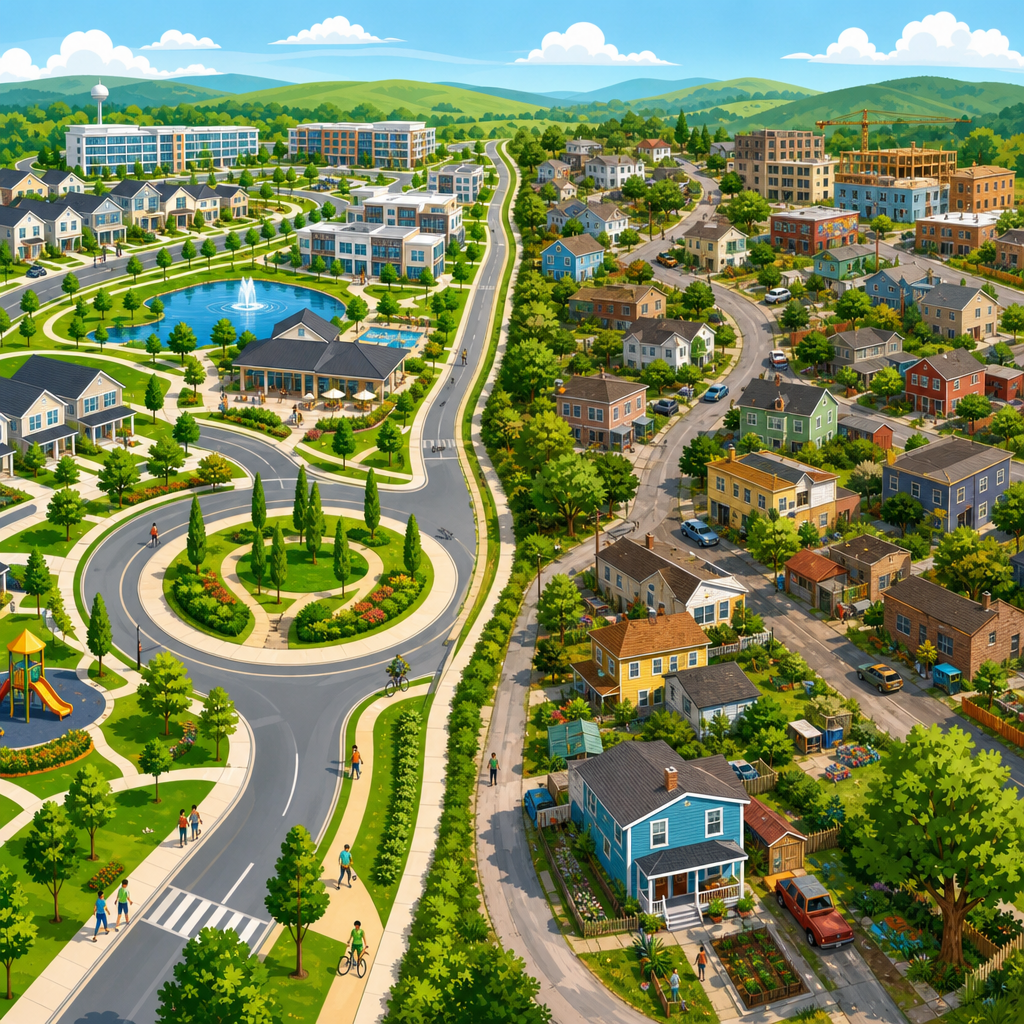
Master planned communities and incremental neighborhood growth represent two fundamentally different ways cities expand, invest, and shape daily life. A master planned community is a large, coordinated development built from a single vision, usually under one lead developer, with land use, street layouts, utilities, housing types, parks, schools, and commercial areas designed in advance. Incremental neighborhood growth is the opposite model: change happens gradually, parcel by parcel, building by building, often across decades, with many owners, small builders, and shifting market demands guiding what gets added next.
This distinction matters because the development pattern chosen today affects housing supply, affordability, transportation costs, public finance, climate resilience, and social cohesion for generations. In my work reviewing plans, zoning updates, and subdivision proposals, I have seen both models succeed and fail. A well-executed master planned community can deliver infrastructure quickly, reserve land for parks and schools, and create a predictable development pipeline. A healthy incrementally growing neighborhood can adapt to real demand, support local businesses, preserve cultural identity, and avoid the fragility that comes from relying on a single buildout schedule or product type.
Urban planners, elected officials, developers, and residents often ask the same core questions. Which approach produces more housing? Which creates better streets? Which is easier to finance? Which is more inclusive? The answer is not simply that one is modern and the other outdated. Each model solves specific problems and creates specific risks. Master planning can coordinate scale; incremental growth can preserve adaptability. Understanding the tradeoffs helps communities set better policy on zoning, infrastructure funding, land assembly, design standards, phasing, and long-term maintenance.
At a policy level, this debate is especially important because many regions are trying to grow while controlling sprawl, lowering emissions, and improving housing choice. If regulations only allow large, prepackaged projects, smaller builders are squeezed out. If rules only permit slow, piecemeal change without infrastructure coordination, neighborhoods may underdeliver housing or overload public systems. The practical question is not which pattern sounds better in theory. It is which combination of land use controls, public investment, and market structure produces durable places where people can live, work, and move efficiently.
How master planned communities work in practice
Master planned communities are typically assembled on large tracts at the metropolitan edge or on major redevelopment sites such as former industrial land, military bases, or aging malls. The lead entity secures entitlements, creates a phasing schedule, finances backbone infrastructure, and sets development standards for everything from lot widths to stormwater systems to façade materials. In the United States, examples include Irvine Ranch in California, The Woodlands near Houston, and Columbia, Maryland. Internationally, similar logic appears in new towns around London, growth areas in Melbourne, and large greenfield districts in the Gulf states.
The core advantage is coordination. Roads, sewer mains, drainage, schools, parks, and utility corridors can be reserved before land fragmentation makes those tasks expensive or politically difficult. Because the plan is comprehensive, a community can establish trail networks, school sites, mixed-use centers, and open-space systems early rather than trying to retrofit them later. This is one reason many local governments favor master planning for large annexations. It reduces uncertainty about who pays for major infrastructure and when public services will be needed.
There are also important operational benefits. Builders working inside a master planned community often use pattern books, design codes, and preapproved engineering standards, which can speed permit review. Retail tenants value predictable demographics. School districts prefer known enrollment pipelines. Transit agencies can at least identify future corridors, even if service comes later. For homebuyers, the offer is clarity: they know where parks, community amenities, and neighborhood shopping are supposed to go, and homeowner association rules can preserve a consistent appearance.
But large-scale coordination carries significant downsides. Because delivery depends on major capital, sophisticated legal structuring, and long entitlement timelines, only well-capitalized firms can usually participate. That narrows competition and often narrows the housing mix. Even when plans show apartments, townhomes, and small lots, the first phases frequently emphasize the safest products for lenders: detached single-family homes. If market conditions shift, the whole project can stall. I have seen approved master plans with ambitious mixed-use centers remain empty fields for a decade because the retail timing never penciled out.
Another recurring issue is monoculture. A community designed in one period may reflect one set of assumptions about household size, commuting, and retail behavior. If those assumptions change, the place can feel rigid. Conventional suburban master plans built around wide arterials, separated land uses, and large parking fields often struggle to retrofit walkability later. Strong design control can also suppress the small, odd, locally driven businesses that give neighborhoods texture. What looks orderly on an illustrative site plan may feel thin in daily life if every block was optimized for absorption rates rather than social variety.
How incremental neighborhood growth builds resilient places
Incremental neighborhood growth happens through many small decisions rather than one controlling blueprint. A homeowner adds an accessory dwelling unit. A corner store becomes a café with apartments above. A vacant lot gets a duplex. A warehouse district gains studios, then offices, then housing. Historic streetcar suburbs and traditional main-street districts across North America and Europe were often built this way. Their enduring strength comes from cumulative adaptation. No single actor had to predict every future need; the neighborhood could evolve as demographics, technology, and markets changed.
This model supports resilience because it distributes risk. If one project fails, the district still functions. If retail demand softens, an individual storefront can change hands without collapsing the larger neighborhood economy. Small-scale infill also opens the market to local builders and owners who cannot finance a thousand-acre project. That matters for housing supply. Research from the Lincoln Institute of Land Policy and multiple state housing studies has shown that missing-middle forms such as duplexes, fourplexes, courtyard apartments, and accessory units can add homes in high-opportunity areas without requiring wholesale redevelopment.
Incremental growth also tends to produce finer-grained urban form. Shorter blocks, mixed building ages, varied lot sizes, and diverse tenancy structures create more opportunity for neighborhood retail and walking. Jane Jacobs identified this decades ago when she argued that diversity of use and building age supports economic and social vitality. Contemporary evidence supports the point. Districts with mixed-age buildings often house more independent businesses than areas dominated by new construction because older, smaller spaces can offer lower rents. That is not nostalgia; it is a basic real estate dynamic.
The challenge is that incrementalism only works when regulation allows it. Many cities prohibit the very forms that historically built beloved neighborhoods. Minimum lot sizes, parking mandates, use segregation, setback rules, and discretionary review can make a duplex or corner store harder to approve than a large greenfield subdivision. Infrastructure can be another bottleneck. A neighborhood may be physically suited to infill, but if sewer capacity, school enrollment, sidewalks, or transit service are constrained, residents may understandably resist additional growth. Incremental development is not the same as unmanaged growth. It still requires public coordination.
There is also a speed limitation. Parcel-by-parcel change rarely delivers thousands of homes at once. In a severe housing shortage, relying only on gradual adaptation can undersupply the market. Some high-demand cities need both gentle infill and large-scale redevelopment around transit, campuses, or obsolete commercial land. The practical lesson is that incremental growth excels at adaptation and diversity, while master planning excels at coordinated delivery. Good urban policy recognizes where each mechanism performs best rather than forcing every site into one template.
Comparing housing, infrastructure, mobility, and fiscal outcomes
When comparing master planned communities vs incremental neighborhood growth, decision-makers should evaluate outcomes across four dimensions: housing mix, infrastructure efficiency, transportation behavior, and long-term public finance. These are not abstract planning ideals. They determine whether residents can afford homes, whether cities can maintain streets and pipes, and whether households spend more time and money driving than they need to.
| Issue | Master Planned Communities | Incremental Neighborhood Growth |
|---|---|---|
| Housing delivery | Can produce large volumes quickly once entitlements and infrastructure are in place | Adds supply steadily, usually in smaller annual amounts across many sites |
| Housing diversity | Often planned for diversity, but early phases may skew toward one product type | Usually more varied over time because many owners respond to changing demand |
| Infrastructure | Backbone systems can be coordinated efficiently from the start | Existing systems are reused, but upgrades can be uneven or politically difficult |
| Mobility | Depends heavily on street network design and land-use mix; many remain auto-oriented | Often supports walking and transit better where blocks are small and uses are mixed |
| Public finance | May require major upfront subsidies or special districts, with long-term maintenance obligations | Can improve tax productivity through infill, but may strain legacy infrastructure without reinvestment |
Housing outcomes depend heavily on phasing and regulation. A master planned community can earmark apartments, age-restricted housing, townhomes, and detached homes, but if financing favors one segment, delivery may skew narrow for years. Incremental neighborhoods, by contrast, can diversify gradually through conversions, additions, and infill, but only if codes permit those forms. In both models, entitlement design matters as much as market demand.
Infrastructure efficiency is more nuanced than many debates suggest. Greenfield master plans can install modern utilities efficiently, yet they also extend networks outward, increasing lifecycle maintenance obligations. Incremental growth leverages existing roads, water lines, and civic facilities, which is fiscally smart when capacity exists. However, older systems may need expensive upgrades. Strong capital improvement planning, utility asset management, and impact fee policy are essential regardless of growth model.
Transportation is often the decisive quality-of-life factor. Many master planned communities promise walkability but deliver it only in limited pods surrounded by high-speed arterials. Incremental neighborhoods with connected street grids, local retail, and transit access usually support shorter trips and lower vehicle miles traveled. The Institute of Transportation Engineers and NACTO have repeatedly shown that network design and destination proximity shape travel behavior more than branding language about lifestyle. If daily needs are within a safe, direct walk, people walk more. If every trip begins at an arterial driveway, they drive.
Policy choices that determine success or failure
The most important planning insight is that outcomes are governed less by labels than by rules. A master planned community with mixed uses, connected streets, varied lot sizes, school siting, and phased transit priority can outperform a fragmented suburb. An incrementally growing neighborhood with exclusionary zoning, parking mandates, and infrastructure neglect can stagnate. Local policy sets the operating environment.
For large planned districts, governments should require measurable performance standards rather than relying on marketing images. That means block-length maximums, street connectivity ratios, affordable housing commitments, park acreage, school coordination, tree canopy targets, stormwater performance, and a realistic phasing plan for commercial and civic uses. Development agreements should clarify who funds and maintains major infrastructure. If a project advertises mixed-use walkability, those uses need enforceable land reservations and street standards that make walking feasible from the first phases, not only after final buildout.
For incremental neighborhoods, the policy toolkit is different. Cities need by-right approval paths for small multifamily housing, accessory dwelling units, lot splits, and corner commercial reuse where appropriate. Form-based standards often work better than rigid use segregation because they focus on how buildings shape the street. Parking reform is especially important. Minimum parking requirements consume land, raise construction costs, and can make small infill projects infeasible. Oregon, California, and several Canadian municipalities have shown that targeted zoning reform can unlock modest density without neighborhood collapse.
Public investment must align with land-use goals. Sidewalk completion, transit frequency, school capacity, utility upgrades, and park maintenance determine whether added homes feel like improvement or stress. I have watched communities approve infill in principle while underfunding the simple infrastructure that makes it acceptable in practice. The same mismatch appears in master planned expansion areas when jurisdictions accept new growth but delay arterial connections, fire service expansion, or drainage improvements. Planning credibility rises when capital budgets match adopted plans.
The strongest strategy is usually a hybrid. Use master planning where coordination is indispensable: large greenfield edges, former industrial sites, rail yards, airports, campuses, and major transit-oriented redevelopment. Use incremental reform across established neighborhoods so they can add housing choice, local commerce, and adaptive reuse over time. This balanced approach broadens participation, spreads risk, and creates urban areas that can both deliver growth and evolve gracefully. If you are shaping policy in urban planning and policy, audit your zoning, infrastructure finance, and approval processes now, then align them with the kind of neighborhoods you actually want to build.
Frequently Asked Questions
What is the main difference between a master planned community and incremental neighborhood growth?
The core difference is how development is organized, timed, and controlled. A master planned community is typically conceived as a large, unified project guided by one developer or a small group of coordinated stakeholders. Streets, utilities, parks, schools, housing types, retail space, stormwater systems, and public amenities are mapped out in advance as part of a single long-range vision. Because so much is decided upfront, the result is often a more predictable built environment with coordinated infrastructure and a clearly defined identity from the beginning.
Incremental neighborhood growth works very differently. Instead of one large plan being delivered in phases, change happens gradually over time through many smaller decisions. Individual property owners, small builders, local investors, and public agencies all contribute to the neighborhood’s evolution. A vacant lot might become a duplex, a corner store might expand, a house might be converted into multiple units, or a new apartment building might replace an underused structure. This process is less centralized and often less visually uniform, but it can create neighborhoods that are more flexible, adaptive, and responsive to changing economic conditions and community needs.
In practical terms, master planned communities emphasize coordination and predictability, while incremental growth emphasizes evolution and adaptability. Neither model is automatically better in every context. The right approach depends on goals such as affordability, infrastructure delivery, transportation access, local character, fiscal sustainability, and how much flexibility a city wants to preserve over time.
What are the advantages of master planned communities?
Master planned communities offer several important strengths, especially when a region needs large amounts of housing and infrastructure delivered in a coordinated way. One major advantage is that roads, water lines, drainage systems, parks, schools, and commercial areas can be designed together rather than added later in a piecemeal fashion. That level of coordination can reduce conflicts between land uses, improve traffic circulation, and make it easier to provide amenities early in the life of the development. Buyers and local governments often value that predictability because it creates a clearer picture of what the community will look like at buildout.
Another benefit is speed and scale. A large developer can often assemble land, finance infrastructure, and deliver housing units at a pace that small, scattered builders cannot match. In fast-growing metro areas, that can help accommodate population growth more quickly. Master planned communities also tend to include branding, design standards, recreational amenities, and a curated mix of housing and retail that appeal to households seeking convenience and a cohesive neighborhood experience.
From a governance and investment standpoint, this model can also make public-private coordination easier. When one lead entity is responsible for much of the development, municipalities may find it simpler to negotiate infrastructure responsibilities, phasing schedules, impact mitigation, and public amenity commitments. The tradeoff, however, is that this efficiency can come with greater standardization, less organic variety, and fewer opportunities for small-scale local actors to shape the neighborhood over time.
What are the strengths of incremental neighborhood growth?
Incremental neighborhood growth is often praised for its resilience, diversity, and long-term adaptability. Because change happens in smaller pieces, neighborhoods can respond more gradually to shifts in housing demand, demographics, transportation patterns, and local business needs. That flexibility matters. A community that evolves parcel by parcel is not locked into one fixed vision created years earlier under a specific market assumption. Instead, it can absorb change through small apartment buildings, accessory dwelling units, mixed-use storefronts, townhouse infill, and building reuse, often without requiring massive upfront redevelopment.
This model also tends to support a wider range of participants in the development process. Instead of concentrating decision-making in one large developer, incremental growth creates openings for homeowners, small builders, local entrepreneurs, nonprofit housing groups, and community-based investors. That can lead to more architectural variety, more ownership diversity, and a finer-grained urban fabric. In many older neighborhoods, the qualities people find most appealing today, such as walkability, mixed uses, local businesses, and varied housing stock, emerged through exactly this kind of gradual layering over time.
There is also a fiscal and social argument in favor of incremental growth. Smaller improvements can be less risky than megaprojects, and they allow cities to test demand before extending costly infrastructure too far. When done well, incremental change can strengthen existing neighborhoods without requiring wholesale replacement. The challenge, of course, is that it can be slower, less coordinated, and sometimes constrained by zoning rules, fragmented land ownership, or neighborhood opposition. Even so, it remains one of the most effective ways to create durable, human-scaled places that evolve naturally rather than appearing all at once.
Which approach is better for affordability, walkability, and long-term community health?
There is no single winner across all three goals, because affordability, walkability, and long-term health depend heavily on execution. Master planned communities can improve affordability when they deliver a large number of homes at once, especially if they include a mix of lot sizes, housing types, rental options, and price points. However, many master planned projects trend toward higher-cost housing, extensive amenity packages, and auto-oriented layouts, which can limit affordability and everyday accessibility if not carefully designed. Walkability in these communities is possible, but it requires intentional planning around block size, street connectivity, local retail, school siting, and transit access. Without those elements, even a visually attractive community can function primarily as a car-dependent suburb.
Incremental neighborhood growth often performs well on walkability and long-term urban health because it builds on connected street grids, mixes uses over time, and allows more daily needs to locate closer together. It can also support affordability through housing diversity, especially when zoning allows duplexes, triplexes, courtyard apartments, accessory units, and small multifamily buildings. That said, incremental growth does not automatically produce affordability either. In strong real estate markets, older neighborhoods can become expensive precisely because they are desirable, walkable, and centrally located. Without policies that encourage more housing supply and protect vulnerable residents, incremental change can still coincide with rising costs.
In terms of long-term community health, incremental growth often has an edge because it allows neighborhoods to adapt rather than requiring large, disruptive resets. Still, the best outcomes often come from blending lessons from both models. A master planned area can borrow the connected streets, mixed housing, and adaptable blocks associated with older incremental neighborhoods. Likewise, established neighborhoods can benefit from more proactive infrastructure planning and public investment. In other words, success usually comes less from choosing one model in the abstract and more from aligning design, regulation, and investment with the outcomes a city actually wants.
Can cities combine master planning and incremental growth in a more balanced development strategy?
Yes, and in many cases they should. Cities do not have to choose between total top-down coordination and completely organic parcel-by-parcel change. A more balanced strategy uses master planning where large-scale infrastructure, environmental constraints, or major land assembly make coordination essential, while also preserving the flexibility for neighborhoods to evolve incrementally over time. This hybrid approach can be especially effective in growth corridors, redevelopment districts, and suburban expansions where cities need roads, utilities, transit planning, stormwater systems, and public spaces organized upfront but do not want every building type and land use frozen into a rigid blueprint.
One practical way to combine the two models is to master plan the framework rather than every detail. That means setting the street network, utility capacity, park system, school sites, flood management, and broad land-use pattern in advance, while allowing individual blocks and parcels to develop gradually with a variety of building types and owners. Instead of dictating a fully uniform product, the city or lead developer can establish adaptable rules that encourage mixed housing, neighborhood retail, connected streets, and phased intensification. Over time, this creates a place that feels coordinated at the systems level but organic at the building level.
For local governments, this balanced strategy often requires zoning reform, flexible subdivision standards, and a willingness to permit small-scale infill alongside larger projects. It also requires attention to financing, because infrastructure is easier to plan centrally than to fund incrementally. Still, when cities get the balance right, they can capture the strengths of both approaches: the efficiency and infrastructure alignment of master planning, along with the diversity, adaptability, and long-term resilience of incremental neighborhood growth.


