
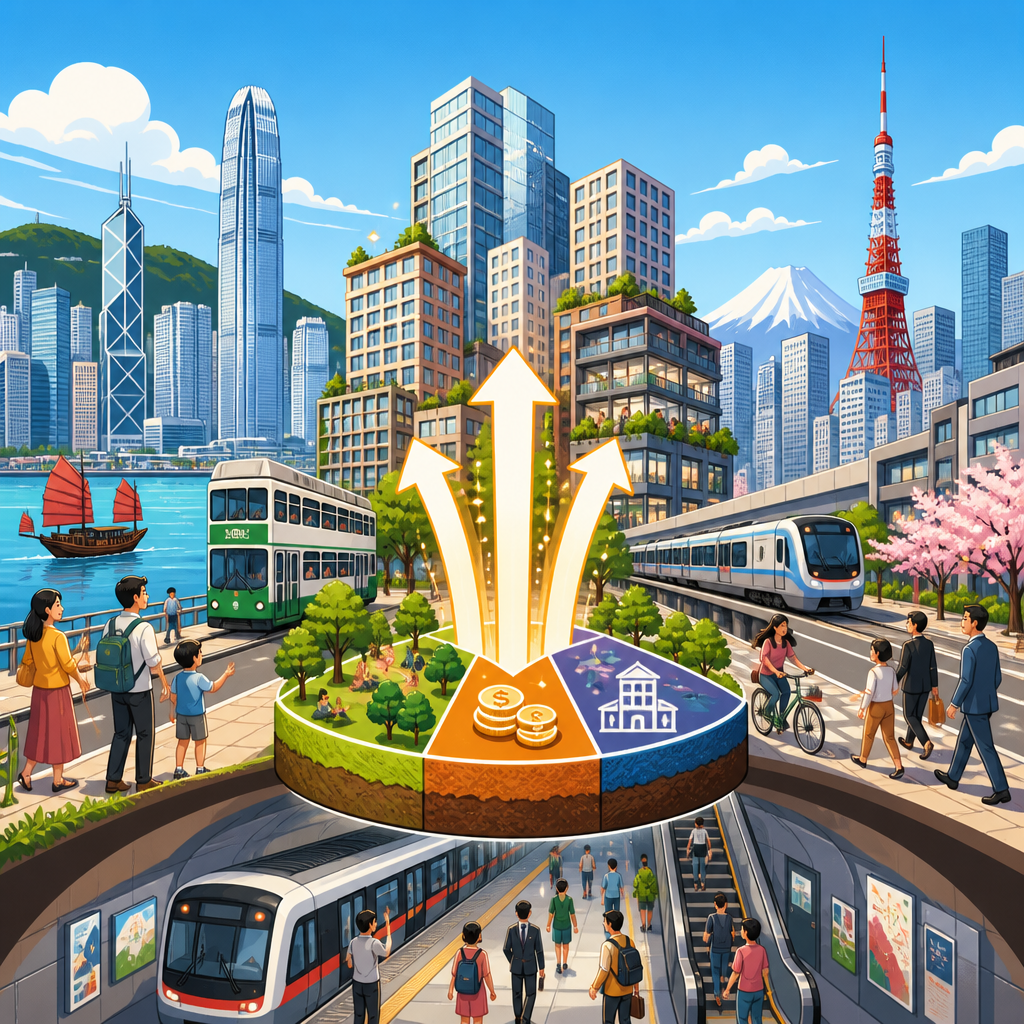
Land value capture in Hong Kong, Tokyo, and other high-transit cities explains how governments and transit agencies recover part of the increase in land value created by public infrastructure, especially rail. When a new station shortens travel time, improves access to jobs, and reduces uncertainty for households and firms, nearby land becomes more desirable. That gain is not produced solely by the landowner. It is partly created by collective investment, planning decisions, and the concentration of public services. Land value capture is the policy family designed to channel a portion of that uplift back into the systems that created it.
In practice, the term covers several mechanisms. Betterment levies charge owners based on increased land value. Special assessments fund infrastructure from properties that benefit directly. Joint development allows transit agencies to build or partner on station-area projects. Sale or lease of development rights monetizes added density. Tax increment financing earmarks future tax growth for current infrastructure costs. I have worked with station-area appraisals and transport business cases, and one lesson repeats across markets: the technical idea is simple, but the institutional design determines whether value capture funds transit reliably or becomes a one-off windfall.
This topic matters because high-capacity transit is expensive, while the benefits are spatially concentrated and economically durable. Urban rail lowers generalized travel costs for decades. That creates measurable gains in rents, land prices, retail turnover, and development intensity around stations. If public agencies capture none of that value, they rely heavily on fares, broad taxes, or debt. If they capture too aggressively, they can suppress development, trigger legal challenges, or worsen displacement. The policy challenge is to recover value without undermining the very urban growth that generates it.
Hong Kong and Tokyo are the essential case studies because both demonstrate that transit and land policy can be integrated at metropolitan scale, yet they do so through very different institutional arrangements. Hong Kong’s model centers on state land ownership, leasehold rights, and a rail-plus-property approach led by MTR Corporation. Tokyo relies more on private railway groups, land readjustment, coordinated zoning, and long-term corridor development tied to commuter demand. Other cities, from Singapore to London, Vancouver, São Paulo, and Delhi, adapt pieces of these systems, but few replicate them fully because legal frameworks, land tenure, and fiscal powers differ.
How land value capture works in transit-rich cities
Land value capture starts with a causal chain. A transport investment changes accessibility. Accessibility affects expected income, business turnover, and household convenience. Markets then capitalize those expected benefits into land values. The uplift is usually strongest where service is frequent, travel time savings are large, and planning rules allow intensive use near stations. A metro stop in a low-rise district with strict height caps may raise prices modestly. The same stop in an upzoned commercial-residential corridor can produce dramatic gains because demand can convert into floor area.
The practical question is not whether uplift exists; decades of urban economics show that it often does. The practical questions are who captures it, when, and through which instrument. Timing matters because value often rises at several stages: announcement, rezoning, construction, and opening. The cleanest systems connect those stages to explicit fiscal tools. Agencies may auction development rights after rezoning, levy charges when permits are issued, or partner with developers before construction to share risk and reward. Strong systems also distinguish land value from building value, because taxing improvements can discourage investment.
Not every transit project creates enough uplift to pay for itself. Line alignment, regional growth, interest rates, and housing supply constraints all shape outcomes. Heavy rail in an already well-served corridor may generate less marginal uplift than a first rapid-transit connection into a growing district. That is why serious value capture programs require baseline appraisals, transparent benefit areas, and conservative forecasts. They work best as one funding source among several, not as a magical replacement for grants, operating subsidies, and fare revenue.
Hong Kong: the rail-plus-property model
Hong Kong offers the most cited modern example because its institutional foundation is unusually favorable. The government owns the land, grants leasehold interests, controls development parameters, and can coordinate rail investment with land disposal. MTR Corporation, while publicly listed, operates within that framework. Under the rail-plus-property model, MTR receives development rights for sites above or adjacent to new stations and depots at a “before rail” land premium. It then partners with private developers, capturing the difference between pre-rail and post-rail values created by the transit investment and associated planning approvals.
This arrangement does several things at once. It helps fund rail capital costs, supports non-fare revenue, and ensures intensive development around stations. Projects such as Kowloon Station, Hong Kong Station, and the Tseung Kwan O line illustrate the pattern: rail infrastructure is integrated with housing, offices, retail podiums, and pedestrian connections. In business terms, MTR is not merely collecting a tax; it is acting as a master planner, infrastructure provider, and land development partner. That integrated role reduces coordination failures that plague many Western cities, where transit agencies, planning departments, and landowners often pursue separate timelines.
Hong Kong’s success is real, but it is not infinitely transferable. The model depends on state land ownership, a deep development market, high transit demand, and strong administrative capacity. It also sits within a housing system marked by scarcity and very high prices, so station-area development can intensify affordability pressures if public housing and land release do not keep pace. In my experience reviewing Asian transit corridors, this is the main misunderstanding abroad: observers copy the revenue ambition without copying the land assembly powers, legal clarity, and metropolitan growth context that made the model viable.
Tokyo: private railways, readjustment, and corridor urbanism
Tokyo reaches similar integration through different means. Rather than one dominant state-led rail-property corporation, the metropolitan region contains major private railway companies such as Tokyu, Seibu, Tobu, Odakyu, Keio, and Hankyu in the wider Japanese tradition, alongside public operators. These firms historically built railway lines and then developed housing, department stores, hotels, schools, and leisure destinations along their corridors. The business model treated ridership, real estate, and retail as mutually reinforcing. A station was not just a boarding point. It was an anchor for a complete urban market.
Land readjustment has been central to this system. Under readjustment, landowners pool fragmented parcels, infrastructure and public space are installed, plots are reconfigured into more usable shapes, and each owner receives a smaller but more valuable serviced parcel. Some land is reserved or sold to cover project costs. This technique is less politically explosive than outright expropriation in many contexts because owners remain participants in the value-creation process. Around Tokyo, it has supported suburban expansion, station-area rationalization, and postwar urbanization while keeping development closely tied to rail accessibility.
Tokyo also benefits from zoning flexibility compared with many Anglo-American cities. Japanese land-use controls generally allow more mixed use and more by-right redevelopment near stations, which means accessibility gains can translate quickly into additional floor space and commercial activity. Private railway groups have long exploited this elasticity. Tokyu’s development of Den-en-toshi line communities is a classic example: railway investment, subdivision planning, retail programming, and commuter market creation were pursued as one integrated strategy. The result was durable fare demand and rising corridor value, captured through both transport operations and land-based income.
What other high-transit cities actually do
Few cities replicate Hong Kong or Tokyo exactly, but many use selected tools. London applied a Business Rate Supplement and a Community Infrastructure Levy to help fund the Elizabeth line, pairing broad beneficiary charges with station-area development. Singapore relies on state land ownership, long-term planning, and integrated new town development around MRT stations, though its fiscal architecture differs from Hong Kong’s commercial rail-property model. Vancouver has used density bonusing, development cost charges, and negotiated contributions around SkyTrain corridors, especially where rezoning unlocks condominium and mixed-use projects.
São Paulo’s sale of CEPACs, tradable certificates for additional construction rights in designated urban operations, is one of the clearest examples of monetizing planning gains. Delhi Metro has pursued property development and commercial leasing around stations, though land assembly, local market conditions, and governance fragmentation have limited the scale compared with East Asian leaders. In the United States, agencies such as WMATA in Washington have engaged in joint development, ground leases, and air-rights projects, but dependence on local zoning approvals and fragmented taxation often constrains systematic capture.
| City | Primary mechanism | Why it works | Main limitation |
|---|---|---|---|
| Hong Kong | Rail-plus-property rights and leases | Integrated land control and strong demand | Hard to copy without state land ownership |
| Tokyo | Private railway development and land readjustment | Corridor-based urban growth and mixed use | Depends on supportive zoning and patient capital |
| London | Beneficiary charges and development contributions | Broad tax base and large central-city uplift | Complex politics and uneven local benefits |
| Singapore | State-led planning and land monetization | Long-range coordination across housing and transit | Different institutional goals from commercial rail models |
| São Paulo | Sale of additional development rights | Directly prices planning-created value | Market cycles affect revenue reliability |
The common denominator is not one legal instrument. It is alignment between transport investment, land-use permission, and institutions able to act before speculative gains dissipate. Where agencies can define benefit areas, grant density, assemble sites, and hold land long enough to share in upside, value capture becomes material. Where those powers are split among many actors, revenue is lower and timing is slower.
Design principles, risks, and what policymakers should do
Effective land value capture follows a small set of hard rules. First, capture value from accessibility gains and planning permissions, not from arbitrary extraction. Second, use transparent valuation methods, ideally with independent appraisal and published assumptions. Third, match the instrument to the market. Joint development suits strong station nodes with development potential. Special assessments fit places with clear local beneficiaries. Development-right sales work where zoning changes create quantifiable additional floor area. Fourth, earmark revenue credibly for transit or area improvements, because public acceptance rises when benefits are visible.
Equity cannot be an afterthought. New rail and rezoning can raise rents, displace lower-income tenants, and redirect gains toward incumbent owners. The best programs combine value capture with inclusionary housing, public land reservations, tenant protections, or funding for social infrastructure. Hong Kong’s public housing system and Singapore’s public development model address this differently from market-led cities, but the principle is the same: if public action creates private gain, some of that gain should support broad access to the city, not only rail balance sheets.
Policymakers should also avoid three recurring mistakes. One is overestimating revenue before testing market absorption and financing conditions. Another is taxing uplift where zoning still blocks meaningful development, which captures little and invites resistance. The third is treating value capture as a substitute for competent planning. It works best when paired with frequent service, walkable station design, limited parking oversupply, and land-use rules that welcome mixed-income density. For urban planning and policy professionals, the lesson from Hong Kong, Tokyo, and other high-transit cities is direct: transit creates land value, but only institutions convert that value into durable public benefit.
Land value capture is most powerful when cities stop viewing rail, zoning, and real estate as separate files. Hong Kong shows how integrated control over land rights and station development can turn transit investment into recurring non-fare revenue and dense urban form. Tokyo shows that private railways, flexible land development, and land readjustment can achieve a similar result through corridor urbanism rather than one centralized property model. Other cities prove that partial adoption is possible, but only when tools fit local law, market depth, and governance capacity.
The strongest takeaway is that value capture is not a gimmick or a universal formula. It is a disciplined way to reclaim part of the wealth created by public decisions. Used well, it lowers pressure on general taxation, supports better stations and neighborhoods, and aligns growth with sustainable mobility. Used poorly, it overpromises, underdelivers, or amplifies inequality. That is why serious programs begin with valuation evidence, clear legal authority, realistic phasing, and explicit equity safeguards.
For anyone working in urban planning and policy, this subtopic deserves close attention because it sits at the intersection of infrastructure finance, land economics, and metropolitan governance. Study the institutions behind the headline examples, not just the revenue numbers. Then assess which tools your city can actually administer. Start with one corridor, one station area, or one development-rights framework, measure results, and build from there.
Frequently Asked Questions
What is land value capture, and why is it especially relevant in Hong Kong, Tokyo, and other high-transit cities?
Land value capture is the set of policies and financing tools used to recover part of the increase in land value that results from public action, especially major transit investment. When a government builds a new rail line, adds a station, improves service frequency, or coordinates zoning and street access around transit, nearby land often becomes more valuable. Travel times fall, access to jobs and services improves, business locations become more attractive, and households gain more certainty about mobility. Those benefits are capitalized into land prices and rents. Land value capture is based on a simple principle: because some of that gain was created by collective investment rather than by the landowner alone, a portion can be recouped to help fund infrastructure, public services, or community improvements.
This idea is particularly important in Hong Kong, Tokyo, and other high-transit cities because rail access strongly shapes real estate markets there. In dense urban regions with limited land, high demand, and extensive transit use, the premium associated with being near a well-connected station can be substantial. That makes value capture more feasible than in places where transit ridership is lower or land markets are weaker. In these cities, rail is not just a transport service. It is a core organizing element of urban development, influencing where housing, offices, retail, and public amenities cluster. As a result, the financial relationship between transport investment and land value becomes much more direct and powerful.
High-transit cities also tend to have planning systems, development institutions, and market depth that make value capture easier to implement. Public agencies may control land, coordinate rezoning, negotiate development rights, or partner with developers in station-area projects. Hong Kong is well known for integrating railway expansion with property development, while Tokyo offers examples of rail-linked urban growth shaped by private railway companies, land readjustment, and coordinated station-area investment. Although the exact tools differ, the common lesson is that when transit and land use are planned together, part of the value created by that coordination can be reinvested into the system that generated it.
How does land value capture work in practice around rail transit projects?
In practice, land value capture can take several forms, and successful systems often use more than one at the same time. One common approach is direct public development or joint development. A transit agency or government entity that owns land near a station can lease, sell, or co-develop that land after transit improvements raise its value. Another method is to grant or auction development rights, such as allowing higher density or mixed-use construction near stations in exchange for payments, infrastructure contributions, or affordable housing commitments. Special assessments, betterment levies, tax increment financing, and negotiated developer contributions are other tools that try to align private gains with public investment.
The mechanism begins with accessibility. A new or improved station changes what can be reached within a given amount of time. That shift affects household decisions about where to live and firm decisions about where to locate. As demand rises for land near high-quality transit, values increase. If institutions are in place, part of that increase can be captured through taxes, fees, leases, land sales, development partnerships, or value-sharing agreements. The revenue may then be used to pay for capital costs, support operations, improve station areas, or fund related public works such as pedestrian access, utilities, and public space.
Timing and governance matter a great deal. Capturing value before, during, and after a project can produce different outcomes. If the public sector acquires or assembles land early, it may retain more of the upside once the project is announced and built. If zoning changes occur without a capture mechanism, much of the gain may simply flow to existing landowners. Clear legal authority, predictable rules, accurate valuation, and transparent negotiations are essential. Without them, value capture can be inconsistent, politically contested, or vulnerable to accusations of unfairness. The strongest systems treat value capture not as a one-off funding trick but as part of a broader framework linking transport planning, land policy, and urban development.
What makes Hong Kong’s approach to land value capture so widely discussed?
Hong Kong is frequently cited because it developed one of the clearest examples of integrating rail investment with property development. Its model is often summarized as “rail plus property.” Rather than relying only on fares or general tax revenue, the system has historically allowed the transit operator to participate in the increase in land value associated with new rail lines and stations. In broad terms, development rights around planned stations can be granted at a value reflecting conditions before the rail improvement, while the completed, transit-served development can later be sold or leased at a much higher market value. The difference helps finance railway construction and related infrastructure.
What makes this approach effective is not just the existence of valuable land, but the institutional coordination behind it. Transit planning, land disposition, density decisions, and real estate development are tied together. Station areas are often designed as integrated urban nodes, combining residential towers, office space, shopping, pedestrian circulation, and direct access to the rail network. This creates a reinforcing cycle: good transit supports high-value development, and high-density development generates ridership and commercial activity that support the transit system. In a compact city with strong demand and limited developable land, that cycle can be especially powerful.
That said, Hong Kong’s model is not infinitely transferable. It depends on local conditions such as public control over land, a robust real estate market, strong state capacity, and high transit usage. It also raises important policy questions. If value capture helps fund rail, who benefits from the resulting development? How are housing affordability, public access, neighborhood livability, and equitable distribution of gains handled? These are not reasons to dismiss the model. They are reminders that financial success alone is not the only measure of a good land value capture system. The deeper lesson from Hong Kong is that transit, land policy, and development rights can be intentionally linked rather than treated as separate policy silos.
How does Tokyo compare with Hong Kong when it comes to capturing land value from transit?
Tokyo provides a different but equally important reference point. While Hong Kong is often associated with a more centralized rail-and-property model, Tokyo’s experience reflects a broader ecosystem in which railway companies, local governments, developers, and planning institutions all play roles in shaping value around transit. Private railway operators in the Tokyo region have long been involved not only in transportation but also in real estate, retail, and new town development. By building rail lines and simultaneously developing housing, commercial centers, and station-area amenities, they helped create the very demand that would sustain ridership and raise land values.
Another important feature of Tokyo’s urban development landscape is the use of land readjustment and related planning tools. These mechanisms can reorganize fragmented landholdings, provide space for roads, stations, and public facilities, and redistribute plots in a way that reflects improved accessibility and infrastructure. Instead of depending only on direct taxation of value gains, the system can capture benefits through coordinated redevelopment, serviced land, and increased development potential. In practical terms, this means the value created by transport investment is often embedded in a wider process of urban restructuring rather than isolated as a single fiscal instrument.
The comparison with Hong Kong is useful because it shows there is no single template for land value capture. Hong Kong demonstrates how strong public control over land and development rights can support direct funding of rail. Tokyo shows how private rail operators, long-term corridor development, and land management tools can also convert accessibility gains into investment returns and urban growth. Both cases depend on high ridership, dense development, and close coordination between transport and land use. But they differ in ownership patterns, governance structures, and the exact channels through which value is captured. For policymakers, the takeaway is that the design of a value capture system must fit local institutions rather than copying another city’s model mechanically.
What are the main benefits and risks of land value capture, and what should other cities learn from high-transit examples?
The main benefit of land value capture is that it can create a more logical and sustainable link between public investment and private gain. Instead of expecting fare revenue alone to pay for expensive rail systems, or asking general taxpayers to shoulder the entire burden, value capture allows some of the beneficiaries of improved accessibility to contribute. This can expand funding options for new lines, station upgrades, public realm improvements, and complementary infrastructure. It can also encourage better urban form by concentrating growth near transit, reducing car dependence, and making it easier to support walkable, mixed-use neighborhoods. In the best cases, value capture is not only a financing tool but also a planning tool that promotes more efficient and connected development.
At the same time, the risks are real. Rising land values can contribute to higher housing costs, displacement pressures, and unequal distribution of benefits if policies do not protect existing residents or provide inclusive housing options. There is also the risk of overreliance on real estate cycles. If governments or transit agencies assume land revenues will always be strong, downturns can leave funding gaps. Poorly designed schemes may encourage speculative behavior, reward windfall gains without accountability, or prioritize the most profitable sites over the most socially needed investments. Administrative complexity is another challenge, since effective value capture requires valuation expertise, legal authority, interagency coordination, and public trust.
For other cities, the most important lesson is to


