
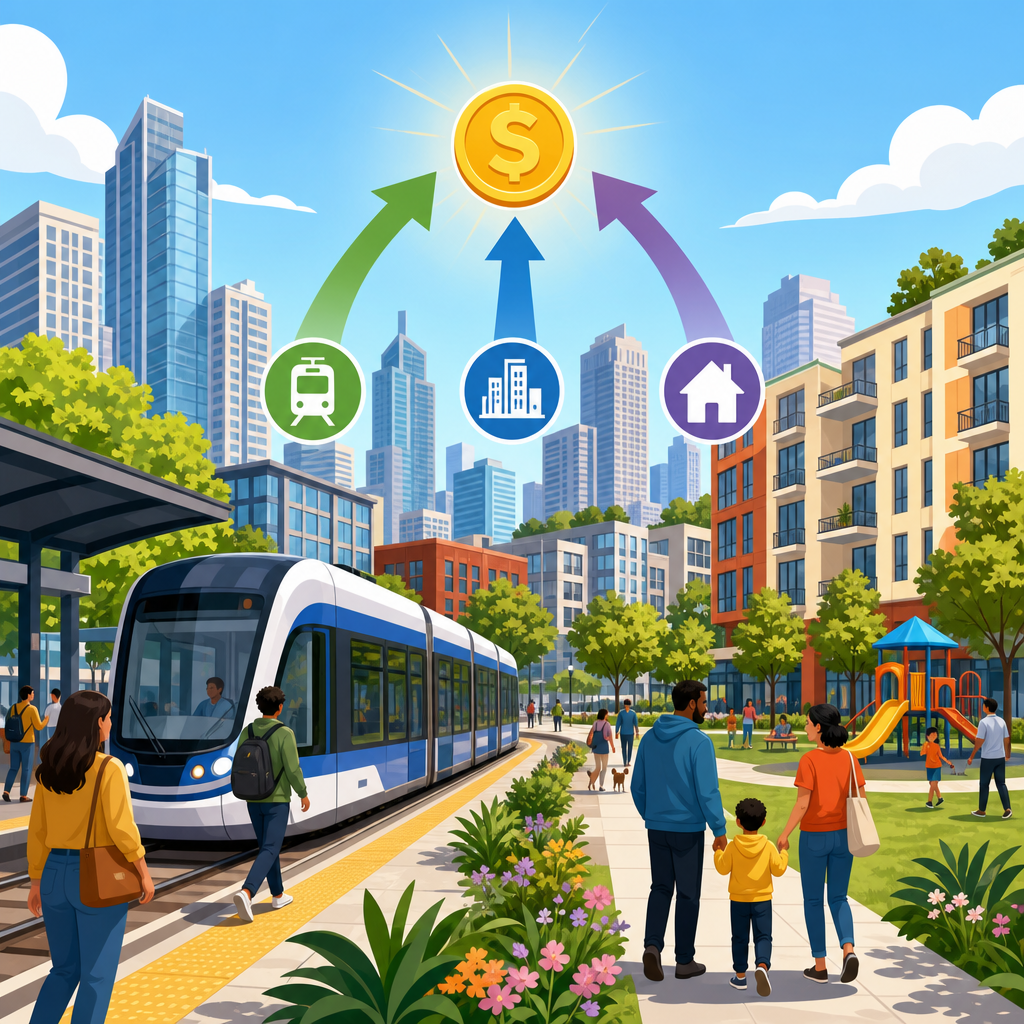
Land value capture for transit and affordable housing is a public finance strategy that converts rising property values near public investment into funding for infrastructure and below-market homes. When a city builds a rail line, rezones land for greater density, improves streets, or creates a station area plan, nearby parcels often become more valuable. That increase is not created by the landowner alone; it is produced partly by public action, community demand, and access improvements. Land value capture is the set of tools governments use to recover part of that publicly created value and direct it toward shared goals.
In practice, this topic matters because transit and affordable housing are capital intensive, politically difficult, and chronically underfunded. I have worked on station area plans where local leaders wanted more homes near trains, fewer long car commutes, and safer walking routes, yet the funding gap blocked implementation. At the same time, landowners around future stations expected major appreciation. That mismatch is exactly where land value capture becomes useful. It links growth to public benefit rather than allowing all gains to be privatized while public agencies carry the costs.
Key terms are straightforward. Transit refers to public transportation systems such as metro, light rail, bus rapid transit, commuter rail, and high-frequency bus corridors. Affordable housing usually means homes priced so lower- and moderate-income households spend no more than about 30 percent of income on housing costs, though program rules differ by jurisdiction. Land value is the market value of a site apart from buildings on it, while value uplift is the increase in market value caused by external changes such as infrastructure, rezoning, or neighborhood improvements. Capture mechanisms include taxes, fees, joint development, land banking, special districts, and development agreements.
This hub article explains how the field works, why timing and market conditions matter, what policy tools cities can use, and how to design programs that support both mobility and housing affordability. It also addresses the central tension: transit investment can raise land prices and displace residents unless governments act early. The best land value capture programs do not treat housing and transportation as separate silos. They use one coordinated framework for stations, zoning, finance, public land, anti-displacement measures, and long-term stewardship. For planners, elected officials, developers, and advocates, understanding that integrated approach is essential.
How land value capture works in urban planning
Land value capture works because accessibility is a market asset. When travel time falls, reliability improves, or regulations allow more floor area, buyers will pay more for certain parcels. The increase can be measured through sales comparisons, residual land value analysis, capitalization of expected rents, or before-and-after assessment data. Public agencies can then claim a portion of that uplift through a legal instrument. The basic principle is simple: if public action increases private land value, some of that increment can fund the public action itself or related community benefits.
The two main families of tools are tax or assessment based mechanisms and development or asset based mechanisms. Tax increment financing dedicates the future growth in property tax revenue within a defined district to repay project costs. Special assessment districts charge properties that benefit from improvements. Betterment levies and impact fees recover part of development gain. Development based tools include density bonuses, inclusionary zoning in some contexts, negotiated community benefit agreements, sale or lease of air rights, joint development at stations, and public land disposition with value-sharing terms. Land readjustment, widely used in parts of Asia, pools land parcels, services them with infrastructure, then redistributes smaller but more valuable plots to owners while reserving land or proceeds for public purposes.
Not every rise in value is capturable, and that is where many early discussions go wrong. Markets respond to interest rates, regional job growth, school quality, crime levels, construction costs, and expectations. A line on a planning map does not automatically create bankable value. Capture depends on enforceable entitlements, credible delivery timelines, and demand strong enough to absorb higher land prices. In weak markets, heavy charges can suppress development. In strong markets, modest charges may leave substantial public value untapped. Good policy starts with feasibility testing, legal review, and parcel-level analysis rather than slogans.
Why transit and affordable housing should be planned together
Transit and affordable housing belong in the same conversation because access is part of affordability. A household paying lower rent but spending heavily on cars, fuel, parking, and long commutes is not truly secure. The Center for Neighborhood Technology popularized the housing plus transportation lens years ago, and practitioners still rely on it because it reflects real budgets. Homes near reliable transit can lower transportation costs, increase access to jobs, reduce exposure to fuel price volatility, and improve household resilience. For that reason, the value created by transit should help secure homes for the people who benefit most from lower travel burdens.
The risk is that successful transit investment can trigger rent escalation, speculative acquisition, and displacement before the first train runs. This pattern appeared around new rail investments in many metropolitan areas, including parts of Los Angeles, Seattle, Denver, and the Washington region. The mechanism is familiar: investors anticipate future access gains, acquire property, and bid up land values. Existing renters, small businesses, and nonprofit housing providers often cannot compete. Without intervention, neighborhoods may gain transit but lose lower-income households, which undermines both equity and ridership goals.
Integrated planning changes that trajectory. Agencies can acquire land before major appreciation, reserve public parcels for mixed-income housing, align rezoning with affordability requirements, and dedicate station-area revenues to preservation and new production. They can also sequence infrastructure so that affordable housing sites receive utility upgrades, sidewalk improvements, and entitlement certainty early. In my experience, the most effective plans start before procurement and continue through operations. Once values have already run up and speculative expectations are entrenched, the public sector has far less room to shape outcomes at reasonable cost.
Major land value capture tools cities use
Cities use different tools depending on legal authority, market strength, ownership patterns, and project timing. No single mechanism is universally best. The table below summarizes the most common options and their practical fit for transit and affordable housing programs.
| Tool | How it raises revenue or value | Best use case | Main limitation |
|---|---|---|---|
| Tax increment financing | Captures future growth in property tax revenues within a district | Large transit corridors with rising assessed values | Depends on state law and strong tax base growth |
| Special assessment district | Charges benefited parcels based on frontage, value, or formula | Station access, streetscape, and local improvements | Property owners may resist if benefits seem uneven |
| Joint development | Leases or sells public land or station rights for private development | Agencies owning station land, parking lots, or air rights | Requires real estate expertise and careful procurement |
| Density bonus or negotiated exaction | Trades added development capacity for fees or affordable units | Upzoned transit districts with strong developer demand | Can reduce project feasibility if calibrated poorly |
| Land banking | Acquires sites early, then holds or disposes them strategically | Future stations in appreciating but not yet overheated areas | Needs upfront capital and political patience |
| Sale or lease of development rights | Monetizes transferable floor area or air rights | Dense downtown stations and rail yards | Complex valuation and entitlement coordination |
Tax increment financing is often the first tool people mention, but it should be used carefully. It does not create free money; it earmarks future tax growth that might otherwise support schools, general services, or county functions. In states where overlapping taxing entities must consent, negotiations can be difficult. Still, when a district has credible growth prospects and a defined capital program, tax increment financing can fund station access, utilities, land assembly, and structured parking removal or replacement. Chicago, Portland, and many California jurisdictions have used variations of this approach, though legal structures differ.
Joint development is especially relevant for transit agencies that control land. Agencies such as WMATA, BART, and Transport for London have long treated land as a strategic asset, not just leftover property. A ground lease can create recurring revenue while preserving public ownership and allowing the agency to require affordable housing, active ground floors, or phased construction. Public land disposition policies matter here. If an agency sells land to the highest bidder with no affordability terms, it may maximize a short-term receipt while losing long-term public value. If it structures a lease with shared upside and clear public objectives, it can support both ridership and housing production.
Policy design principles that make programs effective
Effective land value capture starts with timing. The public sector captures the most value when it acts before infrastructure announcements fully capitalize into prices. That usually means establishing station area policy, acquisition targets, and affordability goals during corridor planning, not after final design. Early action also reduces the need for expensive subsidy later. A city that buys key parcels at pre-announcement prices can make mixed-income development feasible with far less public assistance than a city that waits until speculative values peak.
Calibration is equally important. Charges must reflect local feasibility. Planners often use pro formas, comparable transactions, and sensitivity testing to estimate how much a project can absorb while still attracting capital. Construction type matters. A mid-rise wood frame project has a different residual land value than a high-rise concrete building above a station. Interest rates and insurance costs can quickly change viability. That is why successful programs revisit fee levels periodically rather than setting them once and assuming markets stay constant.
Governance determines whether revenues actually advance affordable housing. Dedicated funds, clear eligibility rules, and transparent reporting are essential. Many agencies establish a housing trust fund, station area fund, or corridor reinvestment account with legally defined uses such as acquisition, preservation, gap financing, tenant protections, or public realm improvements. Without earmarks, captured value can disappear into general budgets. With strong governance, the public can track how many units were preserved or built, which neighborhoods received investments, and whether benefits reached target income groups.
Finally, anti-displacement policy must sit beside value capture, not behind it. Tools include preservation loans for existing subsidized housing, right-to-return policies, tenant counseling, acquisition funds for nonprofit developers, small business support, community land trusts, and property tax relief for vulnerable homeowners. These measures are not optional add-ons. They are part of the core implementation package when transit is expected to increase market pressure. If a city captures value but allows widespread displacement, it has failed the central test of equitable transit-oriented development.
Common challenges, tradeoffs, and lessons from practice
The biggest challenge is that land value capture cannot fund everything everywhere. In very weak markets, there may be little uplift to capture. In very strong markets, uplift may be large, but political conflict over who benefits becomes sharper. Legal constraints also matter. Some states limit special assessments, restrict tax increment structures, or require voter approval for certain levies. Transit agencies may lack real estate capacity, and local governments may lack staff who can model absorption, appraise air rights, or negotiate sophisticated development agreements. Implementation capacity is often the hidden constraint.
There are also real tradeoffs between maximizing revenue and maximizing affordability. A city can demand high payments from market-rate projects, but if the requirement pushes sites into inactivity, both housing production and public revenue suffer. Conversely, a city can offer generous density with minimal public return, stimulating construction but missing an opportunity to finance transit access and subsidized homes. The right balance depends on evidence, not ideology. In practice, I have seen the best results where agencies tested multiple scenarios, consulted lenders and nonprofit developers, and adjusted policy after observing actual project performance.
Several lessons recur across cases. First, public land is often the strongest leverage point because it avoids paying inflated acquisition costs. Second, simple tools usually outperform overly customized formulas that few people understand. Third, corridor-wide strategies work better than isolated parcel negotiations because investors value predictability. Fourth, affordable housing preservation deserves as much attention as new construction, since losing existing lower-cost units can erase gains quickly. Finally, success should be measured not only by dollars captured but by outcomes: reduced displacement, more homes near transit, higher ridership, and stronger neighborhood access to jobs and services.
Building a durable transit and housing strategy
Land value capture for transit and affordable housing gives cities a practical way to turn public investment into lasting public benefit. The concept is straightforward: when transit, rezoning, and place-making increase land values, a share of that gain should help pay for infrastructure and secure homes near opportunity. The details are harder, but the path is clear. Start early, analyze markets honestly, choose legally sound tools, protect existing residents, and dedicate revenues to transparent goals.
The main benefit is alignment. Instead of treating transit as a transport expense and affordable housing as a separate social program, land value capture connects them through the real estate market that links both. That alignment can support new housing, preserve existing affordability, improve station access, and strengthen ridership over time. It also builds a fairer civic bargain: communities that help create value receive a share of the return.
For urban planners, housing agencies, transit operators, and local leaders, the next step is simple. Review upcoming corridors and station areas now. Identify where value uplift is likely, map vulnerable residents, inventory public land, and match each district with the capture tools it can realistically support. Done well, land value capture is not just a finance technique. It is a framework for building transit-rich, inclusive neighborhoods that remain accessible to the people cities depend on every day.
Frequently Asked Questions
What is land value capture, and why is it relevant to transit and affordable housing?
Land value capture is a public finance approach that directs a portion of the increased land or property value created by public action back into public purposes. In practice, this means that when a city builds a new rail line, upgrades a bus corridor, improves sidewalks and utilities, or changes zoning to allow more housing and commercial activity, nearby land often becomes more valuable. That value increase is not generated solely by the private property owner. It is also created by taxpayer-funded infrastructure, public planning decisions, broader market demand, and the improved accessibility that comes with transit and neighborhood investment.
This matters for transit and affordable housing because those two goals are deeply connected. Good transit makes neighborhoods more desirable and can increase rents and sale prices, which can in turn make it harder for lower- and moderate-income households to remain in place. Land value capture is designed to recover some of that publicly created value so it can help pay for the transit system itself, fund affordable homes near stations, preserve existing lower-cost housing, or support anti-displacement programs. In other words, it creates a mechanism for cities to reinvest growth back into inclusive development rather than allowing all of the upside to be privatized while the public bears the cost.
It is especially relevant in station areas and transit corridors where development pressure is strong. Without a capture strategy, rising land values can reward landholders but leave transit agencies and local governments scrambling for funding. With a well-designed strategy, cities can align infrastructure investment, housing production, and equity goals in a more deliberate way.
How do cities actually capture land value created by public investment?
Cities use a range of tools to convert rising land values into public revenue or public benefits. One common method is tax increment financing, in which the growth in property tax revenue above a set baseline is dedicated to pay for infrastructure, station-area improvements, or affordable housing. Another approach is a special assessment district, where properties that receive a measurable benefit from a transit improvement contribute an added assessment because their owners are expected to gain from increased access and higher values.
Development-related charges are also widely used. These can include impact fees, linkage fees, negotiated community benefit agreements, density bonuses, or inclusionary housing requirements tied to added development rights. For example, if a city upzones land near a station to permit taller buildings or more floor area, it may require that some of the new value created by that entitlement be returned through affordable housing units, land dedication, in-lieu fees, or infrastructure contributions. Joint development is another important tool, particularly for transit agencies that own land. In those cases, the agency can lease or develop publicly controlled parcels near stations and use the proceeds to support transit operations, capital needs, or mixed-income housing.
Some jurisdictions also use land banking, public land disposition policies, transferable development rights, or value-sharing requirements triggered by rezoning. The best tool depends on local law, market strength, administrative capacity, and political priorities. Strong markets can often support more robust capture mechanisms, while weaker markets may require a lighter touch to avoid discouraging development. The key principle is that public decisions that generate private windfalls can be structured so part of that benefit supports the broader community.
How can land value capture help fund affordable housing without stopping new development?
The central challenge is calibration. If value capture requirements are too weak, the public misses an opportunity to secure housing and infrastructure benefits. If they are too aggressive, projects may become financially infeasible and never get built. Effective land value capture for affordable housing works by identifying the real value created through public action and setting contributions at levels that the market can absorb.
Cities often begin with feasibility studies that test different development types, land costs, construction costs, financing assumptions, and expected rents or sale prices. Based on that analysis, they can structure policies that capture a reasonable share of new value while still allowing developers to earn enough return to proceed. This may include requiring on-site affordable units, allowing in-lieu payments into a housing fund, offering density bonuses, reducing parking requirements near transit, expediting approvals, or using public land to lower overall project costs. When done carefully, these tools can produce affordable housing and preserve project viability at the same time.
It is also important to understand that land value capture is often strongest when paired with increased development capacity. If a property owner receives a significant benefit through rezoning, station access, or public realm upgrades, there is usually a clearer basis for asking for an affordable housing contribution. In many cases, predictability matters as much as the fee level itself. Developers can price a transparent, consistently applied policy into land acquisition decisions over time. That means the burden is often absorbed partly through lower land prices rather than solely through higher housing prices or canceled projects. Well-designed policies therefore can support growth, direct some of its gains toward affordability, and make transit-oriented development more inclusive.
What are the biggest risks or criticisms of land value capture?
One common criticism is that land value capture can be complex and difficult to administer. Estimating how much value was created by transit, rezoning, or public improvements is not always straightforward, especially in markets where many factors affect prices at once. Cities need legal authority, technical expertise, reliable property data, and clear implementation systems to make these programs work well. Without that capacity, revenue may fall short of expectations or the process may become inconsistent and contested.
Another concern is market sensitivity. In very strong real estate markets, value capture can raise substantial revenue with limited effect on production. In weaker or uneven markets, however, the same policy can suppress development if it pushes projects beyond what lenders and investors will support. That is why one-size-fits-all requirements often perform poorly. Policies usually need to vary by submarket, project type, and timing, and they should be revisited periodically as economic conditions change.
There is also an equity concern if capture mechanisms are implemented too late. If land values rise quickly after a transit announcement, speculative acquisition can occur before protections are in place, driving up prices and increasing displacement risk. In those situations, value capture alone is not enough. It needs to be paired with tenant protections, acquisition funds, community land trusts, preservation strategies, and policies that secure affordable housing early in the planning process. Critics also point out that if governments rely too heavily on value capture, they may overstate future revenue or prioritize growth areas while neglecting neighborhoods that need investment but have less capacity to generate returns. A sound approach recognizes these limitations and treats land value capture as one tool within a broader housing and infrastructure finance strategy.
What does a fair and effective land value capture policy look like in practice?
A fair and effective policy starts with a simple idea: public investment should create public benefit. In practice, that means the rules should be transparent, legally durable, and tied to measurable value created by transit improvements, rezoning, or other government actions. Property owners and developers should know in advance what is expected, how contributions are calculated, where funds will go, and how the policy supports community goals such as affordable housing, better transit access, safer streets, and neighborhood stability.
Good policy design also includes strong equity safeguards. Revenue generated near transit should not only pay for capital improvements but also help preserve affordability for current residents and create housing opportunities for households that would otherwise be priced out. This may include dedicating a share of proceeds to deeply affordable homes, preservation of existing unsubsidized affordable buildings, down payment assistance, small business support, and anti-displacement measures. In station areas with public land, agencies can prioritize long-term ground leases and mixed-income development rather than outright land sales that maximize short-term revenue but reduce long-term public control.
Effective programs are typically shaped by market analysis, community engagement, and periodic review. They are flexible enough to respond to changing conditions but firm enough to ensure that public value is not lost through ad hoc negotiations. They also align housing, transportation, and land use policy rather than treating them as separate issues. When a city links transit planning with zoning, affordability targets, and value capture tools early on, it is much better positioned to produce walkable neighborhoods with reliable mobility and homes people of different incomes can actually afford. That is the real promise of land value capture: not just generating revenue, but turning growth into a more shared and durable public benefit.


