
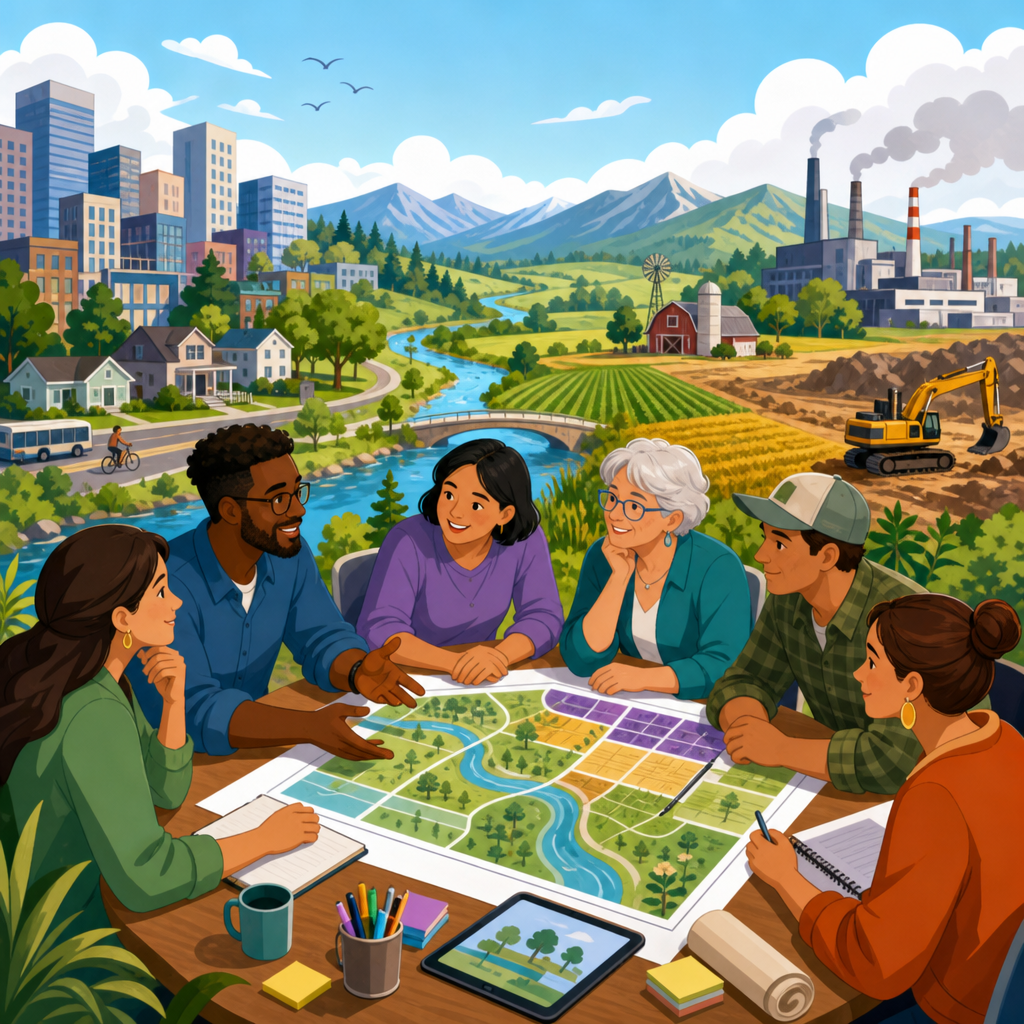
Land use conflict mediation helps planners, elected officials, developers, and residents resolve disputes over how land should be used before disagreement hardens into delay, litigation, or lasting mistrust. In practice, these conflicts arise when different groups assign different values to the same place: housing versus neighborhood character, renewable energy versus viewsheds, industrial jobs versus air quality, farmland preservation versus growth pressure, or public access versus ecological protection. Mediation is a structured, voluntary process in which a neutral third party guides stakeholders toward workable agreements without imposing a binding decision. For urban planning and policy, it matters because land decisions shape housing supply, transportation access, tax base, environmental health, and community legitimacy for decades.
I have worked on planning processes where a rezoning that looked straightforward on paper triggered intense backlash once neighbors understood traffic implications, school crowding fears, or the perceived loss of local identity. The technical merits of a proposal rarely settle the matter alone. Most land use disputes combine facts, law, economics, and emotion. A traffic impact study may be sound, yet residents may still resist because they distrust the applicant or believe earlier promises were broken. Effective mediation recognizes that conflict is not simply a communication failure. It is often a collision between legal entitlements, competing public interests, and unequal power.
Understanding a few key terms makes the field easier to navigate. Land use refers to the regulation and actual use of land for housing, commerce, industry, conservation, agriculture, recreation, and infrastructure. Conflict mediation differs from public engagement because it is designed specifically to address disputes, clarify interests, and negotiate options. It also differs from adjudication in zoning boards or courts, where a decision maker applies law and evidence to reach a ruling. Mediation is useful when parties need a durable solution, when relationships matter, and when the problem cannot be solved by technical analysis alone. In modern planning practice, it has become one of the most practical tools for reducing project risk while improving procedural fairness.
Why Land Use Conflicts Happen and Why Early Mediation Works
Land use conflicts usually emerge from three sources: incompatible goals, uncertain impacts, and low trust. A city may need more multifamily housing to reduce rents, while nearby homeowners worry about parking, building height, or strain on public services. A county may support utility-scale solar to meet climate targets, while farmers object to losing productive soils. A freight facility may promise jobs and tax revenue, while residents fear diesel emissions and nighttime noise. These are not irrational reactions. They reflect real tradeoffs that planning systems must surface and manage.
Early mediation works because it moves discussion from fixed positions to underlying interests before formal hearings polarize the debate. Once a conflict enters a public hearing format, speakers often perform for allies, attorneys narrow arguments to legal points, and compromise becomes politically harder. By contrast, a mediated process can ask practical questions directly: What setback would reduce visual impact? What truck route avoids the elementary school? What community benefit agreement would make a project more acceptable? In one suburban infill case I supported, the breakthrough came only after residents and the development team jointly reviewed shadow studies and loading schedules in a small workshop rather than repeating scripted objections at hearings.
Conflict intensity also rises when planning information is fragmented. Applicants may submit technically complete reports that are inaccessible to lay readers. Residents then fill gaps with assumptions, often spread rapidly through neighborhood forums or social media. A mediator can slow that cycle by establishing shared facts, plain-language summaries, and a sequence for discussing unknowns. This does not guarantee consensus, but it prevents avoidable escalation. For planners, the core lesson is simple: if a proposal is likely to affect identity, property expectations, mobility, health, or environmental quality, mediation should be considered before the entitlement path becomes adversarial.
Core Mediation Tools Planners and Communities Can Use
The most effective land use conflict mediation relies on a repeatable toolkit rather than charisma. The first tool is stakeholder mapping, which identifies everyone with a material interest in the decision, including groups often missed in standard outreach. That means not only adjacent owners and applicants, but also tenants, school districts, transit agencies, tribal governments where applicable, environmental justice communities, small business operators, and utility providers. A good stakeholder map distinguishes between decision makers, affected parties, technical experts, and informal influencers. Missing even one group can undermine an agreement later.
The second tool is issue framing. Planners should separate matters of law from matters of negotiation. If local code caps height at six stories, mediation cannot treat ten stories as equally available unless a legislative change is genuinely on the table. At the same time, many high-conflict items are negotiable: façade articulation, phasing, access management, landscaping, operating hours, truck routing, stormwater features, affordable housing commitments, or park improvements. Clear framing prevents false expectations and keeps the conversation on solvable questions.
The third tool is a jointly accepted fact base. In practice, this often means agreeing on baseline data sources and methods before debating solutions. For transportation, that may include Institute of Transportation Engineers trip generation references, local turning movement counts, and safety data. For environmental questions, it may include floodplain mapping, wetlands delineation, air dispersion modeling, or noise measurements. For market feasibility, it may involve pro formas reviewed under confidentiality by an independent consultant. Shared facts matter because parties rarely agree on solutions if they cannot agree on conditions.
The fourth tool is option generation through scenario planning. Rather than asking stakeholders to react to a single proposal, mediators develop multiple scenarios that test different combinations of density, design, land preservation, access, and public benefits. This method lowers defensiveness and reveals where value can be created. A community that rejects a warehouse at one scale may accept a smaller logistics use with electric truck infrastructure, strict delivery windows, and a vegetated buffer. A neighborhood that opposes apartments may support mixed-income housing above ground-floor services if parking is managed and open space is protected.
| Tool | Primary Purpose | Example in Practice |
|---|---|---|
| Stakeholder mapping | Identify all affected and influential parties | Including tenants and school officials in a rezoning process, not just homeowners |
| Issue framing | Separate legal constraints from negotiable items | Recognizing building height is capped, while loading hours can be negotiated |
| Joint fact-finding | Create a shared evidence base | Using one agreed traffic model and one flood risk dataset |
| Scenario planning | Test alternative packages of tradeoffs | Comparing three site layouts with different access, density, and open space |
| Written agreements | Translate discussion into enforceable commitments | Memorializing buffers, monitoring, and construction management terms |
The fifth tool is documentation. Verbal understandings fail when staff changes, elections shift priorities, or project financing introduces new actors. Mediated outcomes should be translated into development agreements, conditions of approval, memoranda of understanding, design guidelines, construction management plans, or monitoring protocols. The right format depends on local law. What matters is that commitments become specific, measurable, and trackable over time.
How to Run a Credible Mediation Process
A credible process starts with process design. Before the first joint meeting, the planner or mediator should define scope, participants, timeline, decision points, confidentiality rules, and the relationship between mediation and formal approvals. Communities lose faith quickly when mediation feels like theater or when participants discover that key decisions were already made. The neutral must be accepted as independent, especially in high-stakes cases involving major institutional landowners, controversial rezonings, or environmental justice concerns. In many jurisdictions, trained public policy mediators, consensus building practitioners, or land use attorneys with facilitation experience fill this role.
Ground rules are not cosmetic. They protect the process from collapse. Effective rules usually cover respectful speaking, time limits, data sharing, media communication, and how caucuses or private sessions will be used. They also define whether the goal is full consensus, broad agreement, or a clarified record of unresolved issues. Not every dispute ends in unanimity. A successful mediation may instead narrow disagreement, produce conditions that reduce impact, and establish a monitoring framework that builds trust after approval.
Joint fact-finding deserves special attention because it is where many planning disputes either calm down or intensify. The best practice, drawn from consensus building literature and used by agencies across the United States, is to let parties help frame technical questions before consultants produce answers. If neighbors distrust a traffic study, they should be able to question assumptions such as peak hour timing, pass-by trip rates, or site access distribution before the model is finalized. If flood risk is central, the parties should understand whether the analysis uses current rainfall data, future climate assumptions, and downstream effects. Technical transparency is one of the strongest antidotes to procedural distrust.
Finally, process credibility depends on visible follow-through. If mediation produces a commitment to tree preservation, truck restrictions, local hiring outreach, or post-occupancy noise monitoring, someone must be responsible for implementation and reporting. Municipalities often underestimate this step. I have seen solid agreements unravel because no department was assigned to inspect compliance or because approval conditions were too vague to enforce. Durable mediation outcomes require administrative capacity, not just goodwill.
Common Land Use Disputes and Practical Resolution Strategies
Housing disputes are among the most frequent and politically charged. Neighbors may oppose multifamily or supportive housing because of traffic, parking, school enrollment, building scale, or stigma. The practical response is not to dismiss these concerns, but to unpack them. Parking can be addressed through transportation demand management, residential permit systems, shared parking studies, and unbundled parking. Scale concerns can be addressed through step-backs, transitions in height, façade modulation, and open space placement. School impacts can be modeled and addressed through phasing or fees where authorized. When the conflict is really about fear of displacement or exclusion, mediation should include anti-displacement tools, affordability covenants, and tenant protections in the conversation.
Industrial and logistics disputes often center on externalities: noise, truck traffic, emissions, lighting, and operating hours. These cases benefit from operational specificity. Communities need to know not just what is being built, but how it will function day to day. Effective agreements may designate haul routes, prohibit idling, require electric charging infrastructure, limit overnight loading, install sound walls, and set complaint response timelines. For air quality, planners should look closely at cumulative burden, especially near schools or overburdened neighborhoods. Broad assurances do not resolve these disputes; measurable operating conditions do.
Energy and environmental conflicts require careful balancing of climate, conservation, and local land values. Wind projects can raise concerns about views, wildlife, noise, and setbacks. Solar facilities can trigger debate over prime farmland conversion, glare, stormwater runoff, and decommissioning. Transmission lines may be necessary for reliability but deeply disruptive to communities along the route. Mediation is especially valuable here because no single metric captures the full public interest. Successful processes often compare sites, mitigation packages, habitat offsets, agricultural compatibility measures, and long-term restoration obligations rather than treating the proposal as all or nothing.
Public space and conservation disputes can be just as difficult. A city may want more trail access, while nearby residents worry about parking overflow and habitat disturbance. A coastal community may support shoreline protection, while fishers oppose restrictions that affect livelihoods. In these cases, phased pilots work well. Temporary access plans, seasonal closures, visitor caps, ranger presence, and adaptive management can test solutions before permanent rules are adopted. Mediation is at its best when it creates a learning process, not merely a one-time compromise.
Technology, Law, and Long-Term Capacity for Better Outcomes
Modern mediation is stronger when supported by good tools and clear legal grounding. Geographic information systems can visualize buffer impacts, pedestrian access, flood exposure, tree canopy, parcel ownership, and environmental justice indicators in ways that make conflict legible. Three-dimensional modeling helps residents understand height, shadows, and view impacts better than flat plans. Online engagement platforms can widen participation, but they should supplement, not replace, in-person meetings, translated materials, and targeted outreach. Digital tools are useful only if they reduce information asymmetry instead of amplifying it.
Legal context matters because mediated agreements must fit within zoning, subdivision regulations, comprehensive plans, environmental review, fair housing obligations, and constitutional limits such as due process and equal protection. Conditions of approval must have a nexus to project impacts and be enforceable under local law. Exactions must be handled carefully. Communities sometimes ask for benefits unrelated to the proposal, while applicants sometimes promise items they cannot legally deliver. A skilled mediator and planning staff team should know where flexibility exists and where the law sets hard boundaries.
Long-term capacity is the final differentiator. Jurisdictions that handle land use conflict well usually invest in staff training, model participation plans, plain-language templates, and protocols for dispute resolution before controversy erupts. They also track outcomes: appeal rates, permit delays, litigation frequency, implementation of conditions, and post-approval complaints. Those metrics reveal whether mediation is reducing conflict or simply relocating it. For planners and communities, the central benefit is not harmony for its own sake. It is better decisions that stand up over time because they are informed, legitimate, and realistic. If your city or organization faces recurring land disputes, build mediation into the planning process early, train people to use it well, and turn conflict into a more durable form of public problem-solving.
Frequently Asked Questions
What is land use conflict mediation, and how is it different from a standard public hearing?
Land use conflict mediation is a structured, facilitated process used to help people with competing interests work through disagreements about how land should be used. It is designed to bring planners, residents, developers, elected officials, agency staff, and other stakeholders into a problem-solving conversation before positions harden into formal opposition, delay, or legal action. Instead of treating a conflict as a win-or-lose debate, mediation focuses on identifying the underlying concerns, values, and tradeoffs driving the dispute. That often includes issues such as traffic, housing affordability, neighborhood character, environmental impacts, economic development, agricultural preservation, public access, and long-term community identity.
A standard public hearing usually happens later in the decision-making process and is often governed by procedural rules, time limits, and formal testimony. In that setting, participants typically speak to a decision-maker rather than with one another. The format can be important for transparency and legal compliance, but it is not always well suited to collaborative problem solving. Mediation, by contrast, is interactive. It allows participants to ask questions, test options, clarify misunderstandings, and explore creative alternatives that may not emerge in a hearing room. In many cases, mediation does not replace hearings or formal approvals; it complements them by improving communication and narrowing disputes before final decisions are made.
Another key difference is that mediation pays close attention to relationships and trust, not just the technical merits of a proposal. A land use conflict may appear to be about building height, setbacks, noise, or drainage, but underneath there may be deeper concerns about fairness, transparency, cumulative neighborhood change, or whether residents feel heard. A skilled mediator helps surface those concerns in a constructive way. That can reduce polarization and make it easier to reach durable agreements that communities and applicants are more likely to support and implement.
When should planners and communities use mediation in a land use dispute?
Mediation is most effective when it starts early, ideally as soon as planners or community leaders recognize that a proposal or policy change is triggering strong disagreement. Early signs include organized neighborhood opposition, conflicting agency comments, repeated misinformation, escalating rhetoric, threats of appeal or litigation, or meetings where the same parties keep talking past one another. At that stage, mediation can still help shape the options on the table. Once a conflict becomes entrenched, solutions are still possible, but the process usually takes more time and effort because trust has already eroded.
It is especially useful in disputes where the issues are technically complex, politically sensitive, or value-laden. Common examples include siting affordable housing, rezoning agricultural land, approving renewable energy projects, expanding industrial uses near residential areas, balancing shoreline or trail access with habitat protection, or redeveloping historic or culturally significant places. In each of these situations, the parties are often not simply arguing over facts. They are assigning different meanings and priorities to the same landscape. Mediation creates room to discuss those differences openly and translate them into practical design changes, mitigation measures, phasing strategies, community benefits, or monitoring commitments.
Planners should also consider mediation when a conflict affects long-term civic relationships. Even if a single permit decision moves forward, unresolved resentment can spill into future planning efforts, capital projects, and elections. Mediation can help preserve the working relationships a community needs to make good decisions over time. That said, not every issue requires full-scale mediation. Sometimes targeted facilitation, a design workshop, a listening session, or a small-party negotiation can address the core problem. The right approach depends on the number of stakeholders, the level of mistrust, the legal timeline, and whether the parties are willing to engage in good faith.
What tools are most effective in resolving land use conflicts before they escalate?
The most effective tools combine strong process design with clear information and meaningful opportunities for participation. One of the first and most important tools is stakeholder mapping. This means identifying not just the loudest voices, but all groups affected by the decision, including adjacent residents, property owners, tenants, workers, tribal representatives, advocacy organizations, environmental interests, business groups, and public agencies. Good stakeholder mapping helps planners avoid a common mistake: assuming the conflict is only between two visible sides when, in reality, there may be several distinct interests with different concerns and possible areas of agreement.
Another essential tool is a neutral facilitator or mediator. Neutrality matters because many land use conflicts are fueled by distrust of process as much as disagreement over substance. A trained facilitator can set ground rules, manage speaking time, reframe inflammatory statements, and keep discussions focused on interests and options rather than accusations. Joint fact-finding is also highly effective. In many disputes, parties disagree because they rely on different traffic studies, environmental data, market assumptions, or design interpretations. A joint fact-finding process allows participants to agree on what questions need to be answered, what experts should be consulted, and how uncertainty will be handled. That often reduces claims that information is biased or incomplete.
Visual and scenario-based tools can be equally powerful. Maps, 3D models, storyboards, build-out scenarios, view-shed analysis, shadow studies, and alternatives testing help people react to concrete possibilities rather than abstract fears. Design charrettes and workshop formats can help participants compare tradeoffs across multiple options, such as increased density with stronger buffering, renewable energy development with habitat setbacks, or public access improvements with seasonal ecological protections. Community agreements, memoranda of understanding, and development conditions are practical tools for translating discussion into commitments. Finally, strong communication tools matter more than many realize: plain-language summaries, multilingual outreach, accessible meeting formats, online engagement platforms, and transparent documentation all help prevent misunderstandings from becoming full-blown conflict.
How can communities balance competing values like housing, environmental protection, economic development, and neighborhood character?
Balancing competing land use values begins with accepting that these goals are not always fully compatible, but they are often more negotiable than they first appear. The real work of mediation is not to eliminate conflict entirely, but to make tradeoffs visible, discuss them honestly, and shape solutions that are legitimate, workable, and fair. For example, a housing proposal may raise concerns about scale, parking, tree loss, or school capacity, while also serving urgent affordability goals. A mediated process can help participants distinguish between impacts that can be mitigated, values that require protection, and assumptions that need testing. That distinction is critical because communities often make better decisions when they move from broad opposition to specific conditions and performance standards.
A useful approach is to separate interests from positions. A position might be, “No apartment building on this site.” The underlying interests could include concerns about traffic safety, privacy, infrastructure strain, displacement, or loss of neighborhood identity. Once those interests are clear, a broader range of solutions becomes available: revised site layout, stepped-down height transitions, affordability commitments, open space preservation, transportation demand measures, environmental restoration, or phased development tied to infrastructure improvements. The same principle applies in disputes over renewable energy, farmland, industrial expansion, or conservation. When stakeholders understand what others are trying to protect, they are more likely to consider alternatives that respect multiple values at once.
Good planners support this balancing process with policy context and objective criteria. Comprehensive plans, zoning ordinances, environmental standards, housing needs assessments, climate goals, and infrastructure plans all help define what the community has already said it values. Mediation works best when it is grounded in that framework rather than improvised from scratch. At the same time, communities should remain open to site-specific solutions that formal policy may not anticipate. Durable outcomes often come from combining policy consistency with creative design, mitigation, and accountability measures. In other words, the goal is not to make everyone equally happy. It is to develop a transparent, evidence-based, and respectful path forward that addresses the most important concerns while serving the broader public interest.
What makes a land use mediation process successful, and how do you know whether it worked?
A successful land use mediation process does more than produce an agreement on paper. It improves understanding, narrows areas of dispute, increases confidence in the process, and creates a clearer path for implementation. Success usually starts with good preparation. That includes defining the scope of the conflict, clarifying which decisions are negotiable, identifying who needs to be at the table, setting realistic timelines, and making sure participants understand how the mediation relates to formal planning and approval procedures. If people enter the process with false expectations, even a well-facilitated dialogue can unravel quickly.
Process quality is another major indicator of success. Participants should have access to understandable information, fair opportunities to speak, and confidence that their concerns are being accurately captured. Meetings should be structured enough to stay productive, but flexible enough to allow real discussion. Strong mediations often include clear agendas, issue summaries, decision logs, and written documentation of tentative agreements. They also make space for difficult conversations about power, historical mistrust, and cumulative impacts, especially in communities that have experienced exclusion or environmental burdens in the past. Ignoring those issues may create the appearance of progress while leaving the roots of conflict untouched.
You know mediation worked when the outcome is both substantively useful and socially durable. That may mean the parties reach full agreement, but it can also mean they narrow disagreements, refine a proposal, establish enforceable conditions, identify shared facts, or avoid unnecessary escalation. Practical indicators include fewer appeals, reduced project delay,


