
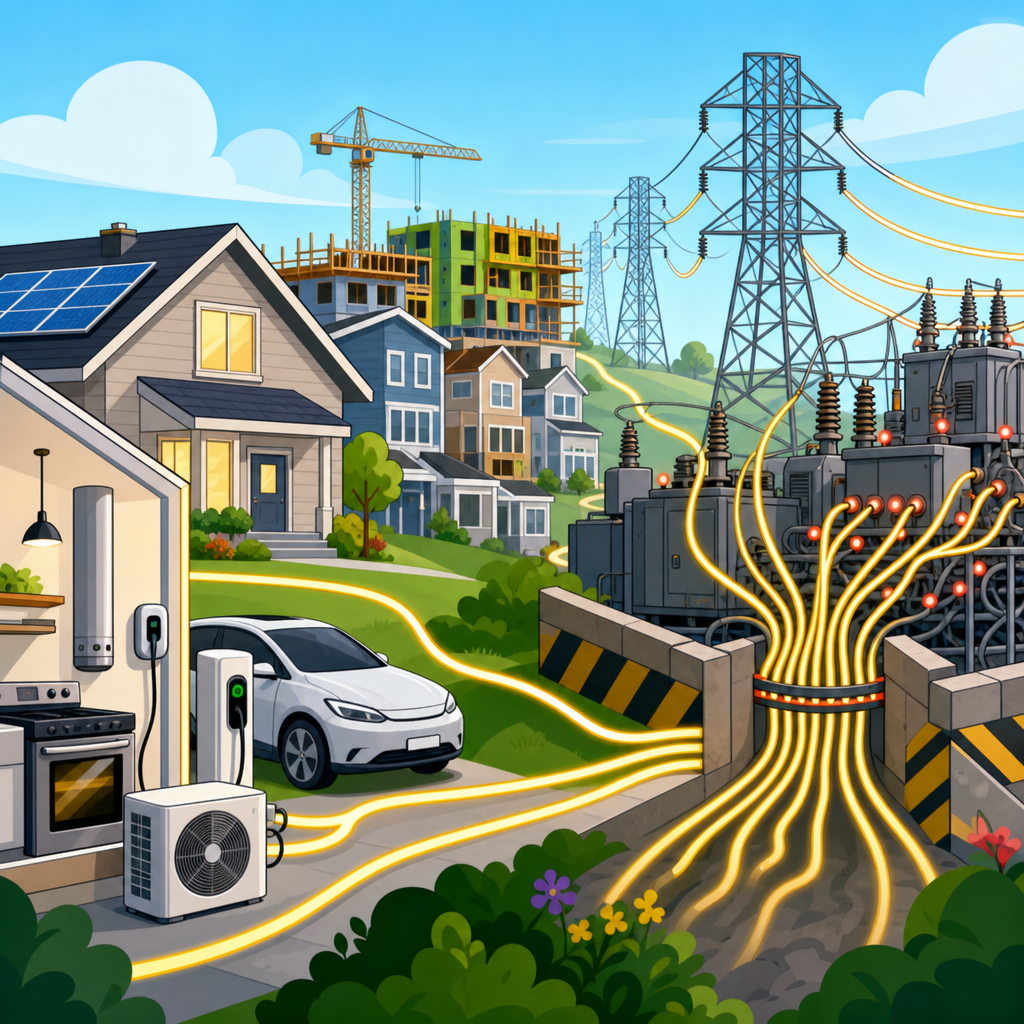
Grid capacity is becoming the quiet constraint behind housing growth, climate policy, and the practical rollout of building electrification. In planning meetings, utility filings, and development pro formas, the central question increasingly sounds simple: can the local electric system support more homes, more heat pumps, more electric water heaters, and more electric vehicle charging without long delays or major upgrade costs? That question defines the housing-electrification bottleneck. Grid capacity refers to the ability of generation, transmission, substations, feeders, transformers, and service lines to deliver electricity reliably at the times and places customers need it. Housing electrification means shifting residential end uses that commonly rely on fossil fuels, especially space heating, water heating, and cooking, onto electricity, ideally through efficient technologies such as cold-climate heat pumps and heat pump water heaters.
This matters because housing and energy systems now collide in the same permitting queue. Cities want more homes to address affordability. States want lower building emissions to meet climate targets. Utilities must maintain reliability under rules set by public utility commissions, regional grid operators, and engineering standards. Developers, meanwhile, need service connections on a predictable schedule. I have worked on projects where a multifamily building was fully entitled and financed, yet construction paused because the utility estimated eighteen months for transformer replacement and feeder upgrades. The policy argument for electrification was sound, but the delivery system was not ready. That mismatch is no longer unusual; it is a structural issue affecting infill apartments, affordable housing, suburban subdivisions, and mixed-use redevelopment.
The bottleneck is not one problem but several stacked together. Some neighborhoods face local distribution constraints, such as overloaded transformers or feeders with little spare headroom. Other places have adequate wires nearby but lack substation capacity or face long interconnection backlogs. In dense urban areas, the challenge may be vault space, conduit congestion, or the time required to coordinate street cuts. In fast-growing metro fringes, new subdivisions can trigger expensive line extensions and substation expansions. Layer onto that the winter peak growth created by electric heating and the evening peak created by vehicle charging, and planners quickly see why electrifying housing is not merely a technology swap. It is an infrastructure sequencing problem, a land-use problem, and a governance problem that demands coordinated decisions across agencies that rarely move in step.
What grid capacity means in housing development
For housing, grid capacity is best understood at three levels. First is bulk power: enough generation and transmission to serve regional demand. Second is local distribution: substations, feeders, transformers, and secondary networks that physically deliver power into neighborhoods. Third is customer interconnection: the service drop, panel, meter, and on-site equipment that allow a specific building to use power safely. A project can clear one level and fail at another. A city may sit inside a power-rich region, yet a single street segment can still lack enough local capacity for a midrise apartment building with all-electric systems. That is why early utility coordination is now as important to housing feasibility as zoning, parking, or stormwater review.
Load is the core concept. Utilities design systems around expected demand, not just annual energy use. A hundred apartments with efficient heat pumps may consume modest yearly energy, but if many units need heat during the same cold morning, the coincident peak can strain local equipment. Peak demand is what drives transformer sizing, conductor limits, and substation upgrades. Electrification changes load shape. Gas-heated buildings typically use electricity for lights and appliances, creating one pattern. Fully electric buildings add heating, water heating, induction cooking, and often vehicle charging, creating another. The efficiency of heat pumps helps, but capacity planning still turns on the timing and simultaneity of demand.
Developers often discover this distinction too late. A utility service letter may initially seem routine, then evolve into a major cost item after detailed engineering shows a pad-mounted transformer must be upsized, a feeder reconductored, or a substation relay setting reviewed. In some jurisdictions, the developer pays only project-specific connection costs. In others, line extension rules, demand thresholds, or special facilities charges can assign a large share of upstream upgrade costs to the first mover. That creates uncertainty, and uncertainty is deadly for affordable housing finance, where layered tax credits, public subsidies, and fixed construction budgets leave little room for surprise electrical infrastructure bills.
Why electrification stresses the system differently
Electrification is not simply more of the same electric load. It changes seasonality, coincidence, and customer behavior. In many U.S. regions, summer air-conditioning historically set the peak. As homes adopt heat pumps, winter peaks can rise sharply, especially during cold snaps when many systems run at once and electric resistance backup may engage. Water heating can also contribute to morning and evening peaks. Add unmanaged vehicle charging after work, and the local evening ramp becomes steeper. Utilities therefore must plan for not only higher consumption but more synchronized demand at precisely the hours when equipment is already stressed.
Cold-climate heat pumps are far more efficient than baseboard resistance heat and usually more efficient than electric furnaces, but efficiency does not eliminate peak challenges. A building switching from gas to heat pumps may reduce emissions and operating costs while still increasing electrical demand enough to require service upgrades. Multifamily properties can mitigate this with central systems, thermal storage, diversified load assumptions, and high-performance envelopes. Still, the engineering needs to be explicit. In practice, I have seen successful projects pair envelope improvements with load calculations based on Manual J, heat pump performance data at design temperatures, and realistic domestic hot water diversity factors rather than optimistic nameplate assumptions.
Another complication is the mismatch between policy calendars and utility asset timelines. Building codes can require electric-ready or all-electric construction in one adoption cycle. Utility upgrades, by contrast, may require procurement of transformers, switchgear, and cable with lead times that have recently stretched well beyond a year. Distribution planning also depends on forecasts, capital approval, rights-of-way, and outage coordination. You can mandate electrification quickly; you cannot manufacture substation capacity by ordinance. This timing gap is the heart of the bottleneck.
Where the bottleneck appears first in cities and suburbs
Urban cores, inner-ring suburbs, and greenfield growth areas each experience the problem differently. In downtown network districts, the issue may be legacy underground infrastructure designed for older building types. Network protectors, vaults, and secondary systems can be expensive to modify, and street work requires coordination among transportation departments, water utilities, and private telecom providers. In older residential neighborhoods, small pole-top transformers and aging secondary conductors often become the weak link when homes add heat pumps, panel upgrades, and vehicle chargers. In new suburban growth corridors, local capacity may not exist at all, forcing developers to wait for feeder extensions or entirely new substations.
Affordable housing is especially exposed. These projects often target infill sites with constrained utility corridors and limited flexibility on schedule. A market-rate developer might absorb delay by repricing units; an income-restricted project usually cannot. Public agencies promoting decarbonization sometimes miss this implementation detail. Requiring all-electric design without funding predevelopment utility studies or off-site upgrades can unintentionally slow the very housing they want to accelerate. The equity issue is clear: if capacity upgrades happen only where high-margin projects can pay first, lower-income neighborhoods and nonprofit developers get stuck at the back of the queue.
| Setting | Typical constraint | Housing impact | Practical response |
|---|---|---|---|
| Dense urban core | Underground network limits, vault space, street coordination | Longer interconnection timelines for multifamily projects | Early utility design review and corridor mapping |
| Older inner-ring suburb | Undersized transformers, aging feeders, limited panel capacity | Retrofit delays and costly service upgrades | Targeted neighborhood capital plans and managed load programs |
| Greenfield edge growth | Need for new feeders or substations | High upfront infrastructure charges and phased buildout risk | Infrastructure financing districts and coordinated sequencing |
How planners, utilities, and developers can reduce delays
The most effective response is coordinated planning before a project reaches final design. Cities should map housing growth areas against utility hosting capacity, substation loading, and capital improvement plans. Utilities already perform distribution planning, but those studies are often not aligned with rezoning, comprehensive plans, or housing element targets. When local governments share parcel-level development forecasts and electrification assumptions, utilities can model future load more accurately and schedule upgrades sooner. Conversely, when utilities provide planners with transparent capacity signals, jurisdictions can steer high-load projects toward better-served areas or phase policy requirements to match infrastructure readiness.
Project teams should treat electrical capacity as an early due diligence item, not a late-stage technicality. That means requesting preliminary load letters, confirming service voltage, reviewing transformer and feeder conditions, and stress-testing whether proposed amenities, especially centralized electric domestic hot water and parking-area charging, alter the interconnection path. Design choices matter. Smart panels, load management for chargers, staggered water-heating controls, and battery-supported peak shaving can reduce maximum demand and avoid some upgrades. For larger buildings, thermal storage and central heat pump plants can flatten peaks more effectively than unitized equipment. None of these strategies replaces system investment, but they can defer or right-size it.
Policy design also needs sharper tools. One useful approach is to distinguish electric-ready from all-electric mandates where local capacity is constrained, while setting a clear transition timeline. Another is to fund neighborhood-scale upgrades in advance of private development through rate-based utility investment, tax increment financing, or state infrastructure grants. Performance-based utility regulation can help if it rewards timely interconnections, non-wires alternatives, and transparent queue management instead of only capital deployment. The key principle is simple: if public policy wants cleaner homes quickly, it must address the shared infrastructure that sits between the meter and the substation.
What this means for urban planning and policy
The housing-electrification bottleneck changes how urban planning should evaluate land supply, infrastructure adequacy, and decarbonization strategy. Zoning capacity on paper is no longer enough; jurisdictions need energy capacity realism. Comprehensive plans should include utility coordination, building load forecasts, and subarea strategies for electrification-intensive growth. Climate action plans should identify where all-electric construction is easiest now, where retrofit programs need grid support first, and where non-wires solutions can buy time. Building departments, housing agencies, and utilities should share data definitions so forecasts of units, square footage, and end-use assumptions are consistent rather than contradictory.
For policymakers, the lesson is that electrification succeeds when infrastructure timing, financing, and regulation are aligned. Grid capacity is not an argument against more housing or cleaner buildings. It is a reminder that urban systems are interdependent. The best-performing jurisdictions plan feeder upgrades alongside rezoning, support developers with early capacity information, and invest in demand flexibility so electrified homes do not automatically translate into uncontrolled peak growth. If you work in planning, housing, or local policy, start by asking one concrete question of every major project and every growth area: where will the electric capacity come from, and when will it be ready? That question turns ambition into implementation.
Frequently Asked Questions
What does “grid capacity” actually mean in the context of housing and building electrification?
In this context, grid capacity refers to the ability of the electric system to deliver additional power reliably to new homes, multifamily buildings, and electrified loads such as heat pumps, electric water heaters, induction cooking, and electric vehicle charging. It includes more than the bulk power supply on the regional grid. It also depends on the local distribution system: substations, feeders, transformers, service lines, and protection equipment that ultimately deliver electricity to a neighborhood or a specific project site. A region may have adequate overall generation, but a particular circuit or substation can still be constrained, creating a bottleneck for housing growth and electrification.
That is why the issue increasingly shows up in planning meetings and development underwriting. A proposed project may be perfectly viable from a zoning, financing, and market-demand standpoint, yet still face delays or unplanned costs because the local utility must study whether the existing system can support the added demand. If the answer is no, the developer may need to wait for infrastructure upgrades, contribute to upgrade costs, redesign the project’s load profile, or phase construction differently. In practical terms, grid capacity is not just an engineering concept. It has become a timing, cost, and feasibility issue that affects housing delivery, decarbonization goals, and the speed at which buildings can transition away from fossil fuels.
Why is grid capacity becoming a bottleneck for new housing development?
Grid capacity is becoming a bottleneck because several major trends are converging at once. Many regions need more housing, and more of that housing is expected to be electric-ready or fully electrified to align with climate policy, air-quality goals, and building-code changes. At the same time, utilities are seeing load growth from electric vehicles, data centers, industrial expansion, and the broader shift from fossil fuels to electricity. Much of the local distribution system was not originally designed for rapid, simultaneous increases in residential electric demand across multiple sectors. As a result, what used to be a fairly routine utility connection process can now trigger more extensive engineering reviews and infrastructure upgrades.
For developers, this can create a chain reaction. Interconnection studies may take longer. Upgrade costs may emerge later in the process than expected. Construction schedules can be disrupted if a substation expansion, feeder reconductoring, or transformer replacement is needed before occupancy. For local governments, the problem is equally significant because housing targets and climate targets can begin to compete with one another if the electric system is not ready to support both. In other words, the bottleneck is not simply about whether electrification is desirable. It is about whether the physical network, planning process, and investment pipeline are moving fast enough to support the scale of housing growth and electrified end uses that policy now assumes.
Which electrified building loads tend to create the biggest local grid challenges?
The biggest challenges usually come from the cumulative effect of several loads rather than a single appliance on its own. Space heating with heat pumps can be especially important because it can increase winter peak demand in regions that historically peaked in summer. Electric resistance backup heating, if used, can further raise peak loads during cold weather events. Electric water heating also matters because it adds substantial load, though it can often be managed more flexibly with controls and storage strategies. Electric vehicle charging is another major factor, particularly in multifamily housing where many vehicles may charge during overlapping evening hours. Common-area loads, elevators, ventilation systems, and cooling also contribute, especially in large residential buildings.
What utilities care about most is not just annual energy use but coincident peak demand: when many loads turn on at the same time and stress local infrastructure. A neighborhood with widespread EV adoption, increasing air-conditioning use, and new all-electric housing can see transformer and feeder constraints much sooner than headline energy forecasts might suggest. That is why load diversity, demand management, and project design matter so much. Smart charging, heat-pump water heaters with load shifting, thermal storage, building controls, and panel and equipment sizing strategies can materially reduce the burden on the grid. The challenge is therefore not simply that electrified buildings use electricity. It is that poorly coordinated electrification can create expensive peaks, while well-planned electrification can often fit more successfully within existing system limits.
How do grid constraints affect project costs, timelines, and housing affordability?
Grid constraints can affect a project at multiple stages, and the consequences can be substantial. Early in development, uncertainty about available capacity can complicate site selection and due diligence. A parcel that looks attractive on paper may turn out to require significant utility upgrades, which can alter the project budget or make the deal unworkable. During design and entitlement, teams may need to revisit mechanical systems, EV charging plans, or phasing assumptions based on utility feedback. During construction, delays in utility studies, equipment procurement, or off-site infrastructure work can push back energization and occupancy dates. Each delay can increase carrying costs, create financing stress, and reduce overall project viability.
Those impacts often flow directly into affordability. If electrified housing requires major off-site upgrades with unclear cost allocation, the added expense may be absorbed through higher rents, higher sale prices, reduced project scope, or the loss of below-market units. In some cases, developers may shift to less ambitious electrification approaches simply to avoid uncertain utility timelines. That creates a tension between housing production goals and decarbonization goals, especially in high-cost markets where margins are already thin. The broader policy implication is that grid readiness is becoming part of housing affordability infrastructure. Just as roads, sewers, and water systems shape where and how homes can be built, electric capacity now plays an increasingly decisive role in whether all-electric or mixed-load housing can be delivered on time and at a cost the market or subsidy structure can support.
What are the most effective ways to reduce the housing-electrification bottleneck?
The most effective solutions combine better planning, targeted infrastructure investment, and smarter building design. On the utility side, proactive distribution planning is essential. Utilities and regulators can identify housing growth areas, likely electrification adoption patterns, and feeder-level constraints before projects arrive one by one. That allows upgrades to be planned strategically rather than reactively. Faster and more transparent interconnection and service-review processes also matter, because developers need earlier visibility into timelines, costs, and feasible load assumptions. In many cases, public policy can help by aligning utility capital planning with housing production goals and building-decarbonization mandates rather than treating them as separate policy tracks.
At the project level, developers and design teams can reduce bottlenecks by engaging utilities early, modeling realistic load shapes, and incorporating flexible-load strategies from the start. Managed EV charging, demand-response capability, heat-pump water heating with controls, thermal storage, battery systems where appropriate, and careful equipment sizing can all lower peak demand. In some locations, distributed energy resources such as rooftop solar and storage can support resilience and reduce certain grid impacts, though they are not a universal substitute for distribution upgrades. The larger point is that solving the bottleneck requires coordination. Housing agencies, utilities, regulators, local governments, and developers all need a shared view of where electrified growth is expected and what infrastructure is required to support it. When that coordination is missing, grid capacity becomes a hidden brake on both housing supply and climate progress. When it is present, electrification can scale much more predictably and affordably.


