
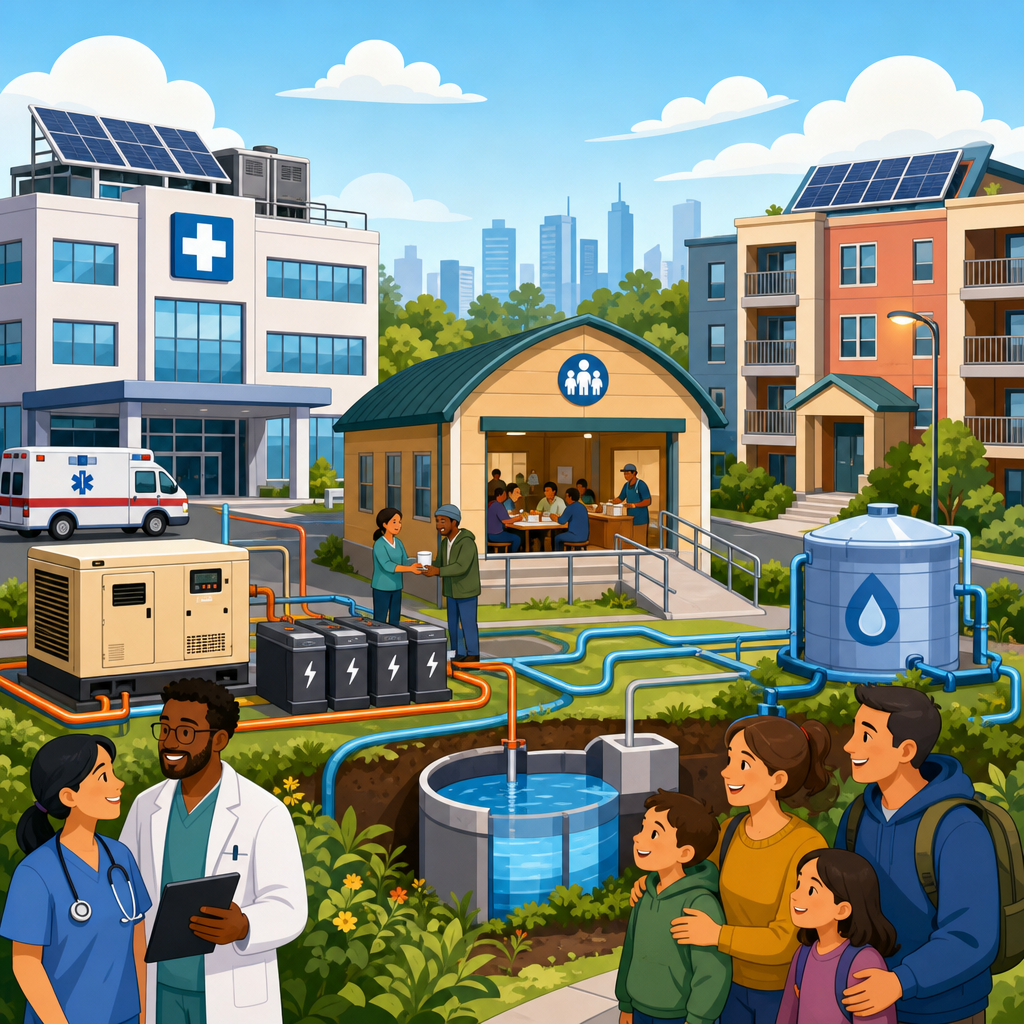
Designing redundant systems for hospitals, shelters, and public housing is a core discipline in resilient urban planning because these facilities must keep operating when power fails, water pressure drops, communications break, or supply chains stall. In this context, redundancy means deliberate duplication, diversity, and backup capacity across critical building systems so that a single fault does not trigger service collapse. I have worked on resilience planning reviews where one failed transfer switch, one flooded basement pump room, or one unavailable fuel delivery route put entire facilities at risk, and the lesson is always the same: life-safety buildings need graceful failure, not brittle efficiency. Hospitals depend on uninterrupted electricity for ventilators, imaging, sterilization, and medication refrigeration. Shelters need heat, cooling, sanitation, and communications during extreme weather, often when citywide infrastructure is under stress. Public housing requires reliable elevators, domestic water, fire protection, and indoor air quality because residents may have limited mobility, chronic illness, or few alternatives.
The topic matters because climate hazards, aging infrastructure, and tight operating budgets are increasing the consequences of outages. Redundant systems reduce downtime, protect vulnerable occupants, and help municipalities meet continuity, equity, and risk-management goals at the same time. They also support compliance with established standards such as NFPA 99 and NFPA 110 for health care electrical systems and emergency power, ASHRAE guidance for ventilation and thermal comfort, FEMA continuity planning principles, and local building and fire codes. Good redundancy is not simply buying a second generator. It is a layered design strategy that considers independence, location, maintenance access, cybersecurity, spare parts, staffing, and the realistic duration of disruption. The best plans identify what must never fail, what can pause briefly, and what can be restored in stages. For urban planners, architects, facility directors, and housing authorities, this hub explains how to design redundant systems that are technically sound, operationally practical, and socially responsible.
Start with critical functions, failure modes, and service priorities
The first step in designing redundancy is deciding which services are mission critical and how long each one must survive without normal utility support. In hospitals, the essential electrical system is typically divided into life safety, critical, and equipment branches, each with different restoration expectations and load priorities. In shelters, critical functions usually include emergency lighting, refrigeration for medicines, accessible charging, communications, ventilation, potable water, and heating or cooling depending on climate. In public housing, priorities often center on elevators, domestic water boosting, wastewater ejection, corridor lighting, fire alarm, access control, and apartment conditioning for medically fragile residents. Without a clear hierarchy, backup investments become expensive but incomplete.
I have found failure mode and effects analysis especially useful because it forces teams to ask practical questions rather than generic ones. What happens if the utility feeder is lost for six hours, three days, or two weeks? What if the generator starts but one automatic transfer switch fails? What if the emergency switchgear room floods, the roof fuel day tank leaks, or the cellular network is down during a heat emergency? A resilient design documents single points of failure in electrical distribution, water service, controls networks, fuel logistics, and staffing. It also accounts for dependencies between systems. A generator cannot help if ventilation in the generator room fails, if fuel polishing was neglected, or if the building automation system cannot coordinate load shedding.
Service priorities should also reflect occupant vulnerability. A dialysis clinic within a hospital campus faces different consequences than an administrative office. A public housing tower serving many elderly tenants may need stronger elevator and cooling resilience than a low-rise family development. During planning workshops, the most effective teams map functions, not just equipment. That approach reveals which spaces can be converted, which loads can be curtailed, and which operations require manual workarounds when automation is unavailable.
Electrical redundancy: utility, generators, storage, and selective load design
Electrical resilience usually begins with utility configuration. Dual utility feeders from separate substations are ideal where available, but they are not fully redundant if both paths share the same underground vault, flood zone, or upstream switching station. Hospitals often supplement dual feeds with on-site generation sized to support essential loads within code-required timelines. NFPA 110 defines performance expectations for emergency and standby power systems, while health care facilities follow stricter coordination and testing requirements. In practice, the strongest designs separate normal and emergency distribution, use selective coordination to prevent nuisance tripping, and place switchgear above flood elevation with protected access.
Generators remain the backbone of redundancy, but they are not enough on their own. Diesel is common because of high energy density and mature equipment, yet fuel storage duration, fuel quality management, and refill contracts are decisive. I have seen facilities with impressive generator nameplate capacity but less than forty-eight hours of dependable fuel under winter road restrictions. Natural gas generators avoid on-site storage limits, but they depend on pipeline continuity and pressure during regional emergencies. Increasingly, hospitals and housing authorities are combining generators with battery energy storage, solar photovoltaic systems, and microgrid controls. Batteries provide bridge power, reduce generator loading swings, and can support critical IT and communications loads instantly. Solar alone is not emergency power unless paired with islanding-capable inverters and storage, but in a microgrid it can extend fuel endurance materially.
| System | Primary strength | Main limitation | Best use case |
|---|---|---|---|
| Diesel generator | High reliability and long duration with stored fuel | Fuel logistics, emissions, maintenance burden | Hospitals and large shelters needing sustained backup |
| Natural gas generator | No on-site fuel replenishment during normal gas service | Dependent on gas network continuity and pressure | Urban campuses with stable gas infrastructure |
| Battery storage | Instant response, quiet operation, supports critical electronics | Limited duration without charging source | Transfer bridging, IT rooms, cooling controls, medical refrigerators |
| Solar plus storage microgrid | Extends endurance and lowers operating cost | Higher controls complexity and capital cost | Shelters and housing sites with repeated outage exposure |
Selective load design matters as much as generation size. Rather than backing up an entire building indiscriminately, good practice tiers loads so the system can carry only what is essential during prolonged emergencies. That means hardwiring emergency circuits for operating rooms, nurse call, smoke control, selected receptacles, domestic water pumps, and one elevator per bank, while allowing nonessential amenity spaces to shed automatically. For public housing, corridor outlets for medical device charging and a conditioned community room may offer more resilience per dollar than trying to maintain every apartment at full normal service. Redundancy works best when electrical engineering, operations staff, and emergency managers agree on these priorities early.
Water, wastewater, HVAC, and communications redundancy
Hospitals, shelters, and public housing fail quickly without water and environmental control, so non-electrical systems deserve equal attention. Redundant domestic water service can include dual incoming mains, backflow arrangements that do not create a hidden choke point, on-site storage tanks, and duplex booster pumps with independent controls. In high-rise public housing, domestic water pressure systems should be designed so one pump can fail without losing service to upper floors. Wastewater systems need the same thinking. If lower-level plumbing depends on ejector pumps, provide duplex or triplex pumps, emergency power, high-level alarms, and physical flood protection. A backup generator is of limited value if toilets cannot flush or medical sterilization lacks water.
HVAC redundancy should match the facility’s role. Hospitals require ventilation strategies that protect infection control and patient safety, including redundancy in chilled water distribution, air-handling units serving critical spaces, control air, and filtration maintenance. During recent heat events, I saw shelters succeed or fail largely based on whether they had segmented cooling, operable isolation dampers, and the ability to convert a dining room or gym into a clean, conditioned refuge zone. Public housing often benefits from decentralized systems because one central plant failure can affect hundreds of residents at once. Split systems, packaged units, or floor-by-floor equipment may sacrifice some efficiency but improve containment of failures and speed of replacement.
Communications redundancy is often underestimated. Facilities need layered connectivity: landline, radio, cellular with signal boosters, and data redundancy for cloud-based platforms. Building automation systems should have local manual overrides and offline operating modes. Access control should fail safely without trapping occupants or opening sensitive areas indiscriminately. In shelters, public address systems, multilingual signage, and backup device charging are basic resilience measures, not extras. In hospitals, cybersecurity and redundancy intersect directly because a ransomware incident can disable imaging, pharmacy workflows, and even networked building systems. Segmenting networks, backing up configurations, and maintaining manual downtime procedures are part of infrastructure design.
Physical hardening, maintainability, and operational readiness
Redundant equipment only works if it survives the hazard and can be maintained under pressure. Physical placement is therefore a design decision with policy consequences. After major floods such as Hurricane Sandy, many hospitals and housing providers learned that basements were convenient for boilers, switchgear, and pumps until storm surge made those rooms inaccessible. Best practice is to elevate critical equipment above design flood levels, protect fuel and water lines at points of entry, and separate redundant components so one fire, leak, or blast does not disable both. True redundancy requires independence. Two pumps in the same pit with one shared controller may look redundant on paper but still represent a single point of failure.
Maintainability deserves equal weight. I prefer designs with clear isolation valves, bypasses, labeled feeders, spare breaker capacity, and room to remove and replace major components without shutting down adjacent functions. Predictive maintenance tools such as infrared scanning, vibration analysis, fuel testing, and remote condition monitoring improve reliability when paired with disciplined work orders. Commissioning is essential. Every transfer sequence, alarm, and override should be tested under realistic conditions, then retested periodically. Hospitals routinely perform generator testing, but shelters and housing portfolios often lack the same rigor. That gap leads to hidden failures such as dead starting batteries, stale fuel, or unverified sequence programming.
Operational readiness also includes contracts and staffing. Fuel delivery agreements should define priority status, access routes, and minimum refill windows. Spare parts inventories should reflect long-lead items such as VFDs, controllers, pump seals, and transfer switch components. Staff need simple emergency operating procedures that assume stress, noise, darkness, and incomplete information. Cross-training matters because the one technician who knows the legacy control panel may be unavailable during a citywide emergency. Tabletop exercises and full-scale drills convert redundancy from a design feature into a usable capability.
Equity, budgeting, and governance for resilient public facilities
The hardest part of redundant system design is usually not technical; it is governance. Capital budgets favor visible expansion over backup capacity that may sit idle for years, yet the social cost of failure is highest in facilities serving people with the fewest alternatives. That is why hospitals, shelters, and public housing should be evaluated through both continuity and equity lenses. A resilience investment that keeps one clinic open or one cooling room habitable can prevent emergency department crowding, ambulance diversions, preventable deaths, and mass displacement. Municipalities should prioritize facilities by community dependency, hazard exposure, outage history, and occupant vulnerability rather than by political visibility alone.
Funding strategies work best when redundancy is packaged as risk reduction, regulatory compliance, and operating modernization together. Energy performance contracts, hazard mitigation grants, FEMA Building Resilient Infrastructure and Communities funding, state housing capital programs, and utility incentives can often support pieces of the solution. The strongest business cases use lifecycle costing, not just first cost. A duplex pump set, microgrid controls, or elevated switchgear may cost more upfront, but avoided relocation, spoilage, overtime, mold remediation, and emergency sheltering frequently justify the investment. Governance should also define who owns maintenance, testing, and emergency decision-making across agencies, especially when public health, housing, and emergency management departments share a site or mission.
Designing redundant systems for hospitals, shelters, and public housing is ultimately about preserving human function under abnormal conditions. The most successful projects begin by identifying essential services, mapping realistic failure modes, and eliminating single points of failure across power, water, HVAC, wastewater, and communications. They combine engineered backups with physical hardening, maintainable layouts, tested operating procedures, and funding plans tied to risk and equity. Redundancy is not waste. In critical community facilities, it is the infrastructure version of preventive medicine: invisible on a normal day, indispensable on the worst day.
For planners, designers, and facility leaders, the practical next step is to audit one building or campus against its top hazards and mission-critical loads, then rank the first three single points of failure you can remove. That process creates a focused roadmap, improves safety quickly, and builds the case for larger resilience investments across the urban system.
Frequently Asked Questions
What does redundancy mean in the design of hospitals, shelters, and public housing?
In this context, redundancy means designing critical systems so that the failure of one component, utility, or pathway does not shut down essential services. It is not simply “having a backup generator” or storing a few extra supplies. True redundancy combines duplication, diversity, reserve capacity, and separation. Duplication means there is more than one way to perform a critical function, such as multiple pumps, parallel electrical feeds, or alternate communication tools. Diversity means those backups should not all depend on the same vulnerable source. For example, if a building relies on electric pumps for water pressure, a meaningful backup plan may also include gravity storage, mobile pumping connections, or on-site water reserves rather than only another electric pump on the same panel.
For hospitals, redundancy is often the most stringent because life safety systems must remain available continuously. Operating rooms, intensive care units, medical gas systems, refrigeration for medicines, and infection control equipment cannot simply pause during an outage. Shelters also require resilient power, water, ventilation, and communications because they may become more occupied precisely when regional conditions are deteriorating. In public housing, redundancy is equally important, though often framed around maintaining heat, potable water, sanitation, elevators where required, fire protection, and basic communications for residents who may have limited mobility or fewer resources to relocate.
The most effective redundant design begins with identifying critical functions rather than individual pieces of equipment. Once planners ask, “What absolutely must keep working for 4 hours, 24 hours, 72 hours, or longer?” the design becomes much more practical. That process typically reveals interdependencies that are easy to overlook. A generator, for example, is only useful if fuel can be delivered, transfer switches function, cooling is maintained, exhaust systems are protected, and staff can access and operate the equipment. Redundancy therefore is less about a single backup device and more about creating layered reliability across systems, operations, maintenance, and emergency procedures.
Which building systems usually need the most redundancy in these facilities?
The systems that most often need the highest level of redundancy are power, water, HVAC, communications, fire protection, and controls. Electrical continuity usually receives the most attention because so many other systems depend on it. In hospitals, this includes emergency power branches, critical care circuits, life safety lighting, medical equipment, nurse call, pharmacy refrigeration, security, and building automation. In shelters and public housing, reliable power supports heat, cooling, domestic water pumps, lighting, charging, food storage, communications, and access control. Redundancy may include dual utility feeds, emergency generators, battery energy storage, automatic transfer switches, protected distribution pathways, and load prioritization strategies.
Water systems are just as important and are often underestimated. A facility can have electricity and still become partially unusable if domestic water pressure drops, sewer service fails, or fire suppression water becomes unreliable. Hospitals may require redundancy in potable water, hot water generation, wastewater handling, and medical process water depending on the facility type. Shelters and public housing need dependable drinking water, sanitation, showers, laundry capability, and fire protection. That often leads to storage tanks, multiple pumping arrangements, backflow protection, pressure zoning, and provisions for temporary outside connections or tanker support.
HVAC redundancy matters because indoor environmental conditions directly affect health, safety, and habitability. Hospitals need continuous ventilation, filtration, pressure relationships, and temperature control in sensitive spaces. Shelters may need surge-capable ventilation and cooling when occupancy rises during emergencies. Public housing may need freeze protection, safe heating continuity, and smoke control support. Communications systems are another critical category: internet, phones, radio, public address, nurse call, security intercoms, and monitoring systems all need backup pathways. Finally, fire alarm and suppression systems, building controls, and access systems should be designed so they fail safely and remain operable under degraded conditions. The key is to prioritize systems based on consequence of failure, duration of acceptable downtime, and the vulnerability of the population being served.
How do designers decide how much redundancy is enough without overbuilding?
The right amount of redundancy is determined through risk-based planning, not guesswork and not simply by adding more equipment. Good teams begin with a resilience assessment that examines hazards, operational priorities, occupancy needs, code requirements, and the expected duration of disruptions. In an urban setting, those hazards may include grid outages, flooding, extreme heat, winter storms, fuel interruptions, cyber incidents, water main breaks, telecom failures, and supply chain constraints. The design question is not “How many backups can we afford?” but “Which failures are most likely, which consequences are unacceptable, and what level of performance must be maintained under stress?”
From there, designers usually classify loads and services by criticality. Some functions are life safety critical and must continue with no meaningful interruption. Others can tolerate brief transfer delays, reduced capacity, or scheduled shutdown windows. Still others can be shed temporarily to preserve core operations. This approach prevents overbuilding because it focuses investment where it matters most. A hospital may require high levels of redundancy for clinical power, medical gases, air handling in specific departments, and sterile processing, while administrative areas can accept lower continuity standards. A shelter may prioritize kitchen refrigeration, emergency lighting, water pressure, and charging stations over less essential amenities. A public housing property may focus on heat, domestic water, emergency lighting, elevator support for accessible residents, and emergency communications before considering full-building backup power.
Another important principle is to avoid common-mode failure. Two identical backups are not truly redundant if both are in the same flood-prone basement, depend on the same fuel delivery route, or share the same control panel. Sometimes a smaller but more diverse resilience package is better than a larger single-mode system. Designers also weigh maintainability, staffing capability, fuel logistics, lifecycle cost, and testing requirements. A system that is theoretically redundant but too complex to maintain will disappoint in real emergencies. The most balanced designs pair technical redundancy with operational realism, clear emergency procedures, and a maintenance program that keeps the backup systems genuinely ready.
What are the most common mistakes in redundant system design for resilient facilities?
One of the most common mistakes is assuming that adding standby equipment automatically creates resilience. In practice, many failures happen because backup systems share hidden dependencies with the primary systems. A second pump on the same electrical feeder, a generator located in a flood-prone room, or dual internet circuits entering through the same underground conduit can all fail together. Designers sometimes focus too narrowly on major equipment while overlooking transfer switches, control wiring, valves, sensor networks, fuel polishing, make-up water, cooling loops, or physical access for operators. In an actual event, these small points of failure can shut down otherwise well-funded systems.
Another frequent problem is designing for installation but not for operation. Redundant systems need clear load-shedding logic, maintenance access, spare parts planning, staff training, commissioning, and routine testing under realistic conditions. If facility teams do not understand sequence of operations during partial failure, they may lose time or accidentally disable the backup pathway. This is especially important in hospitals, where systems are highly interdependent, but it also matters in shelters and public housing where staffing at night, on weekends, or during severe weather may be limited. A resilient design must be operable by the people who will actually manage it under pressure.
Underestimating duration is another major mistake. Many plans are built around short outages, but real disruptions can last days and can involve simultaneous problems such as fuel scarcity, transportation delays, telecom outages, and staffing shortages. Redundancy should therefore include endurance planning, not just transfer capability. Teams should ask how long fuel will last, how water quality will be maintained in storage, how waste will be handled if sewer service degrades, and how replacement parts or vendor support will be obtained if supply chains are constrained. Finally, some projects fail because they do not integrate redundancy with the broader site and community context. A building may perform well internally but still be cut off by flooding, blocked roads, or failed neighborhood infrastructure. Strong resilient design looks beyond the mechanical room and treats the facility as part of a larger urban system.
How can hospitals, shelters, and public housing improve redundancy in existing buildings without a full rebuild?
Many existing facilities can make meaningful resilience gains through phased upgrades rather than complete reconstruction. The first step is a focused vulnerability assessment that maps critical functions, single points of failure, existing backup capacity, and likely disruption scenarios. In older buildings, this often reveals practical improvement opportunities such as separating essential loads from nonessential loads, adding selective branch backup power, replacing undersized transfer equipment, hardening equipment rooms, improving drainage, or relocating vulnerable controls above flood level. These targeted moves can significantly improve continuity without requiring a total system replacement.
For power resilience, retrofits may include adding permanent generator connections, battery storage for short-duration bridge power, upgraded transfer switches, protected electrical distribution for critical circuits, and clearer electrical labeling for emergency operations. Water resilience improvements can include on-site storage, booster pump redundancy, temporary hose or tanker connection points, pressure monitoring, backflow improvements, and contingency plans for potable and nonpotable uses. HVAC upgrades may focus on preserving habitable refuge areas, maintaining critical ventilation zones, adding equipment isolation, and ensuring that freeze protection or extreme-heat response can continue during utility interruptions. Communication resilience often improves dramatically with redundant internet providers, cellular boosters, radio interoperability


