
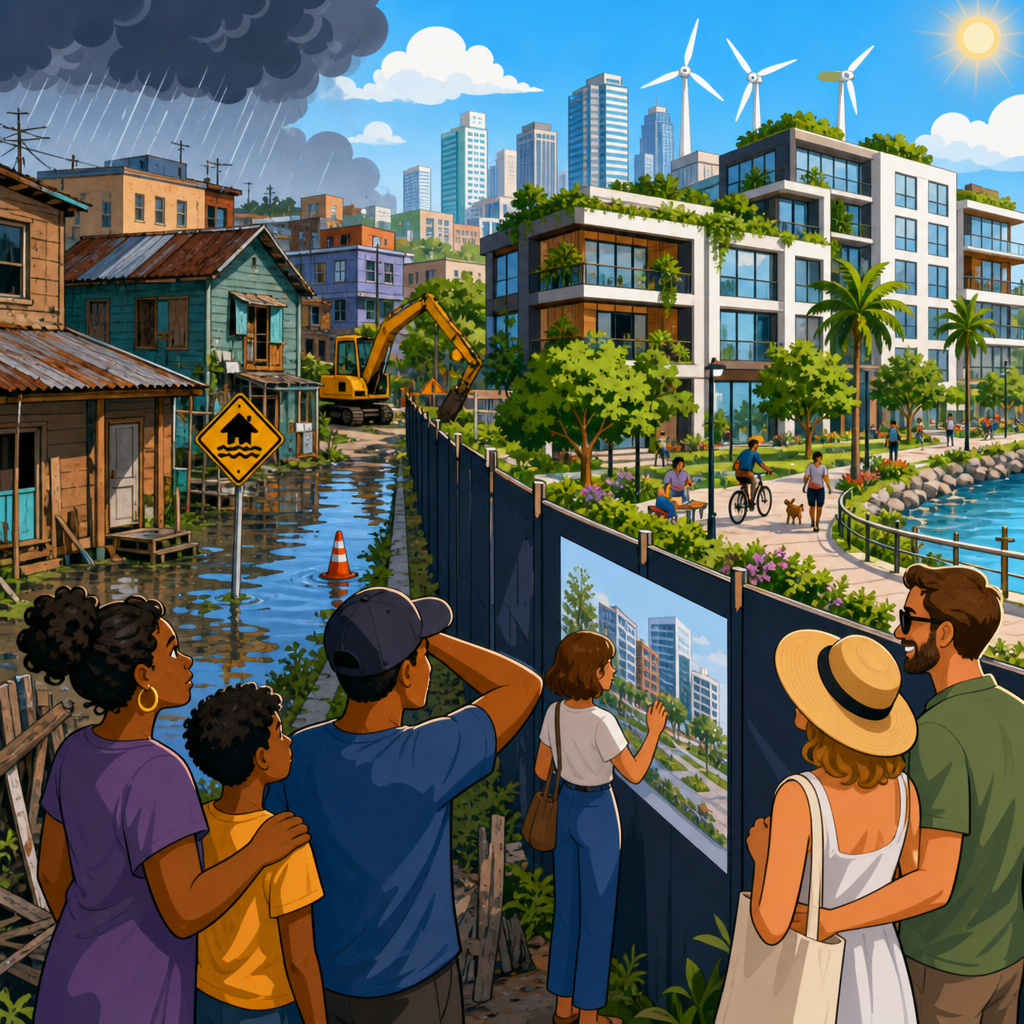
Climate gentrification describes a pattern I have seen repeatedly in coastal and heat-vulnerable cities: investments meant to reduce climate risk can raise land values, attract higher-income residents, and push out the people adaptation was supposed to protect. The term combines two ideas. Climate adaptation means projects, policies, and design choices that help places withstand sea level rise, flooding, extreme heat, storms, drought, and other hazards. Gentrification refers to neighborhood change in which rising investment and prices alter who can afford to live there. When these forces intersect, resilience upgrades can become displacement engines.
This matters because climate risk is no longer a distant planning scenario. It is already reshaping insurance markets, mortgage underwriting, infrastructure budgets, and household decisions about where to live. In Miami-Dade County, researchers documented a “higher ground” effect in which neighborhoods at slightly higher elevation experienced stronger property appreciation than more exposed waterfront areas. In New York, post-Sandy rebuilding and resilience investment sharpened long-running debates about who benefits from protective infrastructure. In cities dealing with extreme heat, new tree canopy, cooling corridors, and park improvements can improve health while also making adjacent housing more expensive. The central question is not whether adaptation is necessary; it is how to prevent adaptation from worsening inequality.
Urban planners, housing officials, developers, and community organizations increasingly use climate gentrification to describe several related dynamics. One is amenity-driven displacement, where green infrastructure, waterfront restoration, or upgraded transit makes a neighborhood more attractive to wealthier buyers. Another is risk-driven sorting, where residents and investors move away from low-lying or fire-prone areas toward safer locations, bidding up prices there. A third is policy-driven displacement, where building-code changes, buyouts, or infrastructure assessments raise costs for existing residents. Understanding these pathways is essential for urban planning and policy because land use, zoning, affordable housing rules, and capital budgeting often determine whether resilience becomes inclusive or exclusionary.
The issue also matters because vulnerability is unevenly distributed. Lower-income households, renters, seniors, immigrants, and communities of color are often concentrated in places with higher flood exposure, fewer quality public services, and less political leverage. They are also less able to absorb rent increases, insurance premium spikes, or temporary relocation during construction. If adaptation policy ignores housing markets, the result is predictable: public money reduces physical risk while market pressure redistributes social risk. A serious climate strategy therefore has to treat housing stability as core infrastructure, not as a side issue to be handled after seawalls, drainage systems, or cooling investments are designed.
What climate gentrification includes in practice
Climate gentrification is not one single process. In practice, it covers several mechanisms that interact. First, there is direct value uplift from protection. A new floodwall, elevated roadway, upgraded stormwater system, or resilient waterfront can reduce expected losses and improve investor confidence. Lenders may view protected parcels as safer collateral, insurers may price risk differently, and buyers may pay more for perceived security. Second, there is value uplift from neighborhood improvement. Bioswales, new parks, shaded streets, and restored shorelines often make an area more pleasant as well as safer. Third, there is scarcity. As households seek less exposed locations, relatively safer neighborhoods become more competitive.
These mechanisms can affect both “receiving” neighborhoods and “sending” neighborhoods. Receiving neighborhoods are places considered safer from flooding, heat, or fire. They may see rapid appreciation, speculative buying, renovation activity, and landlord pressure on tenants. Sending neighborhoods are places seen as increasingly hazardous or expensive to insure. Residents there may face disinvestment, mortgage constraints, managed retreat debates, or predatory acquisition offers. In both cases, the burden usually falls on people with the least bargaining power. Homeowners with inherited property may be asset rich but cash poor, unable to afford repairs or taxes. Renters may have no claim on rising land value and no protection against sudden rent hikes.
A common misunderstanding is that any green or resilient project automatically causes displacement. That is too simple. Displacement risk depends on local housing supply, tenant protections, ownership patterns, tax policy, and whether affordability measures are implemented before investment lands. I have worked on plans where a stormwater retrofit had minimal displacement impact because the area already had strong rent stabilization and nonprofit ownership. I have also seen modest public-realm upgrades trigger intense speculation in weakly regulated markets. The lesson is clear: resilience projects do not operate outside the housing system. They are interpreted by investors, lenders, landlords, and residents through existing rules and power relationships.
How adaptation investments change housing markets
Adaptation affects housing markets through expectations as much as through physical improvements. Markets react when people believe a place will be safer, more insurable, more financeable, or more desirable in the future. A drainage project may take years to complete, yet values can rise when plans are announced, permits are issued, or media coverage frames an area as resilient. Public investment also sends a signal. If a city prioritizes one district for shoreline protection, buyers may infer long-term political commitment there and greater uncertainty elsewhere. That expectation can redirect private capital quickly.
Insurance is one major channel. As catastrophe models become more precise and state regulators approve rate changes, the cost of coverage increasingly differentiates neighborhoods. In flood-prone areas, even subsidized federal programs do not remove affordability pressure entirely. Higher premiums, larger deductibles, and stricter underwriting can make monthly housing costs unsustainable. By contrast, homes in safer or protected areas may retain cheaper coverage and better mortgage access. Over time, that financing advantage feeds price appreciation. Property taxes create another channel. Rising assessed values after adaptation upgrades can burden long-term residents unless abatements, circuit breakers, or homestead protections are in place.
Infrastructure timing matters too. Consider two neighborhoods in the same city. One receives major flood protection and transit upgrades. The other faces repeated nuisance flooding and deferred maintenance. Developers will usually prefer the first area because construction financing is easier, projected sales are stronger, and reputational risk is lower. New apartments, retail, and amenities then reinforce demand, sometimes faster than local incomes can keep pace. This is why adaptation planning cannot stop at hazard maps. It must include parcel-level market analysis, renter vulnerability data, and scenario testing for rent, taxes, and insurance after public investment.
| Driver | How it raises displacement risk | Policy response |
|---|---|---|
| Flood protection investment | Signals lower future risk and increases land values near protected areas | Pair projects with long-term affordable housing requirements |
| Higher insurance costs in exposed areas | Pushes residents out of hazard zones and into safer neighborhoods with limited supply | Expand relocation support and preserve affordable units in receiving areas |
| Green amenities and cooling projects | Improves health and neighborhood appeal, attracting speculative buyers | Use anti-displacement overlays, tax relief, and tenant protections |
| Code upgrades and retrofit mandates | Raises landlord and homeowner costs that can be passed to tenants or trigger sales | Offer grants, low-interest loans, and compliance support for low-income owners |
Who is most exposed to displacement pressure
Renters are typically the most exposed because they do not control the land beneath them and often have limited protection against sudden rent increases or nonrenewal. In many cities, climate-resilient areas already overlap with neighborhoods that have strong transit access, historic housing stock, or central locations. Those places were under price pressure even before climate risk entered the equation. Adaptation can intensify an existing squeeze. Informal tenants, voucher holders, and people with limited English proficiency face additional barriers because they may not receive timely information about redevelopment, code enforcement, or relocation options.
Low-income homeowners face a different set of risks. They may benefit on paper from rising property values, but appreciation is not the same as stability. Higher taxes, repair costs, elevation mandates, floodproofing requirements, and insurance premiums can create a cash-flow crisis. Some owners respond by taking on expensive debt; others sell under pressure to investors who can absorb compliance costs. Heirs’ property owners are particularly vulnerable because unclear title can block access to grants or insurance payouts. In planning meetings, these households often say the same thing: they are not against resilience, but they need the means to stay long enough to benefit from it.
Community institutions are also at risk. Small businesses, religious congregations, cultural centers, and nonprofit service providers can be displaced when commercial rents rise or redevelopment changes the customer base. That kind of loss is harder to measure than residential displacement, yet it directly affects social resilience. After disasters, people rely on trusted local networks for information, food, transportation, childcare, and mutual aid. If adaptation strips a neighborhood of those institutions, physical protection may improve while community capacity declines. Good urban policy therefore tracks not just households but also the organizations that anchor daily life.
What cities are learning from real cases
Miami is often cited because the higher-ground dynamic became visible earlier there than in many U.S. cities. Neighborhoods such as Little Haiti, which sit at elevations slightly above some luxury coastal areas, drew more investor attention as sea level rise entered public discussion. The exact degree to which climate risk alone drove appreciation remains debated, because transit investment, redevelopment trends, and broader speculation also mattered. Still, the case showed something important: even modest elevation differences can become market signals when chronic flooding worsens. Once investors begin to price safety, neighborhoods with long histories of disinvestment can become targets for rapid turnover.
New York offers a different lesson. After Hurricane Sandy, resilience planning focused heavily on coastal protection, building recovery, and infrastructure hardening. Projects such as the East Side Coastal Resiliency initiative brought legitimate public-safety benefits, yet they also raised questions about governance, transparency, temporary loss of park access, and long-term affordability in nearby areas. The city’s experience showed that residents do not judge adaptation only by engineering performance. They also ask who was consulted, who is being protected first, and whether public works will accelerate luxury development. Those questions are not distractions from resilience planning; they are part of resilience planning.
Heat-vulnerable inland cities present another variation. In places such as Phoenix, Los Angeles, and parts of Atlanta, climate adaptation may center on tree canopy expansion, reflective surfaces, shaded transit stops, cooling centers, and park investment. These interventions reduce heat stress and improve public health, especially in neighborhoods with little shade and high asthma rates. But greener, cooler streets can also increase desirability. If cities do not preserve affordability, tenants may be priced out of the very neighborhoods receiving overdue environmental improvements. The policy challenge is to deliver health benefits without turning environmental repair into another wave of exclusion.
How urban planning and policy can reduce harm
The most effective response is to connect climate adaptation with housing policy from the start, not after land prices rise. That means mapping risk and displacement together, then sequencing interventions accordingly. Before a major resilience project breaks ground, cities should identify rent-burdened households, naturally occurring affordable housing, unsubsidized multifamily buildings, small landlords, and tax-vulnerable homeowners nearby. They should then deploy tools early: inclusionary zoning, community land trusts, social housing, right-to-counsel for tenants, preservation financing, acquisition funds for nonprofit buyers, and targeted tax relief. Timing is decisive. Once speculation is underway, options narrow and costs rise.
Zoning and land use rules need equal attention. If a city upgrades only a few safer neighborhoods while keeping housing supply tightly constrained there, displacement pressure intensifies. Allowing more homes near resilient infrastructure can reduce scarcity, but supply alone will not protect low-income residents in hot markets. Production has to include deeply affordable units, permanent affordability mechanisms, and tenant protections. Managed retreat policies also require care. Buyouts can be humane and necessary in repeatedly damaged locations, yet they can become unjust if households receive too little to relocate within the same region. Fair compensation and destination planning are essential.
Public process matters because trust shapes outcomes. Communities that have experienced redlining, urban renewal, highway building, or disaster neglect are rightly skeptical when governments promise that a new adaptation project will benefit everyone. In my experience, better plans emerge when residents can see parcel maps, funding assumptions, phasing schedules, and anti-displacement triggers in plain language. Cities should publish measurable commitments: how many affordable units will be preserved, what tax protections will be offered, how small businesses will be assisted, and how outcomes will be monitored over time. Resilience is credible only when the people at greatest risk can verify that they have a future in the plan.
What to watch next
Climate gentrification will become more visible as climate risk is priced more explicitly into everyday decisions. Better flood modeling, insurer withdrawals, disclosure laws, and lender scrutiny will sharpen differences between neighborhoods. At the same time, governments will spend more on adaptation through infrastructure packages, hazard mitigation grants, and local capital programs. That combination of clearer risk and larger public investment will keep reshaping urban land markets. The best response is not to slow adaptation, but to design it around stability as well as safety. Cities need resilience plans that protect people in place where possible, support fair relocation where necessary, and prevent public investment from becoming a transfer mechanism from vulnerable residents to speculative capital.
For planners and policymakers, the main takeaway is straightforward. Every resilience project should answer three questions before approval: Who becomes safer, who can afford to stay, and who gains financially from the change? If those questions are asked early and backed by enforceable housing tools, adaptation can reduce harm without deepening inequality. If they are ignored, climate gentrification becomes a predictable outcome rather than an unintended one. Use this hub as your starting point for building climate policy that treats housing security, community continuity, and physical protection as one connected agenda.
Frequently Asked Questions
What is climate gentrification, and why does it happen after adaptation projects?
Climate gentrification happens when investments intended to reduce climate risk also make a neighborhood more desirable and more expensive, leading to displacement pressure for existing residents. In practical terms, a city may build stronger flood protection, add cooling green space, upgrade drainage, improve transit access, or change zoning to support safer redevelopment. Those improvements can lower perceived risk, attract developers and higher-income homebuyers, and raise rents, taxes, and land values. The result is a difficult paradox: adaptation can protect buildings and infrastructure while making it harder for long-term residents to remain in place.
This pattern happens because housing markets respond quickly to safety, amenities, and future investment signals. Once an area is seen as more resilient to sea level rise, flooding, extreme heat, or storms, investors often move in before protections are evenly shared across a city. In some cases, neighborhoods on higher ground or in cooler, greener areas become targets for speculative buying even before major projects are finished. Without safeguards such as affordable housing preservation, tenant protections, anti-speculation measures, community land control, and equitable planning, adaptation benefits can be captured by wealthier newcomers rather than the people most exposed to climate risk. That is why climate gentrification is not simply about climate change or gentrification alone; it is about the interaction between resilience planning and unequal housing markets.
Who is most at risk of displacement from climate gentrification?
The people most at risk are usually residents who already face housing insecurity or have historically had less political and economic power. That often includes low-income renters, cost-burdened homeowners, seniors on fixed incomes, immigrant communities, public housing residents, and Black, Latino, Indigenous, and other marginalized groups who have experienced long-term disinvestment or exclusion. These communities are often located in places that are either newly protected through adaptation spending or newly sought after because they are less exposed to flooding, heat, and other hazards. When market demand rises, those residents can face rent hikes, lease nonrenewals, tax increases, code enforcement pressures, redevelopment, and informal landlord harassment.
Displacement risk can be direct or indirect. Direct displacement happens when people are forced to move because their housing becomes unaffordable or is demolished or converted. Indirect displacement happens when residents technically remain in place for a time but lose access to local businesses, community networks, schools, services, or future housing options in their own neighborhood. Cultural displacement also matters: even before someone moves, they may feel that the area no longer reflects their identity, needs, or social ties. Climate gentrification therefore should be understood as both a housing issue and a community stability issue, with unequal impacts shaped by race, class, tenure, and long histories of planning decisions.
What kinds of climate adaptation projects can unintentionally trigger gentrification?
A wide range of adaptation projects can unintentionally increase displacement pressure if they are not paired with equity protections. In coastal areas, seawalls, levees, stormwater systems, shoreline restoration, raised infrastructure, and resilient redevelopment plans can reduce flood risk and signal future value to investors. In heat-vulnerable cities, tree planting, parks, cooling corridors, reflective surfaces, and redesigned public spaces can improve comfort and health while also increasing neighborhood appeal. Transit improvements linked to resilient growth, building retrofits, resilience hubs, and infrastructure upgrades such as backup power, water system improvements, and street redesigns can have similar effects.
The issue is not that these projects are inherently harmful. Many are necessary and can save lives, reduce damage, and improve public health. The problem arises when physical resilience is pursued without social resilience. For example, a new waterfront flood barrier may protect an area from storm surge, but if surrounding property values climb rapidly, long-term renters may be priced out. A tree canopy and cooling investment may reduce extreme heat exposure, but if it is concentrated in neighborhoods already attracting private investment, it can reinforce uneven development. Even voluntary buyout programs can contribute to displacement if residents are not offered realistic, affordable pathways to remain in their broader community. The key lesson is that adaptation planning affects real estate markets, and market responses need to be anticipated rather than treated as an afterthought.
How can cities reduce climate risk without displacing existing residents?
Cities can reduce climate risk more equitably by pairing adaptation investments with strong anti-displacement policies from the beginning. That means treating housing stability as core climate infrastructure, not as a separate issue. Common tools include preserving and expanding affordable housing near adaptation investments, supporting community land trusts, using inclusionary housing rules, strengthening tenant protections, offering property tax relief for low-income homeowners, funding home repairs and retrofits for existing residents, and placing limits on speculative acquisition. Cities can also require community benefits agreements, prioritize nonprofit and mission-driven development, and direct public land toward permanently affordable housing.
Process matters as much as policy. Equitable adaptation depends on early and meaningful community participation, transparent risk communication, and clear accountability for who benefits. Cities should assess likely market impacts before major projects move forward and track indicators such as rent increases, eviction filings, investor purchases, tax delinquency, and demographic change. They should also coordinate across departments so climate planning, housing, transportation, public health, and economic development are not working at cross-purposes. When adaptation is designed around resident stability, it becomes possible to improve flood protection, heat resilience, and disaster readiness while also helping long-term communities stay, recover, and benefit from public investment.
Why is climate gentrification important for the broader climate justice conversation?
Climate gentrification is central to climate justice because it highlights a basic question: who gets protected, who gets invested in, and who gets to stay? Climate hazards do not affect all communities equally, and neither do the solutions. If adaptation funding improves safety but shifts the benefits to wealthier households, then public action can end up reproducing the very inequalities it claims to address. That is especially important in cities where past policies such as redlining, exclusionary zoning, highway construction, urban renewal, and uneven infrastructure spending shaped present-day vulnerability. Climate justice requires attention not just to exposure to hazards, but also to power, ownership, affordability, and decision-making.
This concept also broadens how people think about resilience. True resilience is not only stronger infrastructure or lower insurance losses. It includes the ability of residents to remain in their homes, maintain social networks, access healthy environments, and share in the benefits of public investment. When policymakers ignore displacement, adaptation can become a form of selective protection that stabilizes property values more effectively than communities. Recognizing climate gentrification pushes governments, planners, and advocates to measure success differently: not only by reduced flood depth or lower heat exposure, but also by whether vulnerable residents are safer and still able to live in the neighborhoods they helped sustain.


