
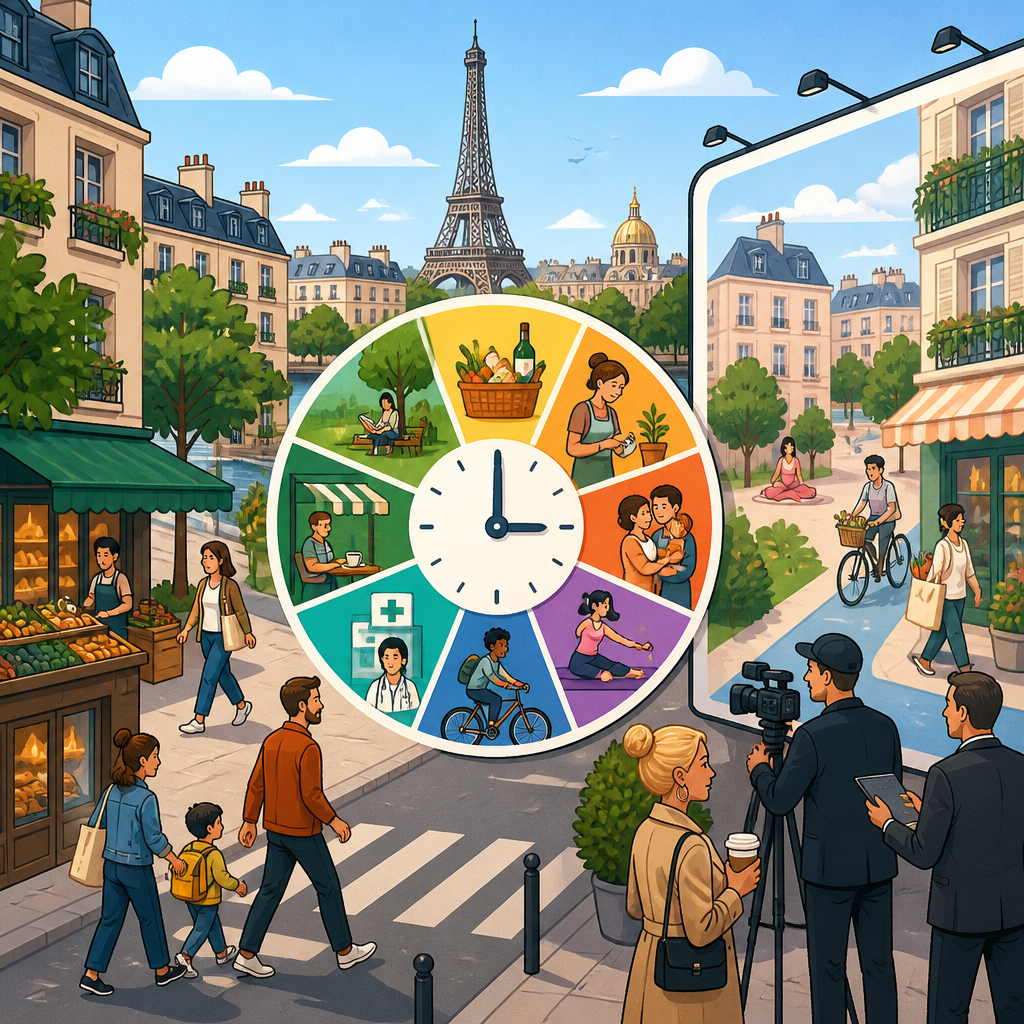
Paris has become the global reference point for the 15-minute city debate, but the phrase often generates more heat than light. At its simplest, a 15-minute city is an urban planning model in which most daily needs—work, groceries, schools, parks, health care, and basic services—can be reached within roughly fifteen minutes on foot or by bicycle. In practice, the idea is less a rigid stopwatch than a design principle: reduce forced travel, mix uses, rebalance street space, and bring essential services closer to residents. Paris matters because few cities have marketed this concept as aggressively while also making visible physical changes on the ground.
The controversy comes from a basic tension. Supporters see a practical framework for healthier neighborhoods, lower emissions, safer streets, and stronger local commerce. Critics argue the label can be vague, politically convenient, and sometimes detached from hard constraints such as housing affordability, job geography, freight movement, and regional commuting patterns. Having worked on mobility and land-use projects, I have seen this pattern repeatedly: a compelling slogan helps align agencies and voters, but slogans can also hide tradeoffs. The real question is not whether Paris uses the right phrase. It is whether policy, budgets, and measurable outcomes match the promise.
To separate substance from branding, it helps to define the key terms clearly. “Substance” means actual policy instruments and urban outcomes: zoning changes, school street programs, bike lane kilometers, traffic injury reductions, public space conversions, local retail retention, and access to services. “Branding” means the narrative layer: speeches, campaign framing, exportable city identity, conference visibility, and a memorable concept that attracts media attention. Good branding is not automatically empty. In city governance, a memorable narrative can create legitimacy for difficult reallocations of street space. But if branding outruns delivery, trust erodes quickly.
Paris is an ideal case study because it combines strong symbolism with unusually concrete interventions. Since 2020, the city has expanded protected cycling infrastructure, reduced through-traffic on selected streets, created school streets, widened sidewalks, added trees, converted parking spaces, and emphasized the neighborhood scale in public services. At the same time, Greater Paris remains a complex metropolitan region where many workers still rely on long regional commutes, where housing costs shape life chances, and where municipal authority stops at administrative boundaries. Understanding the Paris debate requires looking at both the city center and the metropolitan system surrounding it.
What the 15-minute city means in policy terms
The 15-minute city is best understood as a bundle of planning principles rather than a single project. The core elements are proximity, mixed land use, multimodal access, public realm quality, and decentralized services. Proximity means residents should be near everyday needs. Mixed land use means housing, shops, offices, schools, and recreation should not be separated so completely that every errand requires a car or a long transit trip. Multimodal access means walking, cycling, and transit must work together, with street design that protects vulnerable users. Public realm quality means the route matters, not only the destination; a fifteen-minute walk on a noisy, dangerous street does not deliver the same value as one on a calm, shaded, active street.
Paris did not invent these ideas. Urbanists have long discussed neighborhood units, mixed-use development, complete streets, transit-oriented development, and local living. What changed was packaging. The concept popularized by Carlos Moreno gave elected officials a concise way to describe a broad reform agenda. That made the idea politically powerful. Instead of discussing every bike lane, school gate, bus corridor, and zoning code separately, city leaders could present a coherent story about daily life. In communications terms, that is brilliant. In policy terms, it can be useful if each component is backed by implementation plans and performance indicators.
The strongest practical value of the model is that it starts from households rather than transport networks alone. Traditional mobility planning often optimizes speed across the system. The 15-minute approach asks a different question: what daily needs force people to travel farther than necessary, and how can urban form reduce that burden? This shift matters for caregivers, older adults, children, and low-income residents, who often experience time poverty more acutely than affluent professionals. A neighborhood with a pharmacy, childcare, fresh food, and safe crossings nearby can improve quality of life more than a marginal reduction in average vehicle delay.
Where Paris shows real substance
If the debate is about evidence, Paris has more substance than many critics admit. The city has added extensive protected cycling infrastructure, including the “coronapistes” that emerged during the pandemic and then became permanent in many corridors. Cycling volumes rose sharply as safer routes appeared. Road space was reallocated from general traffic and curbside parking toward bike lanes, terraces, trees, and pedestrian uses. Around schools, car access has been restricted on selected streets during arrival and dismissal periods, improving safety and reducing local air pollution exposure for children. These are not branding exercises; they are operational choices with budget, design, and enforcement implications.
Public space redesign also matters. In many Paris neighborhoods, sidewalks have been widened, intersections tightened, and temporary installations tested before permanent construction. That reflects a tactical urbanism approach: pilot first, observe behavior, then invest in capital works. I have used similar sequencing on street redesigns because it lowers risk and builds evidence. Paris has applied this logic at scale. The city has also pushed greening measures, including tree planting and schoolyard transformations intended to reduce urban heat exposure. In a warming climate, shade and permeable surfaces are not cosmetic extras. They are public health infrastructure.
Another substantive dimension is governance attention to the arrondissement and neighborhood level. The 15-minute city framework encouraged municipal departments to think in terms of local access rather than siloed sector outputs. Schools, libraries, sports facilities, and social services become part of a neighborhood ecosystem. That is important because access is cumulative. A resident does not experience urban policy as separate transport, education, and parks systems. They experience a chain of trips across a day. Paris deserves credit for making that integrated perspective politically visible.
| Policy area | Visible action in Paris | Why it counts as substance |
|---|---|---|
| Street reallocation | Protected bike lanes, fewer car lanes, converted parking | Changes how space is used every day and shifts travel behavior |
| School access | School streets and calmer traffic near entrances | Direct safety and air-quality benefits for children |
| Public realm | Wider sidewalks, greening, small plazas | Improves walking comfort, heat resilience, and local activity |
| Service proximity | Neighborhood framing for public facilities | Encourages planning around daily access instead of sector silos |
Where the branding critique is fair
The branding critique becomes valid when the phrase implies a level of completeness Paris has not achieved. A municipality can improve neighborhood life substantially and still fall short of true proximity for everyone. Jobs remain unevenly distributed across the region. Specialized hospitals, universities, cultural institutions, and many major employment centers cannot and should not be duplicated every fifteen minutes. Metropolitan economies depend on concentration as well as dispersal. If the slogan is interpreted literally, it overpromises. Cities need both local access and efficient regional mobility.
Housing is the most serious pressure point. A walkable, service-rich neighborhood becomes less socially valuable if only higher-income households can afford to live there. Paris faces persistent affordability challenges, and that weakens the egalitarian promise of local living. In planning practice, access and affordability must be evaluated together. A district can score well on amenity proximity and still exclude the workers who serve it. Critics are justified when they argue that repackaging urban quality without solving housing costs risks creating an attractive lifestyle brand rather than a broadly shared urban model.
There is also a jurisdictional reality. The City of Paris governs only part of the lived metropolis. Many workers commute from the suburbs, and the larger mobility picture depends on regional rail, buses, and cross-boundary coordination. Municipal leaders can calm central streets and improve local services, but they cannot single-handedly restructure metropolitan labor markets or eliminate long commutes generated by housing and employment imbalances. Any claim that Paris has fully become a 15-minute city ignores this governance limit. The more accurate statement is that Paris has used the concept to reorient municipal policy within its own boundaries while relying on broader regional systems beyond them.
The politics behind the phrase
Branding succeeds when it gives politicians a moral and practical story for change. In Paris, the phrase helped justify reallocating scarce street space away from private cars in a city where such decisions are always contested. It connected climate goals, public health, child safety, and local commerce in one frame. That matters because urban policy often fails not for lack of technical solutions but for lack of a narrative people can understand. Residents may not read a mobility plan, but they immediately grasp the appeal of doing everyday tasks close to home.
At the same time, the phrase became a target because symbolic language invites projection. Some opponents treated the idea as social control or mobility restriction, even though mainstream planning versions are about expanding options, not limiting movement. Others inside the planning field worried that a catchy label would flatten decades of urbanist thought into a campaign slogan. Both reactions are understandable. I have sat in public meetings where the same street redesign was described by supporters as liberation from dangerous traffic and by opponents as an attack on personal freedom. Words matter because they trigger values before evidence is considered.
Paris demonstrates that branding can be a policy tool, not just a publicity tactic. But for branding to retain legitimacy, city governments must publish measurable results: collision reductions, cycling counts, school access improvements, canopy growth, and service accessibility metrics. The phrase should lead to evaluation, not replace it. When cities cannot show before-and-after outcomes, skepticism hardens. When they can, the branding argument weakens because the public can see what changed.
How to judge Paris fairly
A fair assessment uses three tests. First, did policy shift materially? In Paris, yes: street space, school access, cycling infrastructure, and public realm design changed in visible ways. Second, did those changes improve everyday access and safety? In many neighborhoods, yes, especially for walking and cycling. Third, did the city solve the entire problem of equitable urban proximity across the metropolis? No. That would require regional housing, transport, and economic coordination beyond municipal powers. The right verdict is not “all branding” or “complete transformation.” It is “meaningful urban reform packaged in unusually effective political language.”
This balanced view matters for other cities. Copying the slogan without the hard work will fail. Copying the implementation logic—pilot projects, protected cycling networks, school streets, local service planning, and clear metrics—can succeed even if the phrase is never used. The Paris lesson is that a city can leverage branding to accelerate policy, but only if physical changes follow quickly and if leaders acknowledge limits honestly. Urban planning works best when aspiration and administration stay connected.
For readers following urban planning and policy, Paris should be treated as a serious case, not a caricature. The substance is real: redesigned streets, safer routes, greener public spaces, and a stronger focus on neighborhood access. The branding is also real: a polished, exportable story that helped win attention and support. The debate becomes productive when these two truths are held together. If you want to understand modern city policy, look past the slogan and examine the instruments, budgets, and outcomes behind it. That is where Paris offers its most valuable lesson—and where the next generation of urban reform will be judged.
Frequently Asked Questions
What does the “15-minute city” actually mean in Paris, and is the 15 minutes meant literally?
In the Paris debate, the “15-minute city” refers to an urban planning approach in which the basics of everyday life—food shops, schools, parks, pharmacies, health care, public services, and ideally some access to work or co-working—are located close enough to reach on foot or by bicycle in about fifteen minutes. The key point is that this is not supposed to function like a strict stopwatch. It is better understood as a planning principle than a mathematical promise. The underlying goal is to reduce unnecessary long-distance trips for routine needs, make neighborhoods more complete, and give residents more practical choices in how they move around the city.
In Paris specifically, the term gained prominence because it offered a simple phrase for a broader set of policies that were already underway or became more visible: expanding cycling infrastructure, redesigning streets, increasing the role of local services, and reclaiming public space from cars for broader civic use. That simplicity is part of why the phrase traveled so far internationally. But it is also why it gets misunderstood. Critics sometimes treat the concept as if city governments are promising every possible need, for every resident, within exactly fifteen minutes. Supporters, by contrast, tend to use the phrase more flexibly, as a shorthand for proximity, accessibility, and neighborhood-level livability.
So the substance is not the exact time threshold. The substance is the attempt to organize urban life around shorter, easier, lower-cost daily trips and stronger local access. In dense cities like Paris, that often means making better use of the urban fabric that already exists rather than building entirely new districts from scratch. The branding is the catchy number. The policy substance lies in how land use, transport, public space, and local services are coordinated to make everyday life less dependent on long commutes and more resilient at the neighborhood scale.
Why has Paris become the global symbol of the 15-minute city debate?
Paris became the reference point because it combines visibility, density, political ambition, and a highly legible urban form. It is a world city with a strong international media profile, so ideas tested there quickly become part of global urban discourse. At the same time, Paris is compact enough that the concept of local accessibility feels plausible to many observers. If a major capital can reallocate street space, expand bike lanes, calm traffic, and talk openly about neighborhood-based urban life, it provides a vivid example for planners, politicians, and journalists elsewhere.
Another reason is that Paris attached a memorable narrative to a set of concrete interventions. Many cities pursue mixed-use zoning, school improvements, cycling networks, and public realm upgrades without wrapping them in a single story. Paris did the opposite: it helped popularize a unifying label that made technical planning policies easier to communicate. That gave the city influence, but it also made Paris a lightning rod. Once a concept acquires symbolic value, debates about it often exceed the actual details of local policy. People begin arguing not only about bike lanes or school streets, but about freedom, class, mobility, climate, and the future of urban life in general.
Paris also sits at the intersection of genuine urban policy experimentation and political branding. That is not unusual; successful city agendas often need both. Branding can help mobilize support, attract attention, and frame complex reforms in a way the public can understand. But branding can also create distortions. It can imply more coherence, speed, or universality than policy implementation really delivers. That is why Paris matters so much in this debate: it shows both the power and the limits of turning a planning principle into a global slogan.
What are the real policy changes behind the slogan, and what part is mostly branding?
The substantive policy side of the 15-minute city includes several concrete changes. One is land-use mixing: encouraging neighborhoods to contain a wider range of daily functions instead of separating housing, commerce, services, and recreation too rigidly. Another is street reallocation: reducing space devoted to fast car traffic and using it for wider sidewalks, bike lanes, trees, seating, school access, deliveries, and safer crossings. A third is service distribution: trying to ensure that essential amenities are not clustered only in certain privileged districts but are available more evenly across the city. There is also a governance dimension, because making daily life more local often requires coordination across transport, education, health access, housing, and public space management rather than treating each as an isolated sector.
In Paris, many of the visible elements associated with the 15-minute city are things residents can actually experience: protected cycling routes, pedestrian-priority areas, school street redesigns, neighborhood greening, and efforts to strengthen local commerce and civic life. These interventions matter because they alter the practical conditions of mobility and access. They can reduce travel time burdens, improve safety, increase street activity, and make routine trips more manageable without a car. That is the material side of the concept, and it should not be dismissed simply because the phrase itself is polished and media-friendly.
The branding side appears when the label suggests a level of novelty or precision that reality cannot fully support. Cities have long pursued walkability, mixed use, transit access, and neighborhood services under many different names. The “15-minute city” did not invent those objectives. It repackaged them in a way that resonated strongly with contemporary concerns about climate, congestion, quality of life, and resilience. Branding also becomes more obvious when the phrase is used to imply that all districts can quickly be made equal, or that every resident’s needs are similarly local, when actual urban conditions vary widely by income, age, disability, family structure, housing costs, and work patterns. In short, the substance is real, but the slogan can oversimplify the uneven, contested, and gradual nature of implementation.
What are the strongest criticisms of the 15-minute city idea, and are they fair?
The strongest serious criticisms focus less on conspiracy claims and more on feasibility, equity, and trade-offs. One legitimate concern is that not all jobs can be localized. Many people work in specialized sectors, shift-based roles, logistics, health systems, education networks, or regional labor markets that do not fit neatly into a neighborhood model. For them, the city cannot eliminate longer trips, and it should not pretend otherwise. A second critique is that improving neighborhood quality can raise property values and intensify gentrification unless housing policy keeps pace. If walkable, service-rich districts become more desirable but remain unaffordable, the benefits may be captured disproportionately by higher-income residents while lower-income households are pushed farther away.
Another fair criticism is that implementation can become uneven or symbolic. It is easier to paint a compelling vision than to guarantee consistent access to schools, clinics, affordable retail, green space, and safe mobility in every district. There is also the question of trade-offs in street design. Reallocating road space can create benefits for many users, but it can also generate friction around deliveries, disability access, tradespeople’s mobility, bus operations, and regional commuting patterns if changes are poorly designed. In other words, the concept is strongest when treated as a practical framework for improving access, and weakest when presented as a total solution or an ideology immune to compromise.
At the same time, some criticisms are less fair because they attack a caricature rather than the planning idea itself. The 15-minute city does not inherently mean sealing residents into neighborhoods, banning travel, or abolishing metropolitan-scale mobility. A well-designed city still needs strong transit, regional connections, and access to destinations beyond the local district. The concept is about adding proximity, not enforcing confinement. The most useful evaluation, then, is neither hype nor dismissal. It is to ask whether specific measures actually improve daily access, safety, affordability, and quality of life for a broad range of residents rather than just generating headlines or political polarization.
How should readers distinguish between real urban improvement and marketing when Paris is held up as a model?
A good starting point is to look past the slogan and examine outcomes that residents can feel in everyday life. Are streets safer for walking and cycling? Are schools easier to reach? Has access to parks, pharmacies, groceries, and health services improved across different neighborhoods, not just in already-advantaged areas? Are there more useful local amenities, or simply more promotional language about local living? Real urban improvement usually shows up in measurable access, safety, comfort, and convenience. Marketing, by contrast, often emphasizes vision and identity more than the slow work of implementation and maintenance.
It is also important to ask who benefits. If a city presents itself as a 15-minute city but the gains are concentrated in affluent areas, then the branding may be running ahead of the substance. A serious assessment should include questions of affordability, housing stability, disability access, age-friendliness, and the needs of workers whose travel patterns do not fit idealized planning narratives. A city can build bike lanes and pedestrian plazas while still failing to address unequal service provision or rising housing costs. That does not make the interventions meaningless, but it does mean they are only part of the story.
Finally, readers should remember that effective urban policy often needs a memorable public language. Branding is not automatically empty. Sometimes it is what allows fragmented technical reforms to become politically visible and socially legible. The real test is whether the label corresponds to durable changes in land use,


