
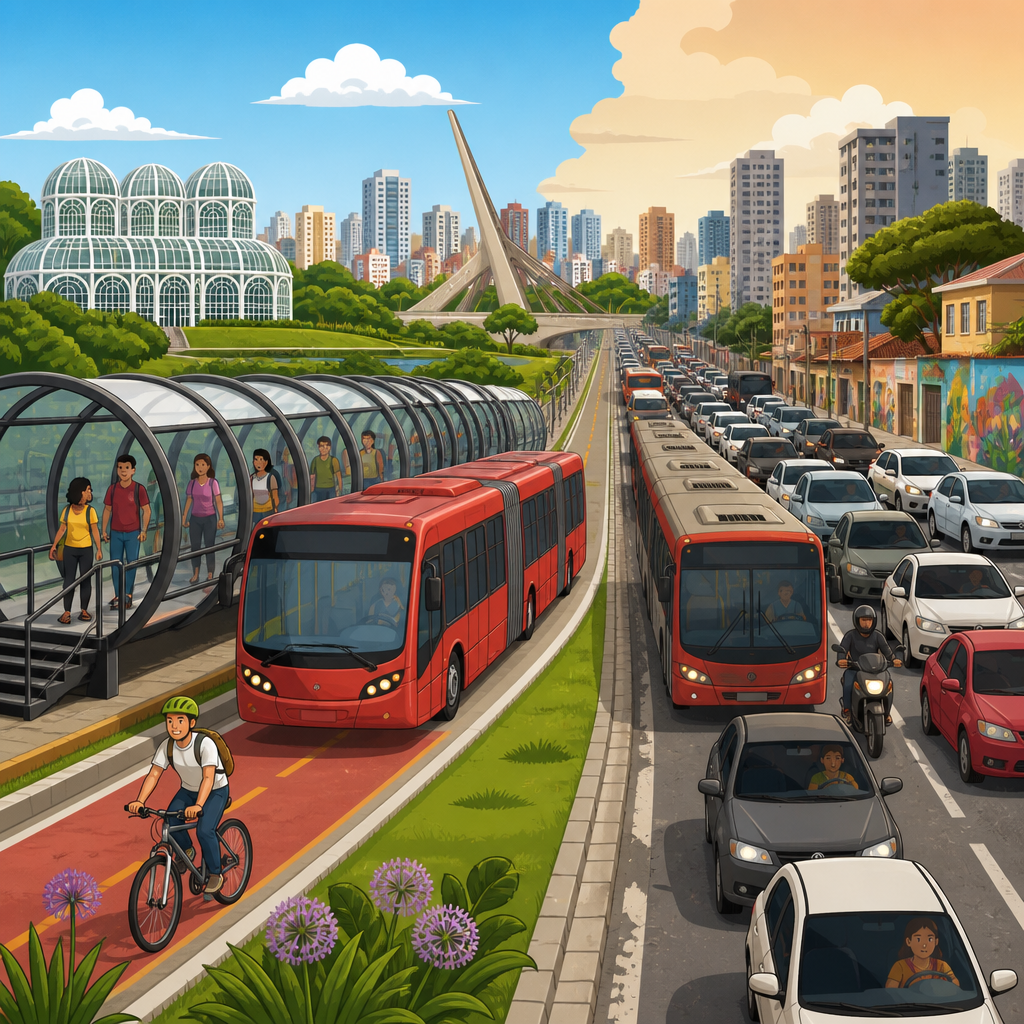
Curitiba’s Bus Rapid Transit legacy is one of the most influential stories in modern urban planning, because it proved that a city could deliver mass transit performance without building a metro. Bus Rapid Transit, usually shortened to BRT, refers to a bus system designed to operate more like rail: dedicated lanes, off-board fare payment, level boarding, frequent service, and stations that speed passenger flow. Curitiba, the capital of Paraná in southern Brazil, became the global reference point for this approach from the 1970s onward. Planners, mayors, transport engineers, and development agencies studied its corridors, copied its iconic tube stations, and cited the city as evidence that smart design could stretch limited budgets further than expensive underground systems.
The model matters because transportation systems shape almost everything else in cities: housing patterns, commuting times, air quality, public budgets, street safety, and access to jobs. I have seen Curitiba invoked in planning meetings far from Brazil as a shorthand for practical innovation, especially in fast-growing cities that cannot finance rail at the scale they need. The appeal is obvious. Compared with metro construction, BRT can be deployed faster, phased incrementally, and integrated with ordinary bus networks. Curitiba also tied transit planning to land-use regulation, encouraging denser development along structural corridors rather than allowing growth to sprawl in every direction. That integration is the real heart of the city’s reputation, not just the buses themselves.
Yet the same case study is often flattened into a myth. The popular version suggests Curitiba discovered a simple, universally transferable formula: paint bus lanes, add stations, move people cheaply, and solve urban mobility. The truth is more instructive. Curitiba’s system was built over decades, under specific political conditions, with strong municipal coordination and an unusually consistent planning culture. Its success depended on route hierarchy, fare integration, corridor zoning, and disciplined street design. Just as important, its limits today show that no transport innovation remains sufficient forever. Population growth, metropolitan expansion, rising car ownership, aging infrastructure, and uneven service quality have exposed strains that admiration alone cannot fix.
This article examines both sides of the Curitiba BRT story: why the city became a benchmark and why the benchmark no longer fully matches current realities. Understanding that tension is valuable for anyone working on urban planning and policy, because legacy systems can be both exemplary and outdated at the same time.
How Curitiba Built a Global Model
Curitiba’s transit revolution is usually associated with architect and planner Jaime Lerner, who served multiple terms as mayor and later governor of Paraná, but the foundations were institutional as much as personal. The Instituto de Pesquisa e Planejamento Urbano de Curitiba, known as IPPUC, gave the city an enduring planning apparatus capable of linking transport, land use, and urban form. In 1966, Curitiba adopted a master plan that shifted growth away from a radial, monocentric pattern and toward linear axes. Instead of expanding equally in all directions, the city would channel development along structural corridors, where high-capacity bus service could support denser housing and commerce.
The key innovation was not a single technology but a coordinated urban system. The city created a trinary road structure along major axes: central lanes for express buses, flanked by local traffic lanes and one-way parallel streets. This arrangement reserved right-of-way for transit without requiring a full rail alignment. Over time, Curitiba developed service layers including express buses, interdistrict routes, feeder services from outlying areas, and direct routes with fewer stops. A unified fare system allowed passengers to transfer across lines without paying again, which is essential for network efficiency. Many cities copied the visible elements of BRT but neglected this deeper network logic.
One reason Curitiba earned such influence is that it solved several operational bottlenecks before many peers recognized them clearly. Off-board fare collection reduced dwell time. Level boarding improved accessibility and sped entry and exit. Enclosed tube stations protected passengers from weather and concentrated boarding in defined locations. Articulated and later bi-articulated buses increased capacity far beyond conventional vehicles. In practical terms, these measures meant buses spent less time stopped and more time moving, which is exactly how high-capacity transit gains productivity. Even today, when I review underperforming bus corridors elsewhere, the missing pieces often look like a reverse image of Curitiba’s strengths: on-board payment, inconsistent stop spacing, poor transfers, and mixed-traffic operations.
Curitiba also benefited from timing. During the late twentieth century, many Latin American cities were growing rapidly but lacked funds for extensive rail networks. International agencies, consultants, and local officials sought scalable alternatives. Curitiba became a working demonstration, not an abstract theory. Bogotá’s TransMilenio, opened in 2000, adapted and expanded BRT concepts at a much larger scale. Systems in Mexico City, Guangzhou, Johannesburg, and Jakarta drew from the same family of ideas, though each adjusted lane design, station form, and fleet strategy to local needs. The point is not that all of these systems reproduced Curitiba exactly, but that Curitiba changed the policy vocabulary of urban transport worldwide.
Why the System Worked So Well
Curitiba’s early success came from matching transit design to city structure. High-capacity buses ran where density was planned to increase, and zoning rules encouraged taller buildings along the same corridors. This is a fundamental planning principle: transit performs best when many people can live, work, and shop within walking distance of frequent service. Curitiba operationalized that principle decades before transit-oriented development became a global buzzword. The city effectively treated transport corridors as development spines, reducing the mismatch between where people were and where service investment went.
Fare integration was another decisive advantage. Riders could enter stations, move between services, and complete trips across the network without punitive transfer costs. In fragmented bus markets, every transfer can feel like a financial penalty and a psychological hassle, pushing people toward informal transport or private cars. Curitiba reduced that friction. The result was a more legible system that served a wider range of trip patterns than a set of isolated routes would have allowed. Strong network design matters more than speed alone; a corridor can be fast, but if passengers cannot reach it easily or connect onward affordably, its real usefulness is limited.
Street geometry and service discipline also mattered. Dedicated lanes protected buses from congestion, giving the system travel-time reliability that ordinary bus routes rarely achieve. Reliability is often undervalued by non-users and prized by regular riders. A commute that consistently takes thirty minutes is usually preferable to one that ranges from twenty-five to fifty. Curitiba’s design addressed that by reducing interference from general traffic. Station design, platform alignment, and vehicle configuration then supported quick passenger turnover. Collectively, these details enabled a bus system to perform many of the functions people associate with rail.
Perhaps most important, the city sustained a coherent planning direction for years. Many municipalities have technically sound transport plans that fail because political cycles, agency fragmentation, or real-estate pressures undermine implementation. Curitiba enjoyed more continuity than most. That continuity does not mean every decision was perfect, but it allowed the network, road hierarchy, and land-use pattern to reinforce one another. From a policy perspective, this is the real lesson: transport excellence is rarely the product of isolated infrastructure. It emerges from governance capacity, institutional memory, and repeated alignment between city plans and annual decisions.
What Other Cities Copied, and What They Missed
As Curitiba’s reputation spread, many cities tried to replicate BRT, but replication often focused on visible artifacts instead of enabling conditions. Tube stations, articulated buses, and painted lanes are easy to photograph. Integrated governance, disciplined corridor zoning, and long-term operating strategy are not. I have reviewed projects branded as BRT that functioned closer to enhanced bus service because they lacked continuous right-of-way, signal priority, strong enforcement, or fare integration. When that happens, the label survives but the performance does not.
The global BRT standard developed by the Institute for Transportation and Development Policy formalized many of the elements that systems need to succeed, including dedicated lanes, median alignments, platform-level boarding, and intersection treatments. Curitiba helped inspire that codification, but later systems sometimes surpassed the original in specific technical areas. Bogotá, for example, pushed very high capacities through passing lanes at stations and intensive trunk-feeder operations. Guangzhou combined BRT with bike sharing and metro connections in a dense urban corridor. These examples show that Curitiba was a starting point, not the final word.
| Feature | Curitiba Legacy | Common Copying Mistake | Why It Matters |
|---|---|---|---|
| Dedicated lanes | Continuous transit priority on structural axes | Part-time or broken lanes | Interruptions destroy reliability and speed |
| Stations | Off-board payment and level boarding | Simple shelters with on-board fare payment | Dwell times stay high without true station functions |
| Network design | Trunk, feeder, and interdistrict hierarchy | Single corridor treated in isolation | Riders need complete door-to-door networks |
| Land use | Density aligned with transit corridors | No zoning reform around routes | Low density weakens ridership and efficiency |
| Governance | Strong municipal planning coordination | Split responsibilities across agencies | Fragmentation slows decisions and weakens service quality |
The broader planning implication is straightforward. BRT is not a kit of parts; it is a system architecture. Cities that copied the hardware while ignoring the operating model usually underachieved. Cities that adapted the principles to local institutions and street conditions performed better, even when their stations looked nothing like Curitiba’s.
The Limits Curitiba Faces Today
Curitiba’s legacy remains substantial, but the system now faces constraints that reveal the limits of relying on yesterday’s innovation in today’s metropolitan context. One major issue is capacity pressure. BRT can move large volumes of passengers, especially with passing lanes, high frequencies, and large vehicles, but corridors have upper bounds. As metropolitan travel demand grows, boarding volumes, bus bunching, and station crowding become harder to manage. Some of Curitiba’s busiest corridors have experienced exactly these stresses, particularly as regional growth has expanded travel beyond the original city structure.
Another challenge is infrastructure aging. Stations, pavements, fleet assets, and operational control systems all require renewal. The romance of innovation often obscures the routine capital maintenance that keeps transit reliable. When stations deteriorate, accessibility suffers. When pavement in bus lanes wears down, ride quality and operating costs worsen. When fleets age, breakdown risk rises and emissions performance lags newer technology. Legacy systems can become victims of their own symbolic success if decision-makers assume historic prestige substitutes for reinvestment.
Motorization has also changed the competitive landscape. Brazil’s urban transport patterns have shifted over the decades as household incomes, car ownership, and motorcycle use increased. Even a well-designed bus system loses relative attractiveness if congestion worsens around it, access streets become less walkable, or service quality slips while private vehicle options expand. At the same time, peripheral urbanization means more riders start farther from the original structural axes, making trips longer and transfers more complex. A corridor strategy designed for one urban form can struggle when the region evolves into a more dispersed metropolitan pattern.
Social equity concerns complicate the picture further. Integrated systems are often praised for efficiency, but fare levels, transfer burdens, and service quality across center and periphery do not affect all users equally. Lower-income riders typically endure the longest trips and are most sensitive to service crowding and waiting time. In policy terms, operational efficiency and social justice are linked. If a celebrated network no longer serves peripheral populations well, the city must evaluate not only ridership totals but also who bears the heaviest daily costs in time and money.
What Curitiba Still Teaches Urban Planning
Curitiba’s current limits do not cancel its achievements. They sharpen the lesson. The city demonstrated that transport and land use must be planned together, that buses can deliver high-quality mass transit when given proper infrastructure, and that institutional continuity matters as much as engineering. Those principles remain valid. What has changed is the scale and complexity of contemporary urban mobility. Cities now must integrate BRT with metro lines, commuter rail, cycling networks, pedestrian improvements, real-time passenger information, electrified fleets, and regional governance structures. No single mode can carry the full burden alone.
For planners and policymakers, the most useful reading of Curitiba is neither worship nor dismissal. It is a case of strategic fit. In its time, under its constraints, Curitiba built an elegant and influential response to rapid urban growth. Today, the same city shows why successful systems must keep evolving. Legacy is not a maintenance strategy. If you are assessing transport policy in any city, use Curitiba as both inspiration and warning: design the network around urban form, protect transit priority, integrate fares and services, and reinvest before success hardens into nostalgia. That is how a celebrated model becomes a living system rather than a museum piece. Study the full story, then apply the principle that every great transit solution has an expiration date unless cities renew it.
Frequently Asked Questions
What made Curitiba’s Bus Rapid Transit system so influential in urban planning?
Curitiba’s Bus Rapid Transit system became influential because it demonstrated that a growing city could achieve many of the benefits associated with rail transit without the much higher cost and construction burden of a subway or metro. Instead of relying on underground tunnels or expensive fixed rail infrastructure, Curitiba organized buses into a coordinated, high-capacity network built around dedicated corridors, pre-paid boarding, platform-level access, and fast passenger circulation. Those elements may sound standard today, but Curitiba helped show the world how powerful they could be when combined into a single system rather than treated as isolated improvements.
The city’s achievement was not just technical. It was also strategic. Curitiba integrated transportation planning with land use, encouraging higher-density development along major transit axes. That meant the BRT was not simply moving people through the city; it was actively shaping how the city grew. For planners around the world, this was a breakthrough idea. It suggested that public transport could guide urban form, reduce dependence on private cars, and support more efficient development patterns all at once.
Another reason Curitiba became a reference point is that its model appeared replicable. Many cities, especially in the developing world, faced severe budget constraints but needed better mass transit quickly. Curitiba offered a practical template: if a city could not afford a metro, it could still build a structured, legible, high-performance bus network. That combination of affordability, speed of implementation, and visible results is why Curitiba’s BRT legacy has remained so central to conversations about sustainable urban mobility.
How does Bus Rapid Transit differ from a regular city bus system?
Bus Rapid Transit differs from a conventional bus service because it is designed to function less like a collection of mixed-traffic routes and more like a true rapid transit network. In a standard city bus system, buses often share the road with cars, stop frequently at the curb, require passengers to board one by one and pay the driver, and are more vulnerable to congestion, delays, and inconsistent travel times. BRT addresses those weaknesses through a set of deliberate design choices aimed at improving speed, reliability, and passenger capacity.
One of the biggest differences is the use of dedicated lanes or exclusive rights-of-way. By separating buses from general traffic, a BRT system can maintain more predictable service and avoid many of the delays that undermine ordinary bus operations. Another key feature is off-board fare payment, which allows passengers to pay before boarding rather than at the vehicle door. This reduces dwell time at stations and makes service move faster. Level boarding also matters because it enables quicker entry and exit, improves accessibility for people with disabilities, and creates a smoother passenger experience.
Frequency and network design are equally important. A genuine BRT system is not just a bus route with some painted lanes; it is a coordinated transit framework with trunk routes, feeder services, clear stations, and operational priority. Curitiba’s system helped define this model by showing that buses could deliver high passenger throughput when supported by the right infrastructure and service planning. In short, the difference is not the vehicle itself but the system around it. BRT is about treating buses as rapid transit rather than as a slower fallback option.
Why was Curitiba able to deliver strong transit performance without building a metro?
Curitiba was able to deliver strong transit performance without a metro because city leaders pursued a systems-based approach that matched transportation investment to local realities. Building a subway requires immense capital, long construction timelines, specialized engineering, and political continuity over many years. Curitiba chose a different path. It focused on creating dedicated transit corridors and structuring bus operations in a way that captured many of the performance advantages of rail, especially along high-demand urban axes.
The city’s success came from combining infrastructure, operations, and planning rather than treating transit as a standalone engineering project. Dedicated busways allowed vehicles to bypass congestion. Station design sped boarding and alighting. Service patterns connected main corridors to feeder routes, making the network more efficient and easier to use. These choices increased capacity and reduced travel times without requiring the full cost of metro construction.
Equally important, Curitiba linked transit planning to urban development. Growth was encouraged along transportation corridors, which concentrated demand where the BRT network could serve it effectively. This made the system more productive and strengthened the relationship between transit investment and land use. In that sense, Curitiba did not simply avoid building a metro; it built a different kind of transit city. Its legacy shows that high-quality mobility is not determined by whether a system runs on steel wheels or rubber tires, but by whether the city organizes infrastructure, policy, and growth around efficient public transport.
What are the main limits of Curitiba’s BRT system today?
Curitiba’s BRT system remains historically significant, but its limits have become more visible over time. One major challenge is that success can eventually produce strain. A corridor-based bus network that performs extremely well can also become overcrowded as population, travel demand, and metropolitan complexity increase. In some cases, infrastructure that was once innovative may age, require modernization, or struggle to absorb volumes that have grown beyond original expectations. This is especially true when continued investment does not keep pace with demand.
Another limitation is that even the best bus-based system has capacity thresholds. BRT can move very large numbers of passengers, but at some point heavily used corridors may face operational bottlenecks, bus bunching, station crowding, or slower service due to sheer volume. That does not mean BRT has failed. It means that a model once ideal for a certain scale may need adaptation, expansion, or complementary modes as the city changes. In Curitiba’s case, the legacy is so strong that it can sometimes overshadow the need to update the system for contemporary conditions.
There are also broader urban pressures. Rising car ownership, metropolitan expansion beyond the original planning framework, and changing commuting patterns can weaken the effectiveness of a transit model designed for an earlier era. A BRT system works best when it is supported by land use discipline, strong governance, and sustained public investment. If those conditions loosen, performance can suffer. So the central limit of Curitiba’s model today is not that BRT was the wrong idea, but that no transport solution remains permanently sufficient without renewal, adaptation, and integration with newer mobility needs.
What lessons can other cities learn from Curitiba’s BRT legacy today?
Other cities can learn two equally important lessons from Curitiba: first, that thoughtful bus-based transit can transform urban mobility, and second, that even the best model must evolve. The original Curitiba lesson was optimistic and powerful. It showed that cities do not need to wait for ideal financial conditions or massive rail budgets to improve public transport. With disciplined corridor planning, dedicated lanes, efficient station design, and strong integration between land use and transit, buses can provide fast, legible, and high-capacity service at a fraction of the cost of a metro.
But the modern lesson is more nuanced. Cities should not copy Curitiba superficially by installing a few bus lanes and labeling them BRT. The real achievement was institutional and strategic: long-term planning, integration across sectors, and a willingness to prioritize public transport in the shape of the city itself. That is the part worth replicating. BRT succeeds when it is treated as a complete mobility system, not as a branding exercise or a low-cost substitute for serious transit investment.
At the same time, Curitiba’s current challenges remind planners that no transport system should be frozen in time. Infrastructure needs maintenance. Corridors need upgrades. Networks may require redesign as cities expand and travel patterns shift. Some corridors may eventually need rail or other high-capacity supplements. So the most valuable takeaway is not simply “build BRT.” It is “build a transit system that fits your city, supports equitable growth, and can adapt over time.” Curitiba remains a foundational case not because it offered a perfect final answer, but because it proved that ambitious, integrated urban transport policy can reshape how a city functions.


