
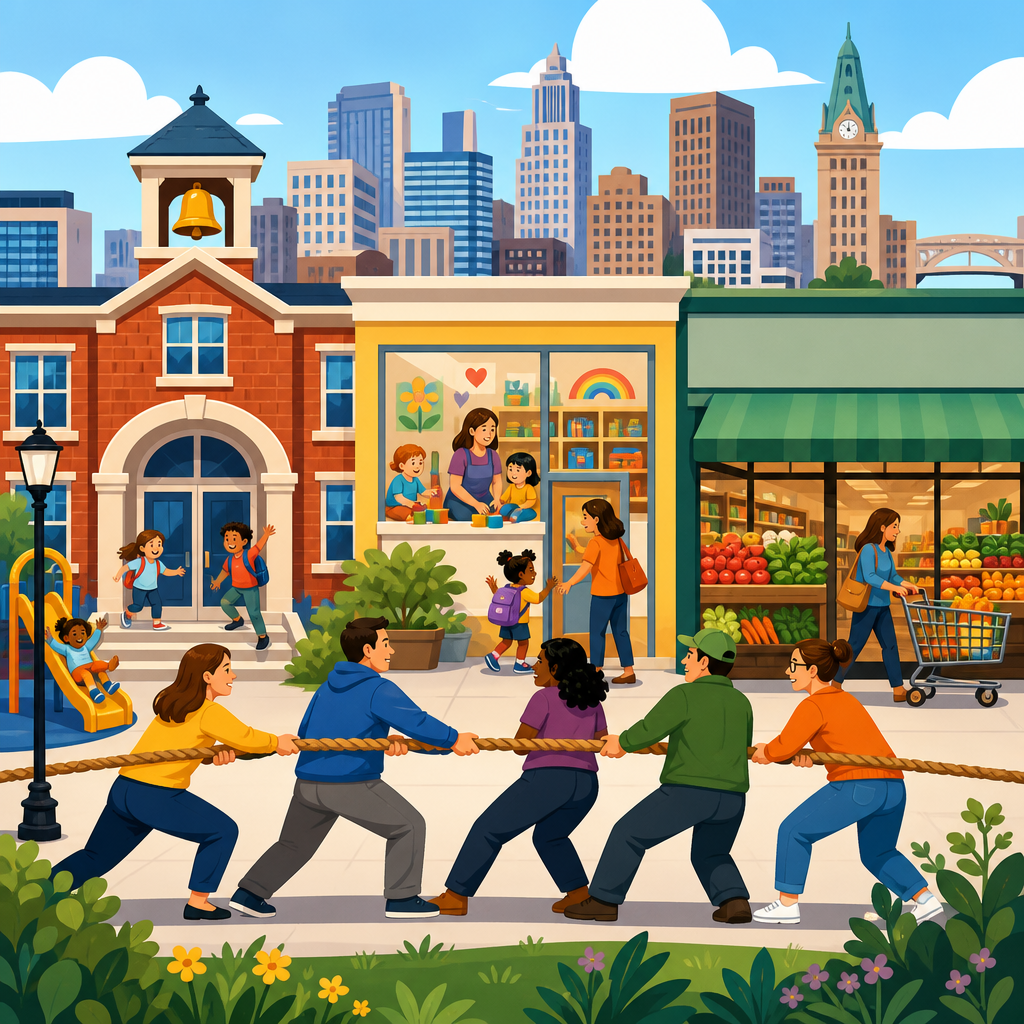
Downtown revitalization is usually measured by office leasing, apartment construction, and restaurant openings, but families judge a center city by a different standard: whether daily essentials remain reliably available. The challenge of keeping downtown schools, child care, and grocery stores open sits at the intersection of urban planning, commercial real estate, municipal finance, and household decision-making. These are not lifestyle amenities that can be swapped in and out with changing market tastes. They are anchor services that determine whether residents can build durable routines close to work, transit, and civic institutions.
In planning practice, “downtown” generally refers to a city’s primary employment and civic core, though in many regions it now includes adjacent mixed-use districts with housing, entertainment, and public services. “Keeping open” means more than avoiding closure notices. It means sustaining operators through rent cycles, labor shortages, enrollment swings, supply-chain volatility, and public safety concerns. A school must maintain enough students and staff to deliver instruction. A child care center must meet strict licensing ratios while covering payroll and insurance. A grocery store must move high volumes of perishable inventory at margins that are often only one to three percent.
I have worked on central business district redevelopment efforts where leaders celebrated new residential towers, then struggled to explain why parents still drove to the suburbs for preschool or weekly groceries. The reason is simple: downtown economies were historically designed for commuters, not households. Office districts can support lunch counters, coffee shops, and parking garages with daytime demand. They do not automatically support elementary classrooms, infant care rooms, or full-service supermarkets, all of which depend on repeat local customers across mornings, evenings, weekends, and school-year cycles.
This matters because the loss of any one of these services weakens the others. When a grocery store closes, downtown becomes less practical for families and older adults. When child care spots disappear, parents may leave center-city jobs or move away entirely. When schools lose enrollment, residential developers face a harder sales pitch and employers have a tougher time recruiting workers who want an urban lifestyle without sacrificing daily convenience. A resilient downtown therefore depends on a complete neighborhood ecosystem, not isolated flagship projects.
Why Essential Services Are Harder to Sustain Downtown
Schools, child care providers, and grocery stores face downtown conditions that differ sharply from neighborhood or suburban settings. The first issue is cost structure. Rents in central locations are typically higher, leases may include operating expense pass-throughs, and build-outs are expensive. A licensed child care center needs secure entries, age-specific rooms, outdoor play space or compliant alternatives, kitchens, restrooms scaled for children, and strict life-safety features. A grocery store needs loading access, refrigeration, waste handling, back-of-house storage, and enough floor area to support basket size. Public schools or charter schools need classroom layouts, gyms or shared recreation space, and circulation patterns that satisfy safety requirements.
The second issue is demand volatility. Downtown customer bases are rarely as stable as they appear on paper. Office attendance patterns shifted significantly after the pandemic, reducing daytime foot traffic that many retailers once counted on. Residential growth may be strong overall but uneven by unit type; many towers add studios and one-bedroom apartments, which do not generate the same school enrollment as family-sized units. Child care demand may look robust, yet providers can still fail if parents need care outside standard hours, if infant care is too expensive to staff, or if commuting patterns change quickly.
Public perception also matters. Even where crime rates are manageable, persistent concerns about safety, cleanliness, homelessness, traffic, or parking can suppress use. Parents make location decisions conservatively. They evaluate sidewalks, street crossings, pickup zones, and the comfort of walking with children before sunrise or after dark. Grocery shoppers consider whether carrying bags to transit feels practical. These small friction points shape revenue more than many downtown strategies acknowledge.
Finally, essential services compete with uses that can pay more. A ground-floor space attractive to a small-format grocer may also interest a bank branch, fitness operator, or restaurant group. A former school building may be more valuable as offices or residential conversion. Without public policy intervention, market logic often reallocates scarce downtown space toward higher-rent tenants rather than uses that create long-term social stability.
Downtown Schools and the Enrollment Puzzle
Keeping downtown schools open begins with understanding enrollment math. Traditional public districts allocate staffing and operating funds largely on a per-pupil basis. Charter schools rely on similar student-based funding, though facilities costs can vary greatly. Private and parochial schools depend on tuition, fundraising, and parish or philanthropic support. In each model, a modest enrollment decline can destabilize budgets quickly because many costs, including administration, utilities, and compliance, are fixed. Downtown schools are especially vulnerable when nearby housing skews toward smaller households or when families move after children reach school age.
From projects I have seen, city leaders often overestimate how many students new apartments will generate. A tower full of luxury one-bedrooms may add tax value and street activity while yielding very few elementary students. By contrast, a moderate number of two- and three-bedroom units, especially at attainable price points, can materially strengthen a neighborhood school. That is why family housing policy and school sustainability are inseparable. If a city wants a downtown school to thrive, zoning and incentives must support units where families can realistically stay for years.
Program identity matters too. Successful downtown schools usually offer a clear reason for parents to choose them beyond proximity. That may include language immersion, arts integration, STEM programming, dual enrollment, or partnerships with museums and universities. Dense urban cores can convert nearby institutions into educational assets, but only if administrators build those partnerships deliberately. A downtown school without a strong program can be perceived as a compromise option; a school with a distinctive model becomes a destination that reinforces downtown living.
Transportation is another decisive factor. Families need safe walking routes, reliable transit, and predictable drop-off arrangements. District planners sometimes underestimate how much enrollment depends on curb management and crossing design. A school can have strong teachers and adequate classroom space yet still struggle if daily access feels chaotic. Streetscape improvements, crossing guards, and coordinated pickup plans are not minor operational details. They are enrollment infrastructure.
Why Child Care Economics Break Down So Easily
Child care is one of the hardest essential services to keep open anywhere, and downtown conditions intensify every weakness in the business model. The core constraint is staffing. State licensing rules require low adult-to-child ratios, especially for infants and toddlers, because quality and safety depend on close supervision. Those ratios are necessary, but they limit how many tuition-paying children each worker can support. When wages rise, as they should in a demanding profession, providers cannot simply scale volume to offset costs. Parents are already paying near the upper bound of affordability in many markets.
According to Child Care Aware of America and similar state-level analyses, annual center-based infant care often rivals in-state public college tuition and can exceed monthly rent for many households. Yet providers still operate on thin margins because labor typically consumes most expenses. Downtown adds higher occupancy costs, parking complications for staff, and pressure for extended hours that match service workers, hospital employees, and hybrid office schedules. A center may have a waiting list and still be financially fragile.
The real estate challenge is severe. Suitable child care space is not just vacant square footage. Operators need code-compliant egress, secure check-in areas, nap rooms, food preparation capacity, diapering stations, and access to outdoor play or equivalent recreation plans. Retrofitting a downtown storefront or office suite can be so expensive that nonprofit sponsors, hospitals, universities, or employers become essential partners. In several city-center projects, I have seen centers succeed only after a landlord offered tenant improvement dollars or a public agency layered grants onto the capital stack.
Demand patterns also complicate operations. Parents in downtown districts often need infant care first, but infant rooms are the least profitable because staffing ratios are strictest. Preschool classrooms may cross-subsidize younger ages, but that balance fails when a center cannot recruit enough teachers or when too many families need only part-time care. The result is chronic instability: long waitlists for some age groups, underused capacity in others, and constant pressure on directors to adjust tuition, staffing, and hours.
The Grocery Store Problem: Margins, Logistics, and Trust
A downtown grocery store can be celebrated as a civic win and still struggle commercially. Full-service grocers depend on frequent trips, predictable baskets, and efficient supply chains. Downtown settings disrupt all three. Basket sizes may be smaller because shoppers walk or use transit. Deliveries are more complex where loading docks are limited or curb space is congested. Shrink from spoilage or theft can be higher. Security costs, insurance, and utility bills for refrigeration systems further tighten already narrow margins.
Store format matters. A compact urban market can work well when population density is high, nearby residents shop often, and the assortment is tailored to local needs. But many downtown stores are expected to do too much at once: serve office workers at lunch, support evening household shopping, carry premium prepared foods, and also offer affordable staples. If the merchandising mix misses local demand, the store may look busy while underperforming financially. I have reviewed cases where leaders cited foot traffic as evidence of success even though average transaction size and repeat household penetration remained too low.
Price perception is equally important. Downtown grocers are often accused of being expensive, sometimes fairly, sometimes because their urban cost structure is visible to shoppers. If residents believe the store caters mainly to affluent newcomers or daytime workers, broader community support erodes. Trust improves when operators communicate value clearly, stock culturally relevant items, accept SNAP and WIC where eligible, and keep core staples competitively priced. A grocery store is not just retail infrastructure; it is a daily signal about who downtown is for.
| Service | Main Revenue Driver | Key Cost Pressure | Typical Downtown Risk |
|---|---|---|---|
| School | Stable enrollment | Facilities and staffing | Too few family-sized housing units |
| Child care | Tuition and subsidies | Labor under licensing ratios | High rent and difficult tenant build-out |
| Grocery store | Frequent repeat household trips | Thin margins and refrigeration | Small basket sizes and delivery constraints |
What City Governments and Downtown Partnerships Can Do
Keeping these services open requires coordinated intervention, not ribbon cuttings. The first tool is land use and development policy. Cities should align housing incentives with family retention by encouraging two- and three-bedroom units, school-safe street design, and mixed-use projects that reserve appropriate space for child care or fresh food retail. Inclusionary housing, density bonuses, and public land disposition can all be structured to support family-serving uses, but only if requirements are realistic and backed by market analysis.
Second, public entities can reduce occupancy costs. Long-term leases in publicly controlled buildings, tax abatements tied to service delivery, facade and tenant improvement grants, and low-interest financing can bridge feasibility gaps. For grocery stores, some cities have used healthy food financing programs to support equipment and fit-out costs. For child care, capital grants and shared facilities models can lower barriers for nonprofit operators. For schools, joint-use agreements with parks, libraries, and recreation centers can expand program capacity without duplicating every facility on-site.
Third, data needs to improve. Too many decisions rely on broad population projections instead of block-level analysis of household composition, income, commuting patterns, and purchasing behavior. A downtown may have enough residents to justify a grocer in theory, yet not enough weekly spend retained locally. It may show many children under five, yet too few parents seeking full-time licensed care. Strong planning starts with demand segmentation, not slogans about creating a 24-hour neighborhood.
Fourth, partnerships matter. Major employers, hospitals, universities, and cultural institutions can stabilize demand by sponsoring child care slots, purchasing from downtown grocers, supporting school programming, or master leasing space. Business improvement districts and downtown development authorities can coordinate marketing, streetscape maintenance, security ambassadors, and event programming that strengthens daily confidence in the district. None of these tools alone guarantees survival, but together they make operations more predictable.
How to Build a Downtown That Families Can Actually Use
The practical test is simple: can a parent living or working downtown complete the school run, secure reliable child care, buy groceries, and get home without unreasonable cost or stress? If not, the district is not yet functioning as a complete neighborhood. Cities that want lasting downtown recovery should evaluate essential services the same way they evaluate transit, utilities, and housing supply: as foundational systems. The goal is continuity, not occasional access.
For planners, policymakers, and civic leaders, the lesson is clear. A thriving downtown needs residents across life stages, and that requires schools, child care, and grocery stores that are financially and physically supported for the long term. Start with accurate demand analysis, family-oriented housing, feasible real estate, and cross-sector partnerships. Then protect these uses before the next market shift tests them again. If you are shaping an urban policy agenda, treat everyday essentials as core infrastructure and plan accordingly.
Frequently Asked Questions
Why are schools, child care centers, and grocery stores so important to downtown recovery?
Schools, child care centers, and grocery stores are foundational services that determine whether downtown can function as a true neighborhood instead of remaining only an employment or entertainment district. Office leasing, residential construction, and restaurant openings may signal activity, but families typically make longer-term decisions based on whether they can reliably access education, care, and food close to home. When these essentials are present and stable, parents are more willing to sign leases, buy homes, and remain in the area through different life stages. That consistency supports broader economic health because it creates repeat spending, sustained foot traffic, and a population invested in the district beyond weekday business hours.
These services also reinforce one another. A grocery store becomes more viable when nearby households shop regularly rather than occasionally. Child care centers benefit from a stable base of working parents who need predictable hours and convenient locations. Schools gain enrollment when families believe they can build a daily routine around downtown life without constant logistical strain. In practical terms, this means that keeping essential services open is not just a social objective; it is a core part of land use planning, commercial occupancy, and fiscal resilience. A downtown that cannot support family basics may attract visitors and workers, but it will struggle to retain residents over time.
Why is it so difficult to keep these essential services open in a downtown environment?
The difficulty comes from a mismatch between high operating costs and fragile demand patterns. Downtown real estate often carries higher rents, taxes, and build-out expenses than other neighborhoods, while schools, child care operators, and grocers typically operate on relatively thin margins. A child care center may need extensive licensing compliance, safety improvements, outdoor space adaptations, and trained staff, all while facing strict staff-to-child ratios that limit revenue growth. Grocery stores must manage labor, refrigeration, spoilage, security, and distribution costs, which become especially challenging when customer traffic is inconsistent or heavily concentrated at certain times of day.
Demand can also be less predictable downtown than many people assume. A district may appear dense on paper, but if its population is dominated by commuters, small households, students, or residents with irregular schedules, essential services may not see the steady, all-day usage they need. Schools and child care providers depend on enrollment that is both sufficient and stable, and grocery stores depend on frequent repeat trips for staples rather than occasional purchases of prepared foods. Add competition from delivery services, suburban shopping patterns, remote work, and changing office occupancy, and the business case becomes even more complex. In short, the challenge is not simply attracting a provider once; it is maintaining enough dependable volume to support the service year after year.
How do city policies and urban planning decisions affect whether downtown families can access these basics?
City policy plays a major role because essential services do not succeed based on market demand alone. Zoning rules can either enable or hinder child care centers, schools, and grocery stores through use restrictions, parking requirements, loading rules, signage limitations, and lengthy approval processes. If a downtown building is physically suitable for a small grocery store or early learning center but requires multiple variances or expensive retrofits to comply with outdated codes, a potential operator may decide the project is not viable. Permitting speed matters as well. Delays increase financing risk and can discourage mission-driven providers that already operate with limited capital.
Municipal finance and public investment are just as important. Cities often provide incentives for housing, office conversion, or entertainment uses, yet family-serving services may need targeted support such as tenant improvement grants, property tax relief, operating subsidies, public-private partnerships, or shared-use arrangements in civic buildings. Planning decisions around transit, sidewalks, public safety, street design, and public space also influence success. Parents need safe drop-off patterns, walkable routes, and confidence that daily errands can be completed efficiently. When downtown planning accounts for family routines rather than only peak commuter flows, these services become more practical to use and more likely to remain open. The broader lesson is that essential services are part of urban infrastructure, not simply retail categories left to fend for themselves.
What does a healthy downtown ecosystem for families actually look like?
A healthy downtown ecosystem for families is one where daily life is convenient, predictable, and adaptable across different income levels and household types. That includes access to schools with stable enrollment and strong community ties, child care options with hours that match real work schedules, and grocery stores that offer affordable staple items rather than only specialty products. It also means these services are connected spatially and operationally. Families should be able to combine school drop-off, transit access, grocery shopping, and other errands without excessive travel time or dependence on a car for every task.
Just as importantly, a family-friendly downtown has redundancy and resilience. One provider in each category is rarely enough, because a single closure can disrupt the entire ecosystem and trigger out-migration. A healthy district offers a mix of public, private, nonprofit, and cooperative models, along with housing diversity that allows teachers, service workers, and families themselves to remain nearby. Reliable services are often supported by complementary investments such as parks, libraries, health clinics, and safe streets. In this kind of environment, downtown is not judged by novelty or short-term buzz. It is judged by whether ordinary routines work smoothly every day, which is the clearest sign that the neighborhood can sustain long-term community life.
What strategies can cities, property owners, and local institutions use to keep downtown essentials open long term?
Long-term success usually requires coordinated action rather than expecting any one market actor to solve the problem alone. Cities can identify essential services as priority uses and align zoning, subsidies, and economic development tools accordingly. That may include reduced permitting barriers, grants for build-out costs, long-term lease support, childcare operating assistance, or incentives for grocery formats tailored to smaller urban footprints. Public agencies can also use anchor institutions such as schools, libraries, transit hubs, and municipal buildings to create shared facilities or co-located services that lower occupancy costs and increase daily foot traffic.
Property owners have a major role because lease terms often determine whether a family-serving use is viable. Flexible rents, tenant improvement allowances, longer lease horizons, and space designed for practical operations rather than only premium aesthetics can make a critical difference. Employers and major downtown institutions can support demand by partnering on child care slots, meal programs, transportation access, or guaranteed purchasing arrangements. Community organizations can contribute by organizing around enrollment, patronage, and advocacy when a service is at risk. The most effective strategy is to treat schools, child care, and grocery access as essential components of downtown economic infrastructure. When leaders plan for them with the same seriousness given to housing, transit, or office recovery, downtown becomes far more capable of retaining families and sustaining real neighborhood life.


