
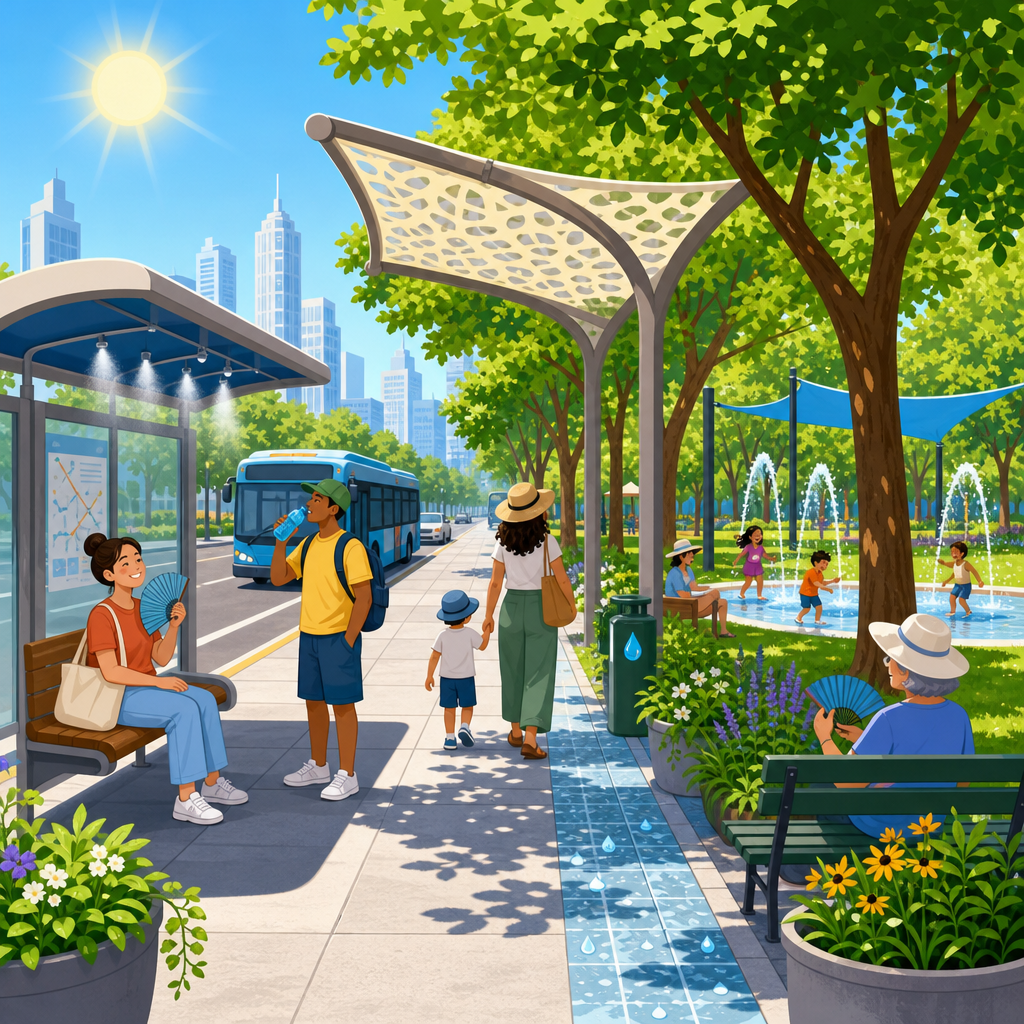
Heat emergencies expose a basic weakness in many cities: public space is often designed for average weather, not dangerous extremes. Cooling bus stops, sidewalks, and parks during heat emergencies means modifying the places people wait, walk, and gather so they reduce heat exposure, lower surface temperatures, and provide practical relief when temperatures and humidity push the human body toward heat stress. In planning terms, cooling can include shade, evaporative strategies, high-albedo materials, tree canopy, water access, transit shelter retrofits, and operational measures such as extended park hours or misting activation during alerts.
This topic matters because heat is not just uncomfortable; it is one of the deadliest weather hazards in many countries. Public health agencies consistently warn that older adults, children, outdoor workers, people with chronic illness, and residents without reliable air conditioning face elevated risk. I have worked on heat-response plans where the most urgent question was not whether a city had a cooling center, but how a person actually reached relief on foot or by transit without overheating on the way. That practical gap is where bus stops, sidewalks, and parks become lifesaving infrastructure.
Urban heat is intensified by the built environment. Asphalt and dark roofs absorb solar radiation, sparse tree canopy allows surfaces to bake, and traffic corridors trap radiant and convective heat. Nighttime cooling can also fail in dense districts because buildings and pavement release stored heat after sunset. As a result, the ambient air temperature reported at an airport often understates what someone experiences while standing beside a six-lane road or crossing an unshaded plaza. Surface temperatures on sunlit pavement can exceed air temperature by several tens of degrees, which increases radiant heat load and accelerates dehydration and fatigue.
For planners and policy makers, the challenge is to cool essential public spaces quickly during an emergency while also building long-term resilience. A strong strategy combines capital improvements, emergency operations, and equity-based targeting. The goal is straightforward: every resident should be able to wait for a bus, walk to daily needs, and use parks without facing avoidable heat danger. The sections below explain what works, where tradeoffs appear, and how cities can turn hot public space into a reliable network of protection.
Why bus stops, sidewalks, and parks are priority heat-response assets
These three public-space types deserve priority because they serve people who cannot simply retreat indoors. Bus riders may wait 10 to 30 minutes on exposed pavement. Pedestrians include schoolchildren, seniors, shift workers, and people making short trips in neighborhoods where driving is not realistic. Parks often become de facto refuges during outages or when apartments overheat, especially where libraries or recreation centers have limited hours. In every heat event I have planned for, the highest-risk journey was usually the uncovered link between home, transit, services, and shade.
Bus stops are especially important because transit dependency and heat vulnerability often overlap geographically. Stops near affordable housing, medical campuses, senior residences, and transfer corridors can generate long waits with little shade. Sidewalks matter because continuous exposure compounds across the trip: one hot block is manageable, but ten unshaded blocks with no benches or water can push a vulnerable person into heat exhaustion. Parks matter because they can deliver immediate thermal relief through tree canopy, soil moisture, and lower mean radiant temperature, while also acting as distribution points for water, information, and emergency staff.
The equity dimension is decisive. Heat risk is rarely distributed evenly. Neighborhoods with less canopy, more pavement, older housing stock, and fewer private cooling options usually face the highest temperatures and the greatest health burden. Good urban planning therefore treats cooling investments as core public safety infrastructure, not beautification. Mapping heat vulnerability with tools such as CDC social vulnerability indicators, local canopy assessments, satellite land surface temperature data, and transit ridership patterns helps cities identify where interventions will save the most lives.
Cooling bus stops: design choices that reduce exposure fast
The fastest way to improve a bus stop during a heat emergency is to increase shade and reduce radiant load. A shelter roof blocks direct solar exposure, but not all shelters perform equally. Narrow transparent canopies often preserve visibility while still allowing low-angle sun to strike riders from the side. Better shelters use wider roof spans, orientation-specific side panels, and materials with low solar heat gain. In hot regions, perforated metal or insulated roof panels frequently outperform dark polycarbonate because they reduce heat build-up above the waiting area. Bench design also matters; metal seating in full sun can become unusable, while shaded slatted benches stay safer.
Retrofit options can be deployed in phases. Temporary shade sails, modular canopies, movable umbrellas at staffed transit hubs, and reflective surface coatings around the stop can deliver rapid benefit before permanent construction. Some agencies add real-time arrival displays so riders can time arrival and shorten waits in direct sun. Others install bottle fillers, emergency call features, or QR codes linking to heat advisories. The operational point is simple: reducing waiting time is a cooling strategy, not just a service strategy.
Placement decisions deserve as much attention as shelter design. A bus stop beside a wide roadway receives reflected and emitted heat from asphalt and vehicles, while a stop set back beside trees or a building shade line can feel significantly cooler. I have seen agencies relocate stops by less than 100 feet to capture afternoon shade from adjacent structures, a low-cost move with outsized user benefit. The same logic applies to transfer centers, where canopy coverage should connect platforms, not stop at the curb edge.
Electricity can improve resilience if used carefully. Solar-powered lighting and displays are useful, but active cooling systems such as fans or misting require maintenance, water management, and accessibility review. Misting can help in very dry climates, yet it is less effective in humid conditions and can create slip risks or maintenance burdens if drainage is poor. The right standard is durability first: shade, seating, clear information, and surfaces that stay cooler under direct sun.
Cool sidewalks start with shade, surface choice, and walkability basics
Cooling a sidewalk begins with understanding thermal comfort. Air temperature matters, but mean radiant temperature often determines whether walking feels tolerable or dangerous. That is why continuous shade usually delivers more benefit than a small drop in air temperature alone. Street trees are the most effective long-term tool because they cool through canopy cover and evapotranspiration while improving walkability and stormwater performance. Species selection, rooting volume, irrigation plans, and utility conflicts must be resolved upfront; a tree pit that is too small will underperform for decades.
Surface materials also influence heat. Traditional dark asphalt absorbs and stores solar energy, while lighter pavements reflect more sunlight and can reduce surface temperature. However, high reflectance is not automatically comfortable if glare increases or reflected radiation hits pedestrians and building façades. In practice, the best results often come from combining moderate-reflectance materials with shade. Permeable pavements may support cooling through retained moisture, but their performance depends on local climate, maintenance, and structural needs. They are not universal replacements for every corridor.
Walkability basics become critical during heat alerts. Sidewalk width should allow people to choose the shaded side, pass each other without stepping into the sun-exposed roadway edge, and pause safely at crossings. Curb ramps, benches, and drinking fountains support people whose heat tolerance is lower. Signal timing matters too. If a crossing forces slow walkers to wait through multiple cycles on a bare concrete corner, the intersection itself becomes a heat hazard. During emergency operations, some cities temporarily adjust maintenance schedules, place mobile water stations on pedestrian routes, and prioritize tree watering to preserve canopy function.
| Public space | Highest-value cooling interventions | Typical tradeoffs |
|---|---|---|
| Bus stops | Wide shade canopies, side panels, real-time arrivals, shaded seating | Right-of-way limits, maintenance, visibility concerns |
| Sidewalks | Continuous street trees, cooler pavements, benches, water access | Utility conflicts, root space, pavement cost, glare management |
| Parks | Dense canopy, splash features, drinking fountains, extended hours | Water use, staffing, security, unequal access across neighborhoods |
Parks as neighborhood cooling networks during extreme heat
Parks can function as outdoor cooling centers when designed and operated for heat resilience. Mature tree canopy is the primary asset. Shaded lawns, groves, and paths can create materially cooler microclimates than adjacent streets because trees intercept solar radiation and the landscape stores less heat than pavement. Water features add relief when they are safe, maintained, and located where people actually gather. Drinking fountains are more important than ornamental water in many emergencies; hydration is basic risk reduction, and a fountain that works reliably is often more valuable than an eye-catching feature that is shut off for maintenance.
Programming and operations make the physical design effective. During heat emergencies, parks departments can extend evening hours, increase ranger or staff presence, open shaded restrooms, and coordinate with public health teams for outreach. Backup power for lighting, communications, and select indoor refuge rooms becomes crucial during grid stress. In several cities, recreation centers inside parks serve as hybrid nodes: the shaded landscape cools the approach, while indoor conditioned rooms protect people during the hottest hours. This layered model works better than relying on a single large cooling center far from daily activity patterns.
Distribution matters as much as quality. A signature downtown park does little for residents in heat-vulnerable outer neighborhoods if reaching it requires a long trip on unshaded transit corridors. The better approach is a network of smaller parks, schoolyards opened by agreement, library grounds, and community plazas linked by cooler walking routes. When agencies map parks against canopy inequity and transit access, they can identify “cooling deserts” where a pocket park, shade grove, or splash pad will produce measurable public-health value.
Emergency operations, policy tools, and measurement
Physical upgrades alone do not create an effective heat-response system. Cities need trigger-based operations tied to heat alerts, forecast thresholds, and local health indicators. A practical playbook identifies which bus stops receive temporary shade or water first, which parks extend hours, and which pedestrian routes get mobile outreach. Transit agencies, parks departments, emergency management, utilities, and public health teams should share one map, one communications protocol, and one list of high-priority sites. In my experience, interagency alignment matters more than perfect modeling because heat emergencies move quickly and confusion wastes the coolest hours of the morning.
Policy tools can accelerate implementation. Zoning and streetscape standards can require shade coverage targets, tree planting minimums, and heat-aware materials in capital projects. Transit shelter contracts can include thermal-performance criteria rather than treating shelters as advertising furniture. Park master plans can identify backup water, maintenance staffing, and accessible cooling features. Funding usually comes from multiple sources: transportation grants, hazard mitigation programs, public health budgets, stormwater funds, and utility partnerships. The most successful cities package cooling as a co-benefit strategy that supports safety, mobility, and resilience at the same time.
Measurement should be concrete. Useful indicators include percentage of transit stops with effective shade, miles of shaded sidewalk on priority corridors, park acreage within a ten-minute walk of high-vulnerability residents, fountain uptime, and observed user behavior during alerts. Thermal imaging, fixed sensors, and on-the-ground audits help verify whether investments work in lived conditions rather than only in design drawings. A city should also track complaints, ridership changes, and heat-related medical calls near intervention sites. If the goal is saving lives and preserving mobility, success must be measured where people actually stand, walk, and wait.
Cooling bus stops, sidewalks, and parks during heat emergencies is one of the clearest ways urban planning can turn climate adaptation into immediate public protection. The essential lesson is not complicated: people need safe shade, cooler surfaces, water, reliable information, and short paths to relief. Bus stops reduce danger when shelters block direct sun and cut waiting time. Sidewalks become safer when trees, materials, benches, and crossing design work together to lower radiant exposure. Parks protect neighborhoods when canopy, fountains, staff, and extended access are planned as emergency assets rather than optional amenities.
The strongest strategies are targeted, measurable, and equitable. They focus first on places where heat vulnerability, low canopy, and transit dependence overlap. They combine long-term capital improvements with short-term operating actions triggered by forecasts. They also acknowledge tradeoffs: reflective pavements can create glare, misting is climate-dependent, and tree planting fails without maintenance. But none of those limits weaken the central conclusion. Public-space cooling is practical, affordable compared with health losses, and effective when cities design for real human conditions instead of abstract averages.
For any city building a heat action agenda, start with a map of the hottest, busiest, and least-shaded public spaces, then upgrade them in the order residents need them most. Treat every bus stop, sidewalk corridor, and park as part of one connected cooling network, and the next heat emergency will find a city that is far better prepared.
Frequently Asked Questions
Why do bus stops, sidewalks, and parks become especially dangerous during heat emergencies?
During a heat emergency, public spaces can intensify exposure because they often combine direct sun, stored heat, and limited access to relief. Bus stops may have small shelters that block little sunlight, sidewalks can absorb and radiate heat from dark paving, and parks may include open lawns or play areas with minimal shade over the places people actually use. This creates a situation where air temperature is only part of the problem. Surface temperature, reflected heat, humidity, and lack of airflow all add to the body’s cooling burden.
People waiting for transit, walking to work, or spending time outdoors may not be able to leave quickly, which increases risk. Older adults, children, outdoor workers, people with disabilities, and residents without reliable air conditioning are especially vulnerable. In many neighborhoods, heat exposure is also unevenly distributed because there are fewer trees, more asphalt, and less investment in cooling infrastructure. That is why cooling public space during heat emergencies is not just a comfort upgrade. It is a public health measure that can reduce heat stress, prevent burns from hot surfaces, and help cities protect residents in the places they must use every day.
What are the most effective ways to cool bus stops during extreme heat?
The most effective bus stop cooling strategies combine shade, material choice, airflow, and access to information. First, shade is essential. Larger shelter roofs, side panels designed to block low-angle sun without trapping heat, and nearby tree canopy can dramatically reduce direct solar exposure. A shelter that is sized for actual passenger demand, rather than a minimal footprint, can protect more people during the hottest parts of the day. Orientation also matters. A well-designed shelter should account for sun angle at different times of day so that the waiting area remains shaded when it is needed most.
Second, the surfaces around the stop should be designed to stay cooler. High-albedo paving, lighter-colored concrete, and lower-heat seating materials can reduce heat buildup compared with dark asphalt or metal benches exposed to full sun. Third, cooling features should support comfort without creating maintenance problems. In some climates, fine-mist systems or adjacent drinking water access may help, but these solutions need reliable operations, water management, and consideration of humidity levels. In very humid conditions, shade and airflow often provide more dependable relief than evaporative systems alone.
Transit agencies and cities can also improve safety with practical additions such as real-time arrival information, which reduces waiting time in the heat, heat warning signage, and lighting that supports safe use during early morning or evening service adjustments. The best bus stop upgrades are targeted first to routes with high ridership, long transfer times, low tree cover, and high social vulnerability. That approach helps ensure cooling investments reach the people who depend on transit most during dangerous weather.
How can cities cool sidewalks without making streets harder to maintain or use?
Cooling sidewalks effectively starts with reducing how much heat the walking surface absorbs and how much solar radiation reaches pedestrians. Shade trees are often the highest-value long-term strategy because they cool people directly, lower surface temperatures, and improve comfort over a wider area than a single device or material change. However, trees need adequate soil volume, irrigation planning, and species selection suited to local heat, drought, and maintenance conditions. Where tree planting is limited by utilities or right-of-way constraints, cities can use shade structures, arcades, awnings, or modular canopy systems to fill gaps.
Material choices also play an important role. High-albedo pavements reflect more sunlight and can reduce surface heating, although they must be selected carefully to avoid excessive glare or reflected radiation onto pedestrians. Permeable materials and landscaped edges can help with stormwater management and, in some contexts, support cooler microclimates. The right solution depends on local climate, foot traffic, cleaning requirements, and accessibility standards. Sidewalk cooling should never compromise smooth, stable, and slip-resistant walking surfaces, especially for wheelchair users, people using mobility aids, and older pedestrians.
Maintenance is a key part of success. Cities should prioritize interventions that can withstand repeated heat cycles, heavy use, and routine repairs. That means coordinating cooling upgrades with capital planning, utility work, and streetscape standards rather than treating them as temporary add-ons. The most durable sidewalk cooling programs are data-driven, tied to neighborhood heat mapping, and implemented as part of complete street design, public health planning, and climate resilience policy.
What cooling strategies work best in parks during heat emergencies?
Parks need layered cooling strategies because they serve many different users and activities. Large-canopy trees are one of the most effective tools for lowering temperatures and improving comfort across trails, seating areas, playgrounds, and gathering spaces. Shade should be placed where people actually spend time, not just at the edges of a park. Picnic areas, benches, transit connections, playground equipment, sports sidelines, and restrooms all need protection from direct sun. In parks with younger visitors, shade over play surfaces is especially important because equipment and ground materials can become dangerously hot.
Water can also play a role, but it needs to be applied thoughtfully. Drinking fountains, bottle filling stations, splash features, and cooling misters may provide relief, especially in dry climates, but they require water quality oversight, drainage, and maintenance. In some heat emergencies, extended operating hours for splash pads or temporary cooling stations in park buildings can offer substantial benefit. Parks can also use lighter surface materials, strategically placed vegetation, and design that supports airflow rather than trapping heat within enclosed plazas or paved zones.
Operational changes matter as much as physical design. During extreme heat, cities can increase staffing, post multilingual heat safety information, extend access to indoor cooled park facilities, and adjust programming to safer hours. Parks in neighborhoods with high heat exposure and limited private cooling options should be prioritized for resilience upgrades. A well-cooled park becomes more than a recreational amenity during a heat emergency. It functions as a neighborhood refuge that helps residents recover, rehydrate, and reduce cumulative heat exposure.
How should cities prioritize cooling investments in public spaces during heat emergencies?
Cities should prioritize cooling investments where heat risk, public exposure, and social vulnerability overlap. That usually means starting with places where people must spend time outdoors whether conditions are safe or not, such as bus stops, school walking routes, major sidewalks, clinic corridors, and parks in lower-canopy neighborhoods. A strong prioritization process uses heat mapping, tree canopy data, transit ridership, pedestrian counts, surface temperature measurements, and demographic indicators such as age, income, disability, and access to air conditioning. The goal is to identify where cooling improvements will reduce risk for the greatest number of vulnerable people.
It is also important to distinguish between emergency actions and long-term capital upgrades. In the short term, cities can deploy temporary shade, water distribution, cooling signage, adjusted transit operations, and targeted outreach during heat events. Over the longer term, they can redesign streetscapes, expand canopy, replace heat-retaining materials, and update design standards so new projects are built for extreme heat rather than average conditions. This dual approach helps cities respond immediately while also reducing future exposure.
The most effective programs are coordinated across public health, transportation, parks, emergency management, and public works departments. Cooling public space should be treated as core resilience infrastructure, not an optional beautification effort. When cities align funding, maintenance, and performance metrics around heat safety, they can create bus stops, sidewalks, and parks that remain functional, accessible, and safer during the hottest and most dangerous days of the year.


