
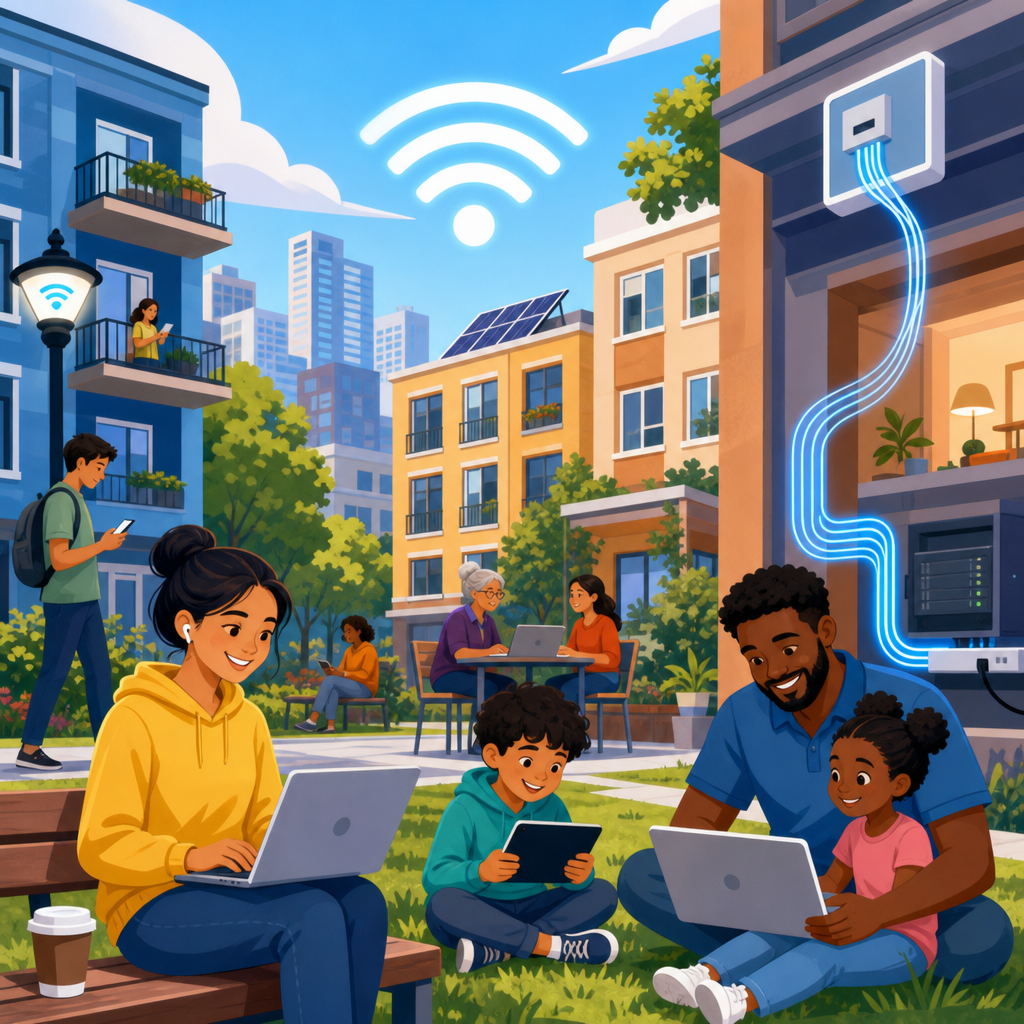
Public Wi-Fi, fiber, and digital infrastructure now shape whether affordable housing supports opportunity or reinforces exclusion. In urban planning and policy, digital infrastructure means the physical networks, service models, devices, and governance systems that let residents connect reliably to the internet for work, school, health care, benefits, and daily communication. In affordable housing, that includes in-building fiber, structured cabling, Wi-Fi coverage in units and common areas, cellular signal quality, device access, and the rules that determine cost, privacy, maintenance, and competition. I have worked on housing and connectivity planning where a building looked complete on paper yet remained functionally disconnected because conduit was undersized, wiring closets lacked power and cooling, or the operating budget ignored ongoing broadband service.
This topic matters because internet access is no longer a luxury amenity. It is basic infrastructure, much like water, heat, and electricity, with direct effects on employment, educational attainment, telehealth adoption, resident services, and property operations. The Federal Communications Commission defines broadband using speed thresholds, but residents experience quality through practical outcomes: whether a child can join a video class without freezing, whether a home health appointment stays connected, whether a job application uploads, and whether a case manager can reach a tenant through a resident portal. When affordable housing projects miss these basics, the burden falls hardest on households with the least flexibility to buy mobile data, switch providers, or travel to libraries and cafes for service.
For housing developers, public agencies, and nonprofit owners, digital infrastructure also affects project finance and long-term asset performance. Retrofitting a completed building for fiber pathways or managed Wi-Fi usually costs far more than designing for it early. Poor connectivity increases staff workload, weakens resident engagement, and can undermine compliance with education, health, and workforce goals tied to public funding. By contrast, well-planned broadband infrastructure supports lease-up, resident retention, smart building systems, and service partnerships with schools, hospitals, and workforce providers. The core planning question is simple: how can affordable housing deliver dependable, affordable, and equitable connectivity over the full life of the building, not just at ribbon cutting?
The answer starts with treating digital infrastructure as a layered system rather than a single product. Fiber provides high-capacity backhaul and future-proofed building connectivity. Public Wi-Fi can extend access into lobbies, courtyards, community rooms, and sometimes surrounding streetscapes. In-building networks distribute service to apartments through Ethernet, Wi-Fi access points, or hybrid models. Devices, digital literacy support, and multilingual onboarding determine whether residents can actually use the connection. Policy then shapes pricing, subsidy eligibility, procurement, privacy, and competition. Affordable housing succeeds when these layers are planned together, with explicit responsibility for capital costs, recurring service, troubleshooting, cybersecurity, and eventual upgrades.
Why digital infrastructure belongs in affordable housing planning from day one
Affordable housing projects often devote intense attention to structure, energy systems, accessibility, and life safety, yet internet infrastructure is still too often treated as an optional amenity. That is a planning error. In practice, broadband affects site selection, building design, operating budgets, and resident outcomes. A project near an existing fiber route may avoid expensive middle-mile extensions. A concrete high-rise may need more wireless access points than a wood-frame building because dense materials weaken signals. A scattered-site portfolio may require a different service model than a single tower. Planning from day one means digital needs appear in feasibility studies, architectural drawings, underwriting assumptions, and property management workflows, not as an afterthought during lease-up.
Early planning also improves negotiating power. When developers specify telecom rooms, risers, conduit sizes, rooftop access, and service demarcation points in construction documents, they can solicit clearer bids from internet service providers and low-voltage contractors. I have seen projects save months of delay by resolving who owns the inside wiring before walls closed. Conversely, vague specifications can leave owners dependent on a single provider with proprietary equipment and unclear maintenance obligations. The most resilient approach is to require open, well-documented pathways and standards-based equipment so future providers can serve the property without major reconstruction.
Digital planning should also align with resident demographics and service models. Senior housing may prioritize telehealth reliability, simple onboarding, and strong coverage in elevators and common rooms. Family housing may need higher capacity in evenings when multiple users stream classes, games, and job training. Supportive housing often benefits from resident portals, connected security systems, and spaces for digital case management. These are not minor differences. They shape network design, staffing, and budget assumptions.
Public Wi-Fi, private broadband, and fiber: what each does well
Public Wi-Fi is useful, but it is not the whole answer. In affordable housing, public Wi-Fi usually refers to shared wireless access in common spaces such as lobbies, courtyards, laundry rooms, community centers, and nearby outdoor areas. It can help residents who lack home service, support visitors and staff, and extend connectivity to neighborhood spaces. Cities also use public Wi-Fi in parks, transit hubs, and streetscape projects to expand access. Its strength is convenience and broad reach. Its weakness is that performance can degrade with congestion, signal interference, and limited privacy if it is used as the primary home connection for every household.
Private in-unit broadband, by contrast, is designed for household use. It can be delivered through fiber-to-the-unit, cable, fixed wireless, or managed Wi-Fi systems that place access points throughout the building. For apartments, the goal is consistent indoor coverage, low latency for video calls, and enough upstream capacity for homework platforms, telehealth, and remote work. Fiber is the strongest long-term foundation because it offers very high bandwidth, strong reliability, and room for future upgrades without replacing the core medium. Many modern affordable housing projects use fiber to the building or to each unit, then distribute service through Ethernet and wireless access points.
| Infrastructure option | Best use in affordable housing | Main advantage | Main limitation |
|---|---|---|---|
| Public Wi-Fi | Common areas, courtyards, nearby public space | Fast shared access for many users | Not ideal as sole in-home connection |
| Fiber to building | Backhaul for multifamily properties | High capacity and future upgrade path | Needs quality in-building distribution |
| Fiber to unit | New construction or major rehab | Strong performance and reliability | Higher upfront construction coordination |
| Managed Wi-Fi | Properties seeking simplified resident access | Seamless onboarding and centralized support | Requires clear privacy and service policies |
The best systems combine these tools rather than choosing only one. A property might use fiber backhaul, managed in-building Wi-Fi for apartments, and separate public Wi-Fi in outdoor gathering spaces. That arrangement supports both household use and community access while preserving network management and security. The key is matching technology to resident need and building form instead of assuming one network model fits every project.
Design standards that make networks reliable and affordable over time
Reliable connectivity depends on boring but critical design decisions. Every affordable housing project should include dedicated telecom rooms with secure access, ventilation, electrical capacity, backup considerations, and room for future equipment. Vertical risers and horizontal pathways should be sized for additional cables, not just immediate needs. Structured cabling should follow recognized standards such as those developed by ANSI/TIA for telecommunications infrastructure in commercial and residential buildings. Even where the final resident connection is wireless, wired backhaul to access points improves performance and simplifies troubleshooting.
Wireless design must reflect actual building conditions. Signal propagation changes based on wall materials, unit layout, corridor length, elevator cores, and outdoor obstructions. Professional site surveys and heat mapping are worth the cost because they prevent dead zones and recurring service tickets. Wi-Fi 6 and newer standards can improve capacity and device handling, but only if access point placement and backhaul are sound. A common mistake is installing too few access points to reduce upfront cost, then facing resident complaints, repeat truck rolls, and expensive corrective work.
Affordability over time also depends on ownership and contract terms. Owners should understand whether inside wiring is landlord-owned, provider-owned, or shared, and whether residents can choose among providers. Exclusive marketing agreements can look attractive but may reduce competition and lock in pricing. Service-level expectations should be explicit: uptime, repair windows, replacement cycles, cybersecurity responsibilities, and support hours. For affordable housing operators with limited staff, managed service can be practical, but contracts must preserve transparency on data practices, equipment ownership, and future upgrade rights.
Funding, policy, and procurement choices that determine success
Capital and operating costs shape every broadband decision. New construction can often include conduit, cabling, telecom spaces, and rooftop coordination at modest marginal cost compared with later retrofits. Major rehabilitation offers another strong opportunity, especially when walls are open and life-safety systems are already being upgraded. Funding can come from local housing trust funds, federal recovery programs, community development resources, philanthropy, or cross-subsidies built into project operations. The most durable projects identify both construction funding and recurring service funding before residents move in.
Policy matters just as much as money. Local governments can require broadband-ready standards in subsidized housing, streamline permits for fiber deployment, support dig-once coordination, and include connectivity metrics in housing funding applications. Housing finance agencies can award points for digital inclusion plans that address service, devices, support, and affordability. Public housing authorities can aggregate demand across properties to negotiate better pricing. At the property level, procurement should evaluate more than speed claims. Review total cost of ownership, support quality, upgrade path, resident choice, cybersecurity controls, multilingual customer service, and experience serving low-income multifamily buildings.
Subsidy programs can help residents afford service, but they should not be the only strategy. Household subsidies are vulnerable to enrollment barriers, changing rules, and administrative churn. Building-level service agreements often produce more stable outcomes because connectivity is embedded into operations, similar to water or trash service. In my experience, the strongest model is layered: robust building infrastructure, competitively priced service, and resident assistance for devices and skills.
Resident outcomes, privacy, and the limits planners must address
The ultimate test of digital infrastructure is resident impact. Strong connectivity improves access to job platforms, school portals, telehealth visits, benefits recertification, banking, and social support. Property managers also benefit from online rent payment, maintenance systems, digital notices, and video interpretation tools. In supportive housing, secure connectivity can help residents connect with case managers and behavioral health providers without transportation barriers. These gains are real, but they do not happen automatically once a router is switched on.
Three limits deserve attention. First, devices remain a barrier. A family sharing one aging phone cannot fully benefit from a high-quality network. Second, digital literacy varies widely. Residents may need help setting up accounts, avoiding phishing, using telehealth platforms, or connecting printers and school devices. Third, privacy and surveillance concerns are legitimate. Managed networks can collect metadata, and smart building tools can expand monitoring if governance is weak. Owners should publish clear privacy policies, minimize data collection, separate operational data from resident browsing data, and ensure any resident-facing monitoring tools are voluntary where possible.
Affordable housing leaders should therefore treat digital infrastructure as a long-term service commitment. Build with fiber and flexible pathways. Use public Wi-Fi strategically, not as a substitute for quality home access. Write contracts that protect competition, clarity, and upgrade rights. Pair connectivity with devices, training, and multilingual support. Measure success through resident outcomes and service reliability, not brochure speeds. If you plan or finance affordable housing, make digital infrastructure a standard line item at project kickoff and revisit it at every design, procurement, and operating milestone.
Frequently Asked Questions
1. Why do public Wi-Fi, fiber, and digital infrastructure matter so much in affordable housing?
They matter because internet access is no longer a luxury amenity; it is basic infrastructure that shapes whether residents can fully participate in modern life. In affordable housing, reliable connectivity affects nearly every essential activity, including applying for jobs, attending virtual classes, completing homework, accessing telehealth appointments, renewing public benefits, communicating with schools, paying bills, and staying in touch with family and support networks. When a building lacks strong digital infrastructure, residents often end up relying on unstable cellular signals, expensive mobile data plans, or nearby public hotspots that may be slow, insecure, or unavailable when needed most.
Fiber, structured cabling, and well-designed Wi-Fi create a stronger foundation than ad hoc connectivity solutions. Fiber provides high-capacity, future-ready bandwidth that can support many households at once, while in-building wiring and managed wireless systems help ensure that service reaches individual units and common areas consistently. For affordable housing owners, developers, and policymakers, this is not only a technology issue but also an equity issue. A property with dependable internet access can support educational attainment, workforce participation, health access, and resident stability. A property without it can deepen existing social and economic disparities. That is why digital infrastructure increasingly belongs in the same conversation as utilities, transit access, and building safety.
2. What does “digital infrastructure” actually include in an affordable housing development?
In affordable housing, digital infrastructure includes much more than a single internet provider or a Wi-Fi router in a lobby. It refers to the full physical and operational system that allows residents to connect reliably and affordably. On the physical side, that often includes fiber connections to the property, structured cabling within the building, telecommunications rooms, conduit pathways, access points for wireless coverage, backup power considerations for network equipment, and design features that make future upgrades possible. In many developments, it also includes strong cellular support, especially where building materials interfere with mobile signal strength.
On the service side, digital infrastructure includes how internet access is delivered and managed. That can involve bulk broadband agreements, open-access service models, managed Wi-Fi systems, resident onboarding processes, technical support, maintenance responsibilities, and cybersecurity protections. It may also include device access programs, digital literacy support, multilingual instructions, and privacy policies that explain what network data is collected and how it is used.
Governance is another important part of the picture. Housing providers and public agencies need clear policies for procurement, vendor accountability, pricing transparency, resident rights, maintenance standards, and long-term sustainability. A building may technically have internet service available, but if the service is too expensive, difficult to activate, poorly maintained, or inaccessible to residents with limited digital skills, then the infrastructure is not truly serving its purpose. Effective digital infrastructure in affordable housing is therefore a combination of hardware, connectivity, service design, affordability, and accountability.
3. How is fiber different from basic internet service or public Wi-Fi, and why is it often considered the best long-term option?
Fiber is the underlying broadband technology that carries data at very high speeds and with high reliability, while public Wi-Fi is typically a method of distributing internet access wirelessly within a certain area. Basic internet service can be delivered over several technologies, including cable, DSL, fixed wireless, cellular, or fiber. The reason fiber is often favored in affordable housing is that it offers strong performance, scalability, and durability over time. It can support high-bandwidth use across many units simultaneously, which is especially important in multifamily buildings where multiple residents may be streaming, attending video calls, learning online, and using cloud-based services at the same time.
Fiber also tends to perform better in terms of upload speeds, which are increasingly important for remote work, telehealth, video conferencing, and school participation. In contrast, some older or lower-capacity technologies may struggle when many users are online at once or may offer much slower uploads than downloads. Public Wi-Fi alone, without robust back-end infrastructure, can become congested and unreliable. That is why simply offering a hotspot in a community room is not the same as building a strong digital foundation for an entire property.
From a planning perspective, fiber is considered a long-term investment because it reduces the risk that a property will become technologically obsolete. Installing conduit, structured cabling, and fiber-ready systems during development or rehabilitation is usually more cost-effective than retrofitting later. It also gives owners and operators more flexibility in choosing providers and service models in the future. In short, public Wi-Fi may be part of the resident experience, but fiber is often the backbone that makes reliable, building-wide connectivity possible.
4. What are the biggest challenges to delivering reliable internet access in affordable housing?
One major challenge is cost, especially when digital infrastructure is treated as an optional add-on rather than a core part of development budgets and operating plans. Retrofitting older buildings can be expensive if they were not originally designed with conduit pathways, telecommunications space, or modern wiring. Even in new construction, projects can fall short if connectivity planning happens too late, after key architectural and financial decisions have already been made. Upfront capital costs are only part of the issue; properties also need a realistic plan for ongoing service fees, equipment replacement, maintenance, and resident support.
Another challenge is the gap between availability and actual usability. A provider may say a building is “served,” but residents may still face high prices, hidden fees, difficult sign-up processes, inconsistent service quality, dead zones inside units, or limited customer support. Language barriers, lack of digital literacy, and limited access to devices can further reduce effective use. This is why infrastructure planning should be resident-centered rather than focused only on technical availability.
There are also operational and governance challenges. Property owners, housing agencies, internet service providers, and technology vendors may have different priorities, and contracts are not always structured to protect affordability or performance over time. Buildings may lack clear accountability for troubleshooting problems, upgrading equipment, or ensuring equitable access across all units. Privacy and security also matter. Residents need confidence that shared networks are secure and that data practices are transparent. The most successful affordable housing connectivity strategies address all of these issues together: capital planning, network design, affordability, support, accountability, and resident trust.
5. What should developers, housing providers, and policymakers prioritize when planning digital infrastructure for affordable housing?
They should start by treating connectivity as essential infrastructure from the earliest planning stages. That means integrating broadband design into site planning, architectural design, construction scopes, and financing discussions rather than waiting until the end of the project. Developers should evaluate fiber availability, include structured cabling and adequate telecom space, plan for whole-building Wi-Fi or in-unit connectivity as appropriate, and ensure that common areas and individual apartments both receive strong service. It is also wise to design for future upgrades, since bandwidth needs will continue to grow.
Affordability and resident experience should be central priorities, not afterthoughts. Housing providers should ask practical questions such as: Will residents face installation fees? Are monthly rates predictable? Is technical support available in multiple languages? Are there options for residents who do not have devices or who need help learning to use online tools? A strong digital infrastructure plan includes not only network capacity but also a clear pathway for residents to get connected quickly and use the service confidently.
Policymakers can reinforce good outcomes by updating housing standards, underwriting criteria, and public funding rules to recognize broadband as a necessary utility-like investment. They can support bulk purchasing models where appropriate, require clearer service standards, encourage open and competitive provider arrangements, and align housing policy with digital equity goals. They can also fund technical assistance and capacity-building so housing organizations are better equipped to negotiate contracts and manage systems effectively. The best results come when physical infrastructure, service affordability, operational accountability, and digital inclusion supports are planned as one integrated strategy rather than as separate programs.


