
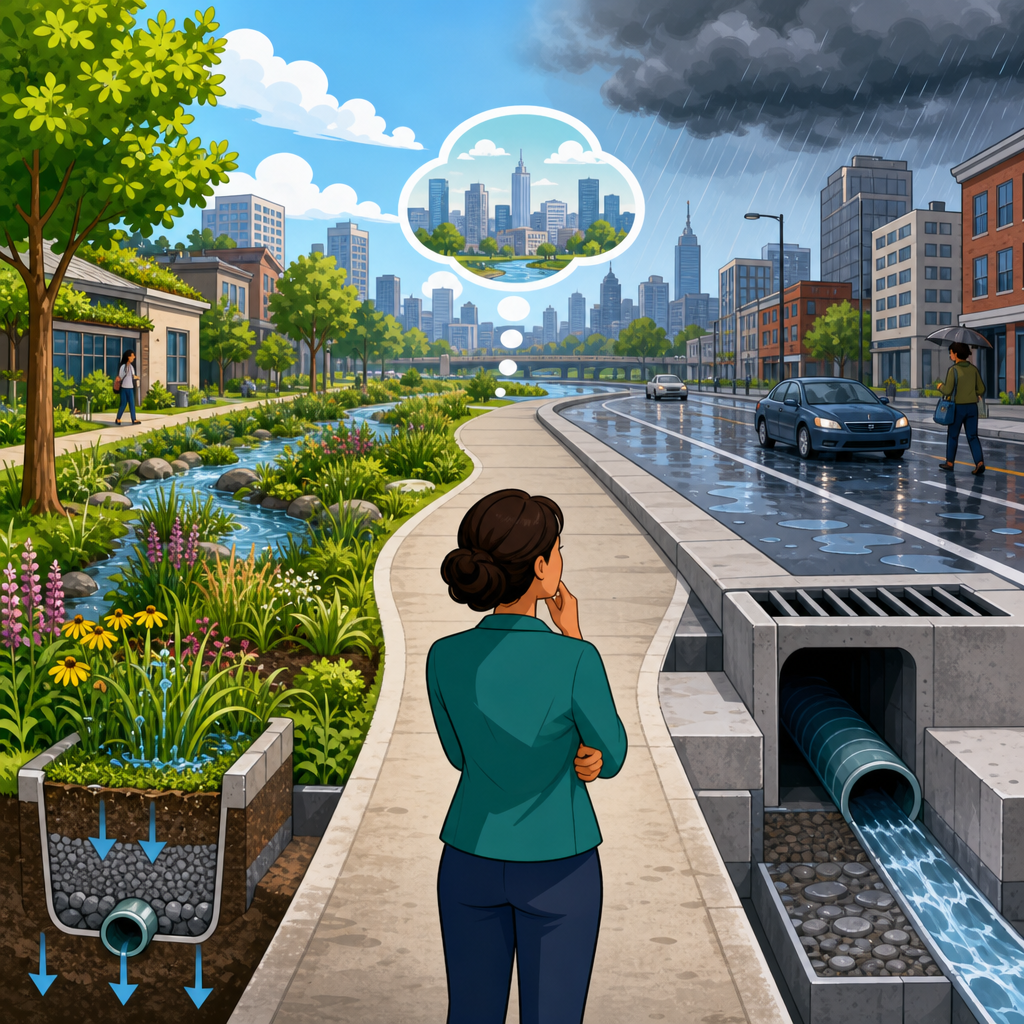
Green stormwater infrastructure and gray infrastructure solve the same urban problem—moving, storing, and treating rainwater—but cities choose between them based on cost, land, risk, regulation, and long-term public value. In urban planning and policy, stormwater infrastructure includes the pipes, culbs, channels, detention areas, streetscape features, and naturalized systems that reduce flooding and prevent polluted runoff from reaching rivers, lakes, and coastal waters. Gray infrastructure usually refers to engineered, hard-built assets such as storm sewers, tunnels, culverts, pumps, and concrete channels. Green stormwater infrastructure refers to systems that slow, soak, filter, and reuse runoff through landscapes and soils, including bioswales, rain gardens, permeable pavement, green roofs, urban trees, constructed wetlands, and restored floodplains.
The distinction matters because cities are no longer managing rain with a single objective. Decades ago, the main goal was often rapid conveyance: get water off streets and away from buildings as quickly as possible. Today, cities must also manage water quality, urban heat, aging infrastructure, combined sewer overflows, neighborhood equity, habitat loss, and climate-driven extremes. A bigger storm sewer can reduce one bottleneck, but it cannot cool a corridor, improve walkability, or create habitat. A rain garden can capture runoff and beautify a block, but it may not protect a dense downtown from a hundred-year cloudburst without support from larger conveyance assets. In practice, the decision is rarely green versus gray in absolute terms. It is about the right mix, in the right place, at the right scale.
I have seen this play out in capital planning meetings where transportation staff wanted curb extensions, utilities wanted pipe capacity, parks departments wanted trees, and finance teams wanted certainty on maintenance costs. The best decisions came from framing stormwater as a system rather than a silo. That means understanding hydrology, asset management, public works operations, watershed rules, and neighborhood outcomes together. Cities that make strong decisions use runoff modeling, level-of-service standards, lifecycle cost analysis, and community engagement to compare options honestly. They ask practical questions: How much runoff must be managed? Where can water safely go? What is the regulatory driver? Who will maintain the asset for thirty years? What co-benefits justify added complexity?
This article explains how cities decide between green stormwater infrastructure and gray infrastructure, where each approach performs best, and why hybrid strategies increasingly define modern urban planning and policy. It also serves as a hub for related topics in this area, including stormwater policy, climate resilience, capital budgeting, streetscape design, watershed management, permitting, and environmental justice. If you need a clear framework for evaluating stormwater investments, start here: define the problem, quantify performance needs, compare full costs and benefits, and select the combination of assets that meets public goals under real-world constraints.
What Green and Gray Infrastructure Actually Do
At a technical level, both approaches manage runoff quantity and runoff quality, but they do so in different ways. Gray infrastructure is built to collect and convey water efficiently. Typical components include inlets, catch basins, storm sewers, box culverts, detention vaults, outfalls, levees, pump stations, and deep storage tunnels. These systems are predictable, compact relative to storage volume, and familiar to public works crews. They are especially effective where development is dense, utilities are layered underground, and failure has high consequences, such as central business districts, hospital campuses, rail underpasses, and airport access roads.
Green stormwater infrastructure works by retaining, infiltrating, evapotranspiring, or reusing runoff near where rain falls. A bioswale slows water and filters sediment and pollutants through vegetation and engineered soil. Permeable pavement lets water pass through a surface into a stone reservoir below. Green roofs absorb rainfall and reduce peak runoff while improving roof insulation. Urban tree trenches intercept water and increase canopy cover. Restored wetlands and floodplains spread and store water over larger areas, reducing downstream peaks. These systems can be distributed across many parcels or integrated into streets, parks, schools, parking lots, and redevelopment sites.
The performance difference is important. Gray systems tend to be designed around a target conveyance capacity, such as the ten-year storm or a local drainage standard. Green systems are often evaluated by capture volume, infiltration rate, water quality treatment, peak flow reduction, or annual runoff reduction. For example, a city may require a site to retain the first inch of rainfall because that first flush carries a large share of pollutants. Another city may target a percentage reduction in impervious-area runoff across a watershed. Because the metrics differ, decision-making can go wrong when teams compare assets without aligning the performance goal first.
How Cities Define the Real Problem Before Choosing a Solution
The first decision is not whether green or gray is better. It is what problem the city is trying to solve. There are at least five common stormwater problem types: nuisance street flooding, structural flood risk to buildings, stream erosion from flashy runoff, water-quality violations, and combined sewer overflows. Each problem points toward a different mix of interventions. If an intersection floods during short intense bursts because inlet capacity is poor, replacing inlets and upsizing a pipe may be the highest-value fix. If an urban stream is eroding because impervious cover sends runoff downstream too quickly, distributed green infrastructure that restores infiltration and delays peaks may perform better over the watershed.
Good cities start with data. They review flood complaints, work orders, CCTV pipe inspections, watershed models, topography, land cover, groundwater conditions, and receiving-water impairments. They also consider future conditions. Intensity-duration-frequency curves are shifting in many regions as storms become more intense, and design standards based only on historic rainfall can understate risk. Federal guidance, state stormwater manuals, and local floodplain ordinances increasingly push cities to stress-test projects for climate resilience. A system that barely meets current standards may underperform before its debt is paid off.
Public context matters too. A low-income neighborhood with chronic basement backups may need immediate reliability, while a heat-vulnerable corridor may justify green features that add shade and traffic calming alongside runoff reduction. This is where urban planning and policy broadens the analysis. Stormwater projects shape streets, parks, housing, business access, and public health. A narrow utility lens misses those interactions.
Cost, Land, and Maintenance Usually Decide More Than Ideology
In public debate, green infrastructure is often framed as progressive and gray infrastructure as old-fashioned. Actual capital planning is less ideological. Most city decisions come down to cost, available space, constructability, maintenance capacity, and tolerance for uncertainty. Gray infrastructure often wins where land is scarce and expensive. A large underground vault beneath a street may store substantial runoff without taking developable land. In a dense downtown, acquiring parcels for surface detention may be politically and financially impossible.
Green infrastructure often wins where land can do double duty. A schoolyard can become a stormwater capture landscape. A street reconstruction can add bioswales and tree trenches inside the existing right-of-way. A park can include a depressed lawn that temporarily stores stormwater during major events. When these projects are bundled with scheduled resurfacing, utility replacement, or public realm upgrades, their incremental cost can be attractive.
Lifecycle cost is where many cities sharpen their analysis. Initial capital cost alone can mislead. A concrete channel may have a long service life, but it can increase downstream impacts and provide few community co-benefits. A network of rain gardens may cost less to phase in, but it requires consistent inspection, sediment removal, plant care, and occasional media replacement. If maintenance is underfunded, performance declines. I have seen excellent pilot installations fail reputationally because no department owned weeding and trash removal after ribbon-cutting. The lesson is simple: the best stormwater asset is the one a city can maintain to standard for decades.
| Decision Factor | Green Stormwater Infrastructure | Gray Infrastructure |
|---|---|---|
| Primary function | Retain, infiltrate, filter, reuse, delay runoff | Collect, convey, store, pump runoff |
| Best fit | Streetscapes, campuses, parks, redevelopment, watershed retrofits | Dense cores, constrained corridors, high-consequence flood points |
| Land needs | Usually higher surface area requirement | Usually lower surface footprint, more underground space |
| Co-benefits | Cooling, habitat, aesthetics, traffic calming, air quality | Primarily hydraulic reliability |
| Maintenance | Frequent landscape and sediment management | Periodic inspection, cleaning, repair of structures and pipes |
| Performance limits | Can be constrained by soils, groundwater, winter conditions | Can transfer problems downstream if used alone |
Regulation, Permitting, and Standards Shape the Choice
Cities do not decide in a vacuum. Municipal separate storm sewer system permits, total maximum daily load requirements, local drainage criteria, floodplain regulations, and state stormwater design manuals can strongly influence project selection. If a city faces nutrient reduction targets under watershed rules, green infrastructure may become more attractive because it treats runoff quality close to the source. If a transportation agency must protect a tunnel portal from overtopping at a defined recurrence interval, gray conveyance and pumping may be mandatory.
Standards also influence design confidence. Gray assets rely on mature engineering conventions, standard details, and predictable hydraulic calculations. Green infrastructure now has strong technical guidance as well, but performance depends more heavily on site conditions such as soil infiltration, compaction, groundwater separation, drainage area, pretreatment, and plant survival. That does not make green systems unreliable; it means cities need disciplined design, construction oversight, and post-installation verification. An infiltration practice installed in compacted subgrade will not perform as modeled.
Permitting can reward integrated thinking. Many cities require stormwater control measures on redevelopment sites, pushing private developers to install green roofs, bioretention, cisterns, or permeable paving. Public agencies then extend the same approach to streets and facilities, creating cumulative watershed benefits. In places with combined sewers, consent decrees have accelerated large investments in both green retrofits and gray storage tunnels. Philadelphia, Washington, DC, and New York City all provide examples of cities using distributed green measures alongside conventional assets to reduce overflow volumes and improve urban environments.
Why Hybrid Systems Are Becoming the Default Urban Strategy
The strongest urban stormwater plans no longer treat green and gray infrastructure as competing camps. They use gray systems for backbone reliability and green systems for distributed performance and co-benefits. This hybrid approach is practical because runoff occurs across scales. A single parcel can manage rooftop water with a cistern or rain garden, a corridor can add permeable parking lanes and tree trenches, and a district can rely on trunk sewers, detention tunnels, and controlled outfalls for major storms.
Consider a redeveloping corridor. The city may replace undersized storm sewers to address existing flood risk, require new buildings to retain the first inch of rainfall onsite, rebuild sidewalks with bioretention curb extensions, and connect a nearby park to emergency overflow storage. Each layer serves a different purpose. The pipe upgrade handles capacity constraints. The onsite retention reduces frequent runoff. The streetscape features improve water quality and public space. The park provides resilience during cloudbursts. No single asset could deliver all four outcomes alone.
Hybrid planning also improves budgeting. Gray megaprojects often require large upfront capital and long lead times. Green networks can be phased block by block as streets are reconstructed or public facilities are renovated. That lets cities spread costs, learn from pilot performance, and target hotspots first. It also creates more visible benefits for residents, which can matter when agencies need public support for stormwater fees or bond measures.
Equity, Public Value, and Political Durability
Infrastructure decisions are political because they allocate safety, environmental quality, and public investment unevenly unless cities are deliberate. Historically, lower-income neighborhoods and communities of color have often borne the effects of underinvestment, flooding, heat, and polluted waterways. Green stormwater infrastructure can help correct that when cities target tree canopy gaps, schoolyard flooding, unsafe walking routes, and park-poor districts. But equity is not automatic. A decorative streetscape in a thriving district is not the same as solving chronic backups in a vulnerable neighborhood.
Political durability depends on visible results and clear responsibility. Residents understand flooded intersections and basement damage immediately. They may not notice watershed-scale benefits unless agencies explain them well. Successful cities publish maps, project dashboards, and maintenance standards. They show how many gallons are captured, how many flood complaints declined, where water quality improved, and which neighborhoods are receiving investment. Transparent metrics build trust, especially when projects use ratepayer funds.
There are also tradeoffs to manage honestly. Green installations can raise concerns about parking loss, mosquitoes, visibility, or upkeep. Gray projects can trigger construction disruption, major debt, and limited public-space improvement. Decision-makers gain credibility when they acknowledge these issues early and show how design addresses them—for example, by using underdrains where infiltration is limited, selecting low-maintenance plant palettes, preserving loading access, or pairing tunnel work with careful traffic management.
How Cities Make Better Stormwater Decisions
The best process is rigorous and repeatable. First, define the service objective in measurable terms: flood depth reduction, runoff volume capture, pollutant load reduction, overflow reduction, or resilience to a specified storm. Second, analyze site and watershed conditions, including soils, utilities, topography, groundwater, and downstream constraints. Third, generate alternatives that include green, gray, and hybrid options. Fourth, compare lifecycle cost, land needs, operational demands, climate performance, and public co-benefits. Fifth, assign maintenance ownership before design is finalized. Sixth, monitor results and update standards based on what actually performs in the field.
For planners, engineers, and policymakers, the central lesson is straightforward. Cities do not choose green stormwater infrastructure or gray infrastructure based on fashion. They choose based on function, context, cost, regulation, and long-term value to residents. Use gray where reliability under tight constraints is essential. Use green where water can be managed close to the source and where added public benefits matter. Use both whenever the city needs a system that is resilient, fiscally sound, and publicly defensible. If you are building an urban planning and policy agenda around stormwater, start by auditing current pain points, mapping opportunities, and creating a cross-department strategy that treats every street, site, and watershed as part of one connected network.
Frequently Asked Questions
What is the difference between green stormwater infrastructure and gray infrastructure?
Green stormwater infrastructure and gray infrastructure are two different approaches to managing the same challenge: what happens when rain falls on streets, rooftops, parking lots, and other hard urban surfaces. Gray infrastructure refers to engineered systems such as storm sewers, culverts, tunnels, detention tanks, concrete channels, and treatment facilities designed to move water away quickly, store it temporarily, or carry it to a discharge point. Its main strengths are predictability, large-volume capacity, and the ability to function in dense places where space is limited.
Green stormwater infrastructure, by contrast, works with natural processes to slow, spread, soak in, and filter runoff closer to where it lands. Common examples include rain gardens, bioswales, permeable pavement, tree trenches, green roofs, restored wetlands, and vegetated detention or retention areas. Instead of treating stormwater only as something to be conveyed, green systems treat it as part of the urban landscape and hydrologic cycle. They can reduce runoff volumes, remove pollutants, lower heat, improve streetscapes, and create habitat at the same time.
In practice, cities rarely choose one approach exclusively. Most modern stormwater strategies combine both. A city may rely on large underground gray systems for flood conveyance during major storms, while also installing green features across neighborhoods to reduce peak flows, improve water quality, and lessen pressure on aging pipes. The real policy question is usually not green versus gray in absolute terms, but how much of each is appropriate for a city’s land use pattern, budget, climate risks, regulatory obligations, and long-term goals.
Why do cities choose gray infrastructure in some places and green infrastructure in others?
Cities make this choice based on a mix of technical, financial, legal, and physical factors. One of the biggest considerations is site condition. In highly built-up downtown areas, there may be little room for surface-based green features, soils may not infiltrate well, utilities may crowd the right-of-way, and property values may make land acquisition expensive. In those cases, gray infrastructure often becomes the practical option because it can deliver high-capacity stormwater control within a compact footprint.
Green infrastructure is often favored where cities want multiple benefits from the same investment. A curbside bioswale or tree trench can reduce runoff while also improving pedestrian experience, urban shade, traffic calming, and neighborhood appearance. In parks, school campuses, redevelopment districts, and lower-density corridors, green systems may be easier to install and can be distributed across a wider area. That distributed pattern matters because it helps manage runoff at the source instead of relying entirely on downstream pipes and facilities.
Regulation also shapes decisions. If a city faces water-quality mandates, combined sewer overflow requirements, or watershed restoration targets, green infrastructure may be especially attractive because it helps reduce pollutant loads and runoff volumes. If the central problem is immediate flood risk from intense storm events, cities may still need gray upgrades to achieve required levels of protection. Political priorities matter as well. Some communities place a high value on visible public improvements, climate resilience, and environmental justice, while others prioritize lowest upfront cost or fastest implementation. The final decision is usually the result of balancing engineering performance with public value.
Is green stormwater infrastructure more cost-effective than gray infrastructure?
The answer depends on how a city defines cost and value. If officials look only at upfront construction expense for a single site, gray infrastructure may sometimes appear cheaper or more straightforward, especially when the project is limited to replacing an existing pipe or expanding a known system. Gray projects are often familiar to public works departments, easier to model using established standards, and simpler to fit into traditional capital budgets. That can make them attractive when schedules are tight and immediate flood control is the main objective.
However, green stormwater infrastructure can be highly cost-effective when cities evaluate the full life-cycle picture. Distributed green systems may reduce the need for larger downstream pipe upgrades, lower treatment burdens, extend the useful life of existing infrastructure, and provide public benefits that gray systems do not. Those benefits can include cleaner waterways, reduced urban heat, improved air quality, traffic calming, neighborhood beautification, and increased property desirability. In some cases, a green investment that appears modest from a drainage standpoint still delivers strong economic value because it improves public space and resilience at the same time.
Maintenance is another important part of the equation. Gray systems require inspection, repair, sediment removal, and eventual replacement, but much of that work is hidden and deferred until failures become costly. Green systems also require regular upkeep, such as vegetation management, trash removal, and ensuring inlets and soils function properly. Cities that underestimate maintenance can struggle with performance over time. The most accurate cost comparison therefore includes capital expense, operations, replacement cycles, avoided flood damage, compliance costs, and co-benefits. When those factors are considered together, the most cost-effective strategy is often a hybrid one rather than an all-green or all-gray choice.
How do land availability and urban density affect a city’s stormwater infrastructure decision?
Land is one of the most decisive factors in stormwater planning. Green infrastructure generally needs surface area or shallow subsurface area to store, filter, or infiltrate water. That makes it easier to implement in places with wider rights-of-way, available open space, redevelopment parcels, campuses, medians, parks, and lower-density neighborhoods. When cities have room to redesign streets or repurpose underused land, green infrastructure can be integrated into the public realm in a way that supports both drainage and placemaking.
In dense urban cores, the situation is more constrained. Sidewalks may be narrow, buildings may extend close to the curb, underground utilities may occupy nearly every available corridor, and soils may be compacted or contaminated. In these settings, the opportunity cost of using land for stormwater management can be high. A city may decide that underground storage, larger pipes, or deep tunnels are more feasible because they preserve surface space for transportation, development, or pedestrian use. Even so, dense areas are not automatically unsuitable for green infrastructure. Cities often use smaller but strategic measures such as green roofs, permeable alleys, planter boxes, tree pits, and curb extensions to capture runoff where possible.
Urban density also affects how quickly runoff accumulates. Highly impervious areas generate larger and faster storm flows, which can overwhelm localized green features if they are not part of a coordinated system. That is why density often leads cities toward layered solutions: source controls at the parcel or block level, green streets where feasible, and gray backbone systems for major conveyance and emergency capacity. In other words, density does not eliminate the value of green infrastructure, but it does change the scale, design, and role it can realistically play.
Why are many cities now using a hybrid approach instead of choosing only green or only gray infrastructure?
A hybrid approach has become common because urban stormwater problems are too varied to be solved well by a single tool. Cities must manage routine rainfall, severe storms, water quality, aging infrastructure, regulatory compliance, neighborhood equity, and long-term climate uncertainty all at once. Gray infrastructure is strong at handling large flows reliably and moving water through constrained urban environments. Green infrastructure is strong at reducing runoff near its source, improving water quality, and generating visible community benefits. Used together, they can offset each other’s limitations.
For example, a city might enlarge a culvert or install underground storage to address a known flood bottleneck while also adding bioswales, permeable pavement, and tree trenches upstream to reduce the amount of water entering that system in the first place. This combination can improve system performance, lower pressure on existing assets, and create a more adaptable response as rainfall patterns change. Hybrid strategies are also easier to phase over time. Large gray projects often require significant capital and long timelines, while green improvements can sometimes be rolled into street reconstruction, park upgrades, schoolyard retrofits, or private development requirements.
There is also a governance advantage to the hybrid model. Different agencies and funding sources can support different parts of the solution. Public works may lead pipe and conveyance upgrades, planning departments may shape zoning and streetscape standards, parks departments may deliver naturalized storage areas, and environmental programs may support watershed restoration. This broader toolkit helps cities align stormwater management with transportation, housing, climate adaptation, and public health goals. In today’s planning environment, the question is less about choosing a winner between green and gray and more about designing the right mix for each neighborhood, watershed, and level of risk.


