
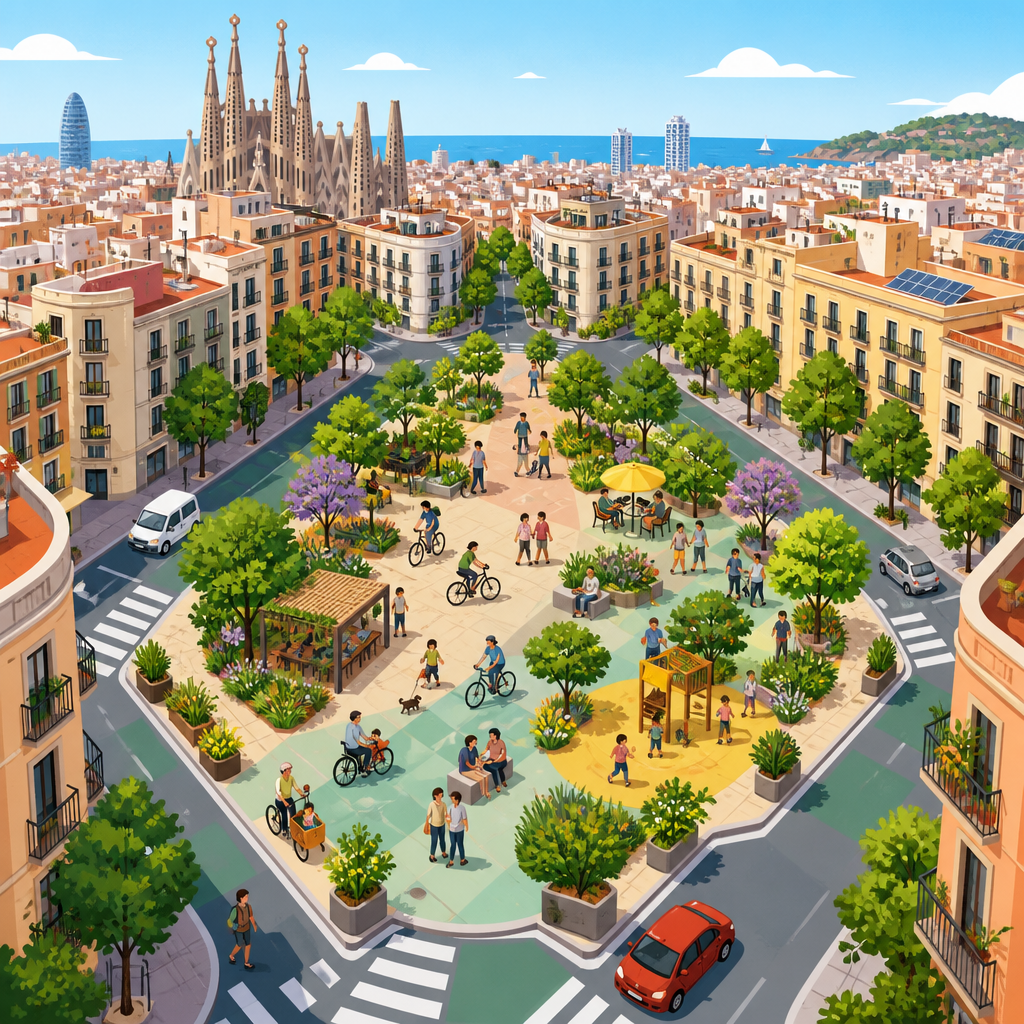
Barcelona’s superblocks have become one of the most influential urban planning ideas of the twenty-first century because they translate an abstract goal—making cities healthier, safer, and more livable—into a street design model that residents can see, use, and judge in daily life. A superblock, known locally as a superilla, is a group of several city blocks where through-traffic is pushed to perimeter roads while interior streets are redesigned for walking, cycling, play, greenery, seating, and neighborhood activity. The concept matters far beyond Catalonia because most large cities face the same pressures: air pollution, traffic injuries, climate risk, rising heat, weak public space, and conflict over how scarce street area should be allocated.
In practice, the superblock is not a single piece of infrastructure but a policy package. It combines circulation management, public realm redesign, environmental health goals, and local economic strategy. When I have worked through street redesign proposals with municipalities, that combination is what separates headline-friendly pilots from durable change. A painted plaza alone is not a superblock. Neither is a traffic restriction without a new social use for the reclaimed space. Barcelona’s version links both: fewer cars moving through local streets and more civic functions happening there instead.
The idea also arrived at the right moment. Urban planners had long discussed traffic calming, low-traffic neighborhoods, complete streets, and transit-oriented development, but many residents and mayors struggled to understand how those concepts would reshape everyday streets. Barcelona provided a legible template. By applying a repeatable neighborhood unit—typically a nine-block grid section in the Eixample, though adapted elsewhere—the city turned a technical planning debate into a visible urban governance model. That clarity helps explain why planners from Paris to Bogotá, from Los Angeles to Melbourne, now study the approach.
Its influence is tied to Barcelona’s urban form as well. The city’s famous nineteenth-century Eixample district, designed by Ildefons Cerdà, already offered a highly ordered grid with broad streets and chamfered corners. Superblocks did not emerge in a vacuum; they were layered onto an inherited structure that could absorb circulation changes. Yet the influence of the model does not depend on copying Barcelona block for block. What travels is the principle: streets inside residential districts should prioritize access, not high-speed movement, and public space should serve health and community before vehicle throughput.
How the superblock model works on the ground
At its core, a superblock reorganizes mobility hierarchy. Perimeter streets carry buses, delivery vehicles, emergency access, and most through-traffic. Interior streets remain accessible, but speeds are reduced dramatically, movements are restricted, and direct shortcuts for drivers are removed. In Barcelona, interior vehicle speeds are often limited to around 10 kilometers per hour, creating conditions where walking dominates and children, older adults, and cyclists can share space more safely. This is a crucial distinction: the model is not a total car ban. It is a rebalancing of priorities.
Design details matter. Successful superblocks use bollards, planters, benches, trees, pavement treatments, protected crossings, and flexible programming to signal that interior streets are not conventional traffic corridors. Without those cues, drivers test the rules and residents doubt the permanence of change. Temporary materials often come first, especially in pilots, because they allow quick implementation and lower political risk. Over time, cities typically need capital upgrades—drainage changes, shade trees, permanent seating, and better surface materials—to convert a tactical intervention into a durable public realm asset.
The circulation logic is easier to understand in a simple comparison.
| Street function | Conventional grid | Superblock approach |
|---|---|---|
| Through-traffic | Uses many local streets as shortcuts | Concentrated on perimeter roads |
| Vehicle speed | Higher and less predictable | Very low on interior streets |
| Public space | Mostly dedicated to moving and storing cars | Reallocated to walking, seating, play, and greenery |
| Neighborhood access | Drivers optimize route choice | Residents retain access, but cut-through driving is discouraged |
| Street identity | Transport corridor first | Civic space first |
This operational clarity is one reason the model is influential. It gives elected officials and practitioners a middle path between two politically difficult extremes: leaving traffic-dominated streets unchanged, or attempting full pedestrianization everywhere. Superblocks permit access while changing behavior. That distinction makes them easier to pilot, measure, and expand.
Why superblocks became a global reference point
Barcelona’s superblocks gained international attention because they connected urban design with public health in a way that was measurable and urgent. Research teams associated with the Barcelona Institute for Global Health, widely known as ISGlobal, estimated substantial potential health benefits from reducing air pollution, noise, heat exposure, and sedentary behavior while increasing access to green and public space. Urban planning often struggles to move from aesthetics to evidence. Superblocks helped close that gap by linking street allocation decisions to premature mortality, respiratory disease, mental health, and physical activity.
Another reason is timing. After the 2008 financial crisis, many cities became more open to low-cost pilots and incremental redesign. Then the COVID-19 pandemic accelerated interest in outdoor public space, local living, and reduced traffic streets. Barcelona had already built a vocabulary and policy apparatus around these issues, so its projects became a natural reference case. When other cities searched for examples of reclaiming street space quickly without waiting decades for megaproject funding, superblocks offered a practical precedent.
Political symbolism also played a role. The model signaled that a city government was willing to challenge the assumption that vehicle flow is the highest public good on every street. In planning departments, I have seen how powerful that signal can be. A single redesigned junction with benches and trees may be dismissed as beautification. A networked system that reroutes traffic and changes street law is recognized as structural policy. Barcelona’s projects therefore influenced not just designers, but public administrators, mayors, health officials, and climate teams.
Media visibility amplified the effect. Before-and-after images from Poblenou, Sant Antoni, and later Eixample interventions were highly legible: painted surfaces, play areas, outdoor classrooms, café seating, and reduced car movement. Unlike underground utility upgrades or zoning text amendments, the benefits and controversies of a superblock are visually obvious. That made the model easy to debate and easy to export as a policy story.
The policy goals behind the design
Superblocks are influential because they solve multiple policy problems at once. First, they address road safety. Slower, simpler street environments reduce the likelihood and severity of collisions. Second, they improve environmental performance by cutting unnecessary car trips within neighborhoods and making walking and cycling more attractive. Third, they expand public space in dense districts where acquiring new land for parks is expensive or impossible. Fourth, they can support local commerce by increasing footfall and dwell time, especially for cafés, food shops, and small retailers that benefit from comfortable streets.
Barcelona’s superblocks also align with climate adaptation. Dense cities are vulnerable to urban heat island effects, and asphalt-heavy streets intensify summer discomfort and health risk. Adding shade trees, permeable surfaces where feasible, and less traffic-heavy pavement can improve thermal comfort. These changes do not replace citywide decarbonization or major green infrastructure, but they make neighborhoods more resilient. In warm climates, that daily comfort dividend matters politically because residents feel it immediately.
Equity is another part of the story, although it is more complicated than promotional material sometimes admits. In principle, redistributing street space benefits people who do not own cars, including children, older adults, low-income households, and people with mobility limitations. In practice, equity depends on where projects are implemented, how access needs are handled, and whether rising desirability pushes up rents. The influential lesson here is not that superblocks are automatically fair. It is that street redesign must be tied to housing, accessibility, and distributional analysis if cities want broad legitimacy.
Real-world impacts, debates, and limits
The strongest reason Barcelona’s superblocks remain influential is that they are neither utopian fantasy nor uncontested success story. They are real interventions with measurable gains and visible tradeoffs. Residents often report quieter streets, more room for children, better places to meet neighbors, and a stronger sense of local identity. Businesses that depend on pedestrian activity may gain from increased street life. Schools benefit when adjacent roads become calmer and safer. These are practical outcomes, not abstract planning rhetoric.
But the criticisms are equally instructive. Traffic does not disappear completely; some of it shifts to perimeter roads, raising concern about congestion or pollution concentration. Freight and service access must be managed carefully. Emergency response routes need clear design coordination. Residents with disabilities may have different access requirements that generic anti-car messaging overlooks. In several city reviews I have participated in, these operational issues determined whether a street redesign was accepted as competent governance or rejected as ideological overreach.
Barcelona’s own rollout has faced political resistance, legal challenges, and neighborhood variation. Some pilots were embraced; others drew complaints about consultation quality, confusing circulation, or excessive temporary materials. That mixed record is precisely why professionals still study the city. Influence does not come from perfection. It comes from producing a model robust enough to adapt, while exposing the implementation questions every city must answer: What traffic can the perimeter absorb? How will deliveries work? Which public uses are permanent? How are impacts monitored over time?
Evidence-based iteration has been essential. Cities evaluating superblock-style interventions typically monitor traffic volumes, nitrogen dioxide levels, noise, mode share, retail patterns, crash data, and resident satisfaction. Tools such as GIS network analysis, air quality sensors, curb management plans, and before-after observational studies help distinguish symbolic change from functional improvement. Barcelona demonstrated that reclaiming street space is not merely a design gesture; it is an ongoing management problem requiring data, maintenance, and political follow-through.
What other cities can learn from Barcelona
The transferable lesson from Barcelona is not “copy the Eixample.” It is to treat neighborhood street networks as public health infrastructure. Cities with irregular grids, suburban blocks, or mixed industrial districts can still apply the underlying logic by reducing cut-through traffic, simplifying local access, and converting selected carriageway space into social and ecological use. London’s low-traffic neighborhoods, Paris school streets, and Milan’s tactical public realm projects all reflect parts of this logic, even where the geometry differs.
Three implementation lessons stand out. First, start with a network, not a single beautified block. Residents quickly notice when one attractive space is undermined by dangerous surrounding streets. Second, pair restrictions with alternatives: reliable transit, safe cycling routes, loading plans, and accessible walking surfaces. Third, move from pilot to permanence deliberately. Cheap materials can prove a concept, but long-term credibility depends on durable construction, maintenance budgets, and transparent evaluation.
Communication is also critical. The most effective project teams explain the superblock in everyday language: fewer shortcut cars, slower local access, more shade, safer crossings, and more usable space near homes and schools. When officials rely on diagrams alone, opponents define the project as a war on drivers. When they explain household-level benefits and show delivery, emergency, and accessibility plans clearly, support broadens. Barcelona’s influence lies partly in making a complex planning intervention simple enough for the public to visualize.
Barcelona’s superblocks are influential because they offer a repeatable answer to one of modern urbanism’s hardest questions: how can dense cities keep access and economic activity while giving streets back to people? They matter as design, as policy, and as proof that the everyday street can be reorganized around health, safety, and social life rather than constant vehicle movement. Their global relevance comes from that combination of clarity and ambition.
The core lesson is straightforward. Superblocks work by changing the function of local streets, not just their appearance. Through-traffic moves to perimeter roads; interior spaces become slower, greener, quieter, and more useful. That shift can improve safety, comfort, and neighborhood vitality, but only when cities handle freight, accessibility, traffic displacement, and long-term maintenance with equal seriousness. Barcelona’s example is compelling precisely because it shows both the promise and the complexity of street transformation.
For planners, policymakers, and residents, the value of studying superblocks is practical. They provide a framework for evaluating how street space is allocated, who benefits from current traffic patterns, and what healthier alternatives could look like in real neighborhoods. Use Barcelona as a hub case, then examine how the principles apply to your own city’s block structure, politics, and mobility needs. That is where the model’s true influence continues to grow.
Frequently Asked Questions
What exactly is a superblock in Barcelona, and how does it work in practice?
A Barcelona superblock, or superilla, is a group of several standard city blocks reorganized so that through-traffic stays on the perimeter while the interior streets are redesigned for local access and public life. Instead of functioning mainly as shortcuts for cars, those inner streets are calmed and repurposed for walking, cycling, children’s play, seating, trees, small gathering spaces, and neighborhood activity. Residents, deliveries, emergency vehicles, and essential services can still enter, but the design makes high-speed, high-volume driving inconvenient inside the superblock.
What makes the model especially powerful is that it turns a broad planning ambition into something tangible. Rather than talking only about sustainability, public health, or climate goals in abstract terms, superblocks visibly change how streets are used from day to day. People can immediately notice less traffic noise, safer crossings, more room to walk, and more opportunities for social interaction. In that sense, the superblock is not just a transportation strategy. It is also a public-space strategy, a health intervention, and a neighborhood design framework rolled into one.
Why have Barcelona’s superblocks become so influential in urban planning around the world?
Barcelona’s superblocks have become influential because they offer a clear, replicable answer to one of the biggest urban questions of this century: how can cities reduce car dominance without shutting down daily life? Many cities want cleaner air, safer streets, lower emissions, and better public spaces, but they struggle to move from policy goals to physical change. Superblocks stand out because they provide a concrete street design model that can be implemented, tested, observed, and adjusted. That practicality has made them highly influential among planners, public officials, designers, and advocates.
They are also influential because they show that street design is not neutral. The way a city allocates space affects health, mobility, inequality, commerce, climate resilience, and social life. By reclaiming interior streets from constant through-traffic, the superblock demonstrates that streets can function as civic spaces rather than just transport corridors. This idea resonates globally, especially in cities trying to reduce dependence on private vehicles while improving quality of life. Barcelona’s example has helped shift the conversation from whether change is possible to what kinds of redesigns can deliver the biggest everyday benefits.
How do superblocks improve health, safety, and everyday livability?
Superblocks influence daily life because they reduce the negative effects associated with heavy traffic and make space for healthier activities. When through-traffic is diverted to perimeter roads, interior streets tend to become quieter, slower, and safer. That can mean fewer dangerous interactions between cars and pedestrians, better conditions for cycling, and a more comfortable environment for older adults, children, and people with limited mobility. Lower traffic volumes can also contribute to improved air quality and reduced noise exposure, both of which matter greatly in dense urban neighborhoods.
Just as important, superblocks improve livability by expanding what residents can actually do in the street. A calmer street can support benches, planters, shaded areas, play space, and informal community use in ways that a traffic-heavy street cannot. That changes the emotional experience of the neighborhood as much as the physical one. Streets become places where people can linger rather than rush through. The result is often a stronger sense of community, more everyday contact among neighbors, and a public realm that feels more humane. This is a major reason the model has attracted so much attention internationally.
Do superblocks eliminate cars completely, or can traffic and local access still function?
No, superblocks do not eliminate cars completely. One common misunderstanding is that they ban vehicles outright, but the model is more nuanced than that. The key change is that interior streets are no longer designed to carry large volumes of through-traffic. Cars can still enter for local purposes such as resident access, deliveries, maintenance, and emergency response. The difference is that the street layout, rules, and design features discourage drivers from using these inner streets as fast cut-through routes.
This distinction is one reason the idea has been so persuasive. Superblocks are not based on the unrealistic assumption that cities can simply switch off vehicle access overnight. Instead, they rebalance priorities. Perimeter roads continue to handle movement at a broader network level, while interior streets prioritize neighborhood life. That layered approach makes the concept more practical and politically viable than many people initially assume. It also helps explain why superblocks are often discussed as a transitional urban strategy: they reduce car dominance significantly while still accommodating the essential functions a city must support.
What lessons can other cities learn from Barcelona’s superblocks?
The biggest lesson is that influential urban planning ideas succeed when they are visible, understandable, and tied to everyday experience. Barcelona’s superblocks are not just a theory about sustainable mobility; they are a design intervention residents can walk through and evaluate directly. Other cities can learn from that clarity. If leaders want public support for major street reforms, it helps to create changes that people can immediately connect to safer crossings, more shade, less noise, and more usable public space. In other words, successful transformation often depends on turning policy aims into daily benefits.
Another lesson is that street redesign works best when it is approached as a multi-benefit strategy rather than a single-issue transport fix. Superblocks matter because they address mobility, public health, climate adaptation, social cohesion, and neighborhood identity at the same time. Cities considering similar approaches should also recognize the importance of local context, community engagement, and iterative implementation. What works in Barcelona may need to be adapted elsewhere, but the underlying principle remains highly transferable: when cities reduce through-traffic in the right places and redesign streets for people first, they can make urban life noticeably better.


