
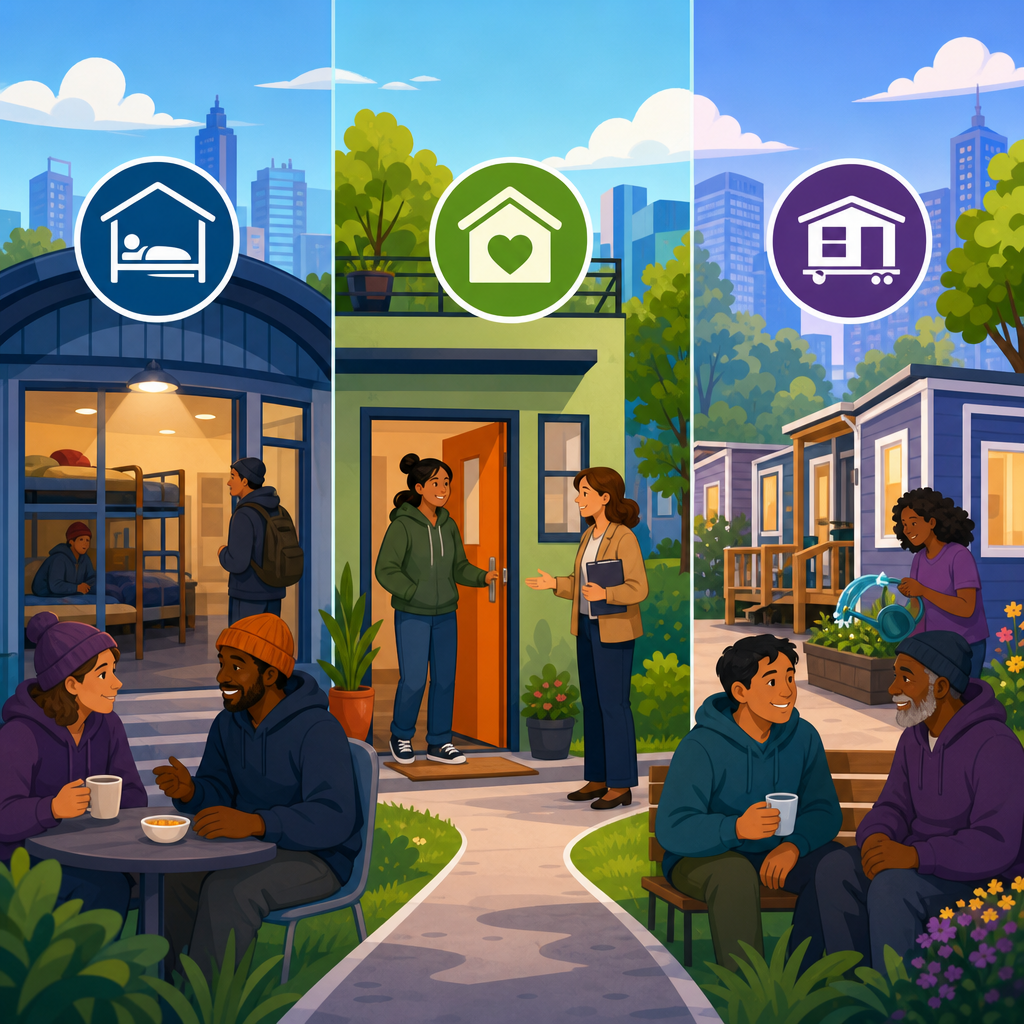
Homelessness response models shape how cities, counties, and nonprofit providers move people from street homelessness and housing instability toward safety, treatment, and permanent homes. In practice, the three models most often compared are emergency shelter, Housing First, and interim housing. Each addresses a different part of the crisis, uses different operating assumptions, and produces different outcomes for unsheltered people, families, veterans, youth, and older adults. Understanding those differences matters because local governments routinely invest millions of dollars in facilities, outreach teams, rental subsidies, and supportive services, yet public debate often blurs terms and overstates what any single model can do.
Emergency shelter generally refers to short-term indoor accommodation that provides immediate safety, basic services, and a place to sleep. Housing First is a policy and program approach that prioritizes rapid access to permanent housing without requiring sobriety, treatment compliance, or program completion before move-in. Interim housing sits between those categories. It usually offers a temporary, more stable setting than a nightly shelter bed, often with case management, storage, privacy, and pathways to permanent housing. In my work reviewing local homelessness systems, I have seen agencies use the same building as “shelter” one year and “interim housing” the next, even though the staffing model, stay length, and client expectations changed substantially. That confusion leads to poor budgeting and unrealistic performance targets.
The stakes are high. Unsheltered homelessness is associated with increased mortality, emergency department use, victimization, and deep barriers to employment and school continuity. At the system level, ineffective program design creates bottlenecks: shelters fill, interim programs become long-stay holding patterns, and permanent supportive housing turns over too slowly to meet demand. At the same time, a well-designed response system can reduce encampment exposure, improve exits to permanent housing, and make better use of scarce public dollars. The central question is not which model is universally best. It is which model fits a specific population, market condition, and service objective, and how those models connect inside a coordinated local response.
This comparison explains how shelter, Housing First, and interim housing work, where each model performs well, where it falls short, and what city leaders should measure before expanding capacity. The goal is practical clarity: define the models correctly, compare them on outcomes, and show how a balanced homelessness response can combine immediate safety with durable housing exits.
Emergency shelter: the front door for immediate safety
Emergency shelter is the most familiar homelessness response because it addresses the most urgent need: getting a person indoors tonight. A shelter bed can protect someone from heat, cold, assault, theft, and sleep deprivation. For families with children, shelter can prevent rough sleeping and offer a base for school transportation, benefits enrollment, and rehousing search. For outreach teams, shelters also create a predictable referral destination, which is essential when closing dangerous encampments or responding to weather emergencies.
But emergency shelter is not one thing. Congregate shelters place many people in a shared sleeping area and are relatively fast and inexpensive to open, especially in repurposed gyms, warehouses, or civic buildings. Non-congregate shelters use hotel rooms, cabins, or partitioned units and usually perform better for people with disabilities, couples, pet owners, and people who avoid large group settings because of trauma or conflict. Low-barrier shelter minimizes entry requirements and is generally more effective at engaging chronically unsheltered adults than high-barrier shelter that requires sobriety, extensive documentation, or daytime exits.
From an operations standpoint, shelter performance should be judged on more than occupancy. I have seen cities celebrate full shelters while ignoring that many beds were unsuitable for the people outside. A top bunk, mandatory curfew, no storage, and no accommodation for partners or pets can render a technically available bed functionally unusable. Strong shelter systems track acceptance rates, returns to homelessness, exits to permanent housing, average length of stay, and safety incidents. They also integrate diversion at the front door, problem-solving for people who can safely reconnect with family or retain existing housing, and housing navigation for those who need longer-term assistance.
Shelter’s limitation is structural. It manages crisis but rarely resolves it by itself. In tight rental markets, people can remain in shelter for months because there is nowhere affordable to move. That creates throughput failure: new people need beds, but current residents cannot exit. The result is visible pressure on encampments, hospitals, and jails. Shelter is indispensable, but it works best as a short-term stabilization platform linked tightly to rapid rehousing, permanent supportive housing, and mainstream benefits.
Housing First: permanent housing as the starting point
Housing First is often misunderstood as “housing only,” but that is inaccurate. The model means people are offered permanent housing quickly and do not have to prove they are “housing ready” before entry. Services are still important; the difference is that participation is voluntary and housing is not conditioned on treatment compliance or sobriety. This approach emerged in contrast to staircase models that required people to progress through shelter, transitional settings, and behavioral milestones before qualifying for a lease.
The evidence base is strongest for chronically homeless adults with disabling conditions when Housing First is paired with permanent supportive housing. Programs using scattered-site apartments or single-site buildings with intensive case management have repeatedly shown higher housing retention than treatment-first approaches. In many communities, retention rates around 80 to 90 percent after one year are achievable for supportive housing residents when rent subsidies, landlord relations, and clinical supports are stable. The mechanism is straightforward: people stabilize more effectively when they have a door that locks, a lease, and a predictable environment from which they can address health, income, and recovery needs.
Housing First also improves system efficiency because it reduces the amount of time people spend circulating through expensive crisis settings. A person sleeping outside who enters permanent supportive housing may reduce avoidable ambulance rides, psychiatric crises, and jail bookings, although cost offsets vary by population and local service pricing. The model is especially relevant in urban policy because chronic homelessness is highly visible and disproportionately associated with emergency public systems. Cities that treat Housing First as a core policy can focus scarce intensive resources on those with the longest histories of homelessness and the highest vulnerability.
Still, Housing First is not a magic switch. It depends on housing supply, subsidy depth, landlord participation, and service staffing. In expensive markets, the model stalls when voucher payment standards lag rents or when zoning and neighborhood opposition limit supportive housing development. It also requires disciplined implementation. If a community claims to use Housing First but offers weak tenancy support, poor crisis response, or inadequate behavioral health partnerships, housing placements can fail. The right conclusion is not that Housing First does not work; it is that permanent housing must be backed by real operating capacity.
Interim housing: a bridge with more structure and more time
Interim housing occupies the middle ground between nightly shelter and permanent housing. It generally offers temporary accommodation for weeks or months, with more privacy, storage, on-site services, and case management than basic shelter. In some cities it includes converted motels, modular cabins, bridge housing villages, recuperative care, or service-enriched shared housing. The practical purpose is to stabilize people who are unlikely to succeed in a crowded nightly shelter but are not yet ready for immediate placement into permanent housing because documents, income, health care, or unit availability are unresolved.
When designed well, interim housing can solve several common system problems. First, it increases engagement among people who reject traditional shelter. A small unit, permission to keep possessions, and accommodation for pets often matter more than policymakers expect. Second, it gives case managers time to replace identification, complete disability verification, resolve warrants, connect people to Medicaid or veterans’ benefits, and search for housing. Third, it supports populations needing recuperation or focused planning, such as people discharged from hospitals, older adults with mobility issues, or youth aging out of foster care.
The risk is that interim housing becomes expensive limbo. I have audited programs where average stays exceeded nine months not because the model required it, but because permanent exits were blocked by rental scarcity and weak case management ratios. Once that happens, interim housing functions like de facto long-term shelter while costing far more per bed. To avoid that pattern, providers need clear eligibility criteria, target lengths of stay, active housing search from day one, and escalation pathways for residents whose needs indicate permanent supportive housing rather than standard rental placement.
| Model | Primary purpose | Typical stay | Best fit | Main limitation |
|---|---|---|---|---|
| Emergency shelter | Immediate safety and crisis response | Days to a few months | People needing same-day indoor access | Limited privacy and weak long-term resolution by itself |
| Housing First | Rapid access to permanent housing | Permanent | Chronically homeless people and others needing stable housing quickly | Constrained by housing supply, subsidies, and service capacity |
| Interim housing | Temporary stabilization with services | Weeks to several months | People who need more support or a better setting than basic shelter | Can become a bottleneck if exits to housing are slow |
How the models compare on outcomes, cost, and fit
The most useful comparison is not ideological; it is operational. Shelter performs best on speed and surge capacity. A city facing freezing temperatures or a major encampment fire needs beds immediately, and shelter can usually scale faster than permanent housing development. Housing First performs best on long-term housing stability, especially for people with disabling conditions and repeated homelessness. Interim housing performs best on engagement and stabilization for those who need a more humane, service-rich setting before a permanent move.
Cost comparisons are often mishandled because people compare capital-heavy programs with operating-only programs, or they ignore the cost of unsheltered homelessness outside the formal system. Congregate shelter may have the lowest per-bed operating cost, but if people cycle repeatedly back to the street, total public costs remain high. Permanent supportive housing can appear expensive, yet it often targets residents who are already among the costliest users of emergency services. Interim housing usually lands in the middle to upper range depending on building type and staffing. Motel-based programs can be deployed quickly but may become costly if used indefinitely without move-on pathways.
Population fit matters just as much as cost. Families with children often benefit from rapid rehousing linked to short shelter stays because many can regain stability quickly with shallow to moderate assistance. People with serious mental illness, physical disabilities, or long histories of unsheltered homelessness are more likely to need permanent supportive housing delivered through a Housing First approach. Youth may need developmentally appropriate services, education support, and safe communal environments that look different from adult shelter. Older adults may require accessibility features and health coordination that basic congregate models rarely provide well.
A strong local system therefore uses all three models, but not interchangeably. If a city funds only shelter, it can reduce immediate exposure while failing to reduce homelessness overall. If it funds only permanent housing, outreach teams may have nowhere to take people tonight. If it overbuilds interim housing without permanent exits, it creates a polished bottleneck. The right mix depends on street homelessness levels, vacancy rates, supportive housing stock, and the capacity of coordinated entry, outreach, and landlord engagement teams.
What city leaders should measure before expanding any model
Before adding beds or units, leaders should ask a disciplined set of questions. What population is the program for? What is the target length of stay? What proportion should exit to permanent housing, family reunification, or treatment settings? What staffing ratio is required? How will data be captured in the Homeless Management Information System, and which outcomes will trigger corrective action? In effective systems, these decisions are made before ribbon cuttings, not after programs drift off mission.
Five indicators matter across models. First is inflow: how many people newly enter homelessness, and from where? Prevention may do more than any bed expansion if evictions or institutional discharges are driving entries. Second is utilization adjusted for fit, not just raw occupancy. Third is throughput: how quickly people move to safe exits. Fourth is housing quality and retention, including returns to homelessness within six and twelve months. Fifth is equity. Many communities find stark racial disparities in both homelessness rates and access to successful housing exits, requiring targeted contracting, culturally responsive services, and fairer prioritization practices.
Implementation details also determine success. Coordinated entry should prioritize vulnerability while remaining transparent and usable. Outreach teams need authority to connect people directly to placements rather than handing off referrals into long queues. Landlord engagement staff should negotiate with property owners, resolve tenancy issues early, and align risk mitigation funds with real leasing barriers. Behavioral health partnerships must include crisis response, not just referrals. These are not side issues. They are the operating spine of any homelessness response model.
Building a balanced homelessness response system
The comparison between shelter, Housing First, and interim housing is most productive when it leads to system design rather than slogans. Shelter is essential for immediate safety. Housing First is the clearest path to durable exits for many people, especially those with chronic homelessness and disabilities. Interim housing can be a valuable bridge when it is genuinely temporary, targeted, and tied to active housing placement. None of these models should carry the whole burden alone, and none should be judged by the wrong metric.
For urban planners and policymakers, the practical lesson is to match each investment to a clearly defined function. Expand low-barrier shelter when people need fast indoor access. Expand permanent supportive housing and rental assistance when chronic homelessness and high service utilization are driving visible street need. Use interim housing selectively for populations that need more stabilization than basic shelter can provide. Then connect all three through coordinated entry, strong data systems, and enough housing navigation capacity to keep people moving forward.
The best homelessness response models do not promise instant resolution. They reduce harm today while creating realistic exits tomorrow. If you are evaluating local policy, start by mapping where people enter the system, where they get stuck, and which model is being asked to solve a problem it was never designed to solve. That analysis will produce better investments, clearer public expectations, and better outcomes for people who need housing, safety, and stability now.
Frequently Asked Questions
What is the difference between emergency shelter, Housing First, and interim housing?
Emergency shelter, Housing First, and interim housing are related but distinct parts of a homelessness response system. Emergency shelter is typically the most immediate, short-term intervention. Its primary purpose is to get a person or family indoors quickly, protect them from weather and street danger, and connect them to basic services such as meals, hygiene, case management, and sometimes healthcare. Shelters can range from congregate settings with shared sleeping areas to motel placements or family shelters with private rooms. They are often designed for crisis stabilization rather than long-term residence.
Housing First is not a building type or a shelter model. It is a service philosophy and placement strategy centered on helping people access permanent housing as quickly as possible without requiring sobriety, treatment completion, employment, or program compliance as a condition of entry. The model is built on the idea that people are more likely to improve health, mental health, and economic stability after they are housed rather than before. Once housed, individuals can be offered voluntary supportive services, including behavioral healthcare, substance use treatment, benefits assistance, employment support, and tenancy coaching.
Interim housing sits between immediate shelter and permanent housing. It is usually more structured and service-rich than basic emergency shelter but still temporary. The goal is to provide a safer, more stable place for people to stay while they complete documents, recover from a health crisis, engage with case managers, reunify with family, or wait for a permanent housing placement. Interim housing may include bridge housing, navigation centers, recuperative care, transitional beds for specific populations, and other short-term options intended to reduce the chaos of unsheltered living while housing plans are actively pursued.
In short, shelter responds to immediate crisis, interim housing supports short-term stabilization and navigation, and Housing First focuses on rapid access to permanent housing with voluntary supports. Strong systems often use all three, but they use them differently depending on a person’s needs, vulnerability, and the local housing market.
Why do many communities prefer a Housing First approach for people experiencing chronic homelessness?
Many communities prioritize Housing First for chronic homelessness because this population often faces the highest barriers to housing stability and the greatest risk of repeated crisis-system use. People experiencing chronic homelessness are more likely to live with disabling conditions, serious mental illness, substance use disorders, untreated medical issues, and long histories of trauma. Traditional models that require people to become “housing ready” before placement can leave them stuck in shelters, on waiting lists, or on the street for long periods. Housing First reverses that sequence by treating housing as the foundation for recovery and stability rather than a reward for achieving them first.
This approach also aligns with what many local systems have learned from practice and data: when people who are highly vulnerable move directly into permanent supportive housing with rental assistance and wraparound services, they are often more likely to remain housed than if they cycle through shelters and short-term programs without a permanent exit. Housing First can reduce the use of emergency rooms, psychiatric holds, detox episodes, jail bookings, and street outreach contacts because once a person has a stable place to live, service engagement tends to become more consistent and less crisis-driven.
Another reason for its popularity is that Housing First lowers program barriers. Many people living unsheltered avoid programs that require sobriety, treatment participation, curfews, or separation from partners, possessions, or pets. A low-barrier Housing First orientation can improve trust and increase participation among people who have had negative experiences with institutions. This matters especially for veterans, older adults, and people with long periods of unsheltered homelessness who may be medically fragile or deeply disengaged from formal systems.
That said, Housing First is not a cure-all and does not eliminate the need for shelter, outreach, treatment, or interim options. It works best when communities have actual units, subsidies, landlord engagement, and support services available. In tight housing markets, the philosophy may be widely accepted while the pace of placement remains slow. Even so, many communities still favor Housing First because it targets the end goal directly: permanent housing with dignity, choice, and support.
When is interim housing more effective than emergency shelter alone?
Interim housing can be more effective than emergency shelter alone when a person needs more than immediate indoor safety but is not yet connected to permanent housing. Basic shelter is essential during crisis, especially during severe weather, after encampment resolution, or when someone needs a same-day bed. However, shelters often operate with high turnover, limited privacy, and fewer opportunities for individualized planning. For people who need time and stability to gather identification, apply for benefits, recover from hospitalization, search for units, or rebuild trust with providers, interim housing can create the conditions needed for progress.
This is especially true for people leaving street homelessness after long periods outside. Someone who has been unsheltered for months or years may need a quieter environment, secure storage, transportation help, clinical support, and ongoing case management before a lease-up is realistic. Interim housing can also be valuable for families waiting for rapid rehousing placement, youth needing developmentally appropriate support, survivors of domestic violence requiring confidential locations, and older adults whose health makes congregate shelter difficult. In these situations, a service-rich temporary setting often produces better engagement than a simple overnight bed model.
Interim housing may also outperform shelter when the local housing process itself takes time. In many communities, obtaining vouchers, passing inspections, coordinating disability paperwork, or locating affordable units can take weeks or months. Without an interim option, people may return to unsheltered homelessness while waiting. A well-designed interim program reduces that drop-off by keeping people connected to staff and services while the housing search continues.
Still, interim housing is most effective when it remains truly transitional and housing-focused. If people stay too long because permanent units are unavailable, interim programs can become bottlenecks rather than pathways. The strongest interim models have clear housing navigation, realistic lengths of stay, strong partnerships with landlords and housing authorities, and tailored supports that move people forward instead of simply managing homelessness in a different setting.
Which model works best for different populations such as families, veterans, youth, and older adults?
No single model works best for every population, because homelessness is not one uniform experience. Families with children often benefit from fast access to private, safe shelter or motel placement followed quickly by rapid rehousing or another permanent housing solution. For families, privacy, school continuity, transportation, childcare coordination, and safety are especially important. Congregate shelter may be necessary in crisis, but family-centered interim options and rapid exits to permanent housing are often more effective than prolonged shelter stays.
Veterans may benefit from any of the three models depending on need, but many communities have built strong veteran-focused pathways that combine outreach, emergency shelter access, bridge housing, and rapid placement into permanent housing through veteran-specific resources. Veterans with disabling conditions or long-term homelessness may be strong candidates for Housing First paired with intensive supportive services. Those leaving institutions or living unsheltered may also benefit from interim housing that helps with documentation, clinical stabilization, and benefit enrollment.
Youth and young adults often need specialized responses that differ from adult systems. Many youth experiencing homelessness are fleeing family conflict, abuse, trafficking, or identity-based rejection. They may distrust institutions and avoid adult shelters. Youth-focused interim housing, host-home models, and low-barrier Housing First adaptations can work better when they emphasize safety, autonomy, education, employment, and healthy relationships. Developmentally appropriate case management matters, and success should not be measured only by immediate lease-up but also by long-term stability and connection to supportive adults.
Older adults frequently face a different set of risks, including mobility limitations, chronic illness, cognitive decline, and vulnerability to heat, cold, and victimization. For them, emergency shelter may be inadequate if it cannot meet accessibility or medical needs. Interim housing with recuperative care, onsite healthcare coordination, or accessible units may be the most practical short-term option. At the same time, permanent supportive housing delivered through a Housing First framework is often highly effective for older adults with disabilities or high service needs because it reduces ongoing exposure to the dangers of unsheltered homelessness.
The most effective systems avoid forcing every population into the same program design. Instead, they use coordinated assessment, targeted housing pathways, and population-specific services to match people to the right intervention at the right time. The best model depends on age, health, trauma history, household composition, disability status, and how quickly permanent housing can realistically be secured.
Can a community rely on just one homelessness response model, or does it need all three?
Most communities need all three. Homelessness is a complex, fast-moving problem that includes emergency survival needs, short-term stabilization needs, and long-term housing needs. A system built only around shelter may keep people alive in the short run but struggle to end homelessness if exits to permanent housing are too limited. A system built only around Housing First may have the right long-term goal but fail to meet immediate needs when people need a bed tonight, a safe place after hospital discharge, or a temporary setting while paperwork and housing search are underway. A system built only around interim housing may create movement off the street without delivering enough permanent outcomes.
The strongest local responses usually operate as a continuum. Street outreach identifies and engages people where they are. Emergency shelter offers immediate protection and a first point of service


